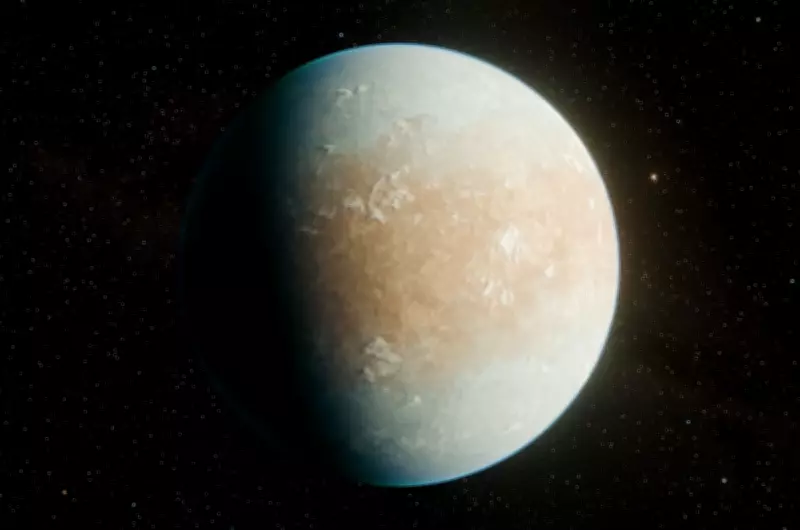
In a groundbreaking astronomical find, an international team of scientists has identified a new Earth-sized planet, HD 137010 b, located approximately 146 light-years from our solar system. This discovery, made by researchers from Australia, the United Kingdom, the United States, and Denmark, offers intriguing possibilities for the search for habitable worlds beyond our own.
Key Characteristics of HD 137010 b
The candidate planet, HD 137010 b, orbits a sun-like star and is estimated to be about 6% larger than Earth. It completes an orbit every 355 days, similar to Earth's annual cycle, placing it within what scientists describe as a "50% chance of residing in the habitable zone" of its host star. This zone refers to the region around a star where conditions might be right for liquid water to exist on a planet's surface, a key ingredient for life as we know it.
Discovery Through Citizen Science and Advanced Technology
The detection of HD 137010 b was made possible using data from NASA's Kepler space telescope's extended K2 mission, captured in 2017. Remarkably, the initial faint signal was spotted by citizen scientists, including Dr Alexander Venner, who contributed to the Planet Hunters project while still in secondary school. Dr Venner, now a PhD graduate from the University of Southern Queensland, reflected on the experience, stating it was "an amazing experience to go back to this work and dig up such an important discovery."
Dr Chelsea Huang, a researcher at the University of Southern Queensland and co-author of the study, expressed initial disbelief, saying the team's first reaction was "that this cannot possibly be true." However, after rigorous verification, they confirmed it as a "textbook example of a transit of a planet," referring to the minute dimming event when the planet crossed in front of its star.
Potential Habitability and Challenges
Despite its Earth-like size and orbital characteristics, HD 137010 b faces significant environmental challenges. The star it orbits is cooler and dimmer than our sun, leading to surface temperatures that could be as low as -70°C, more akin to Mars than Earth. Dr Sara Webb, an astrophysicist at Swinburne University not involved in the research, noted that while the discovery is "very exciting," more data is needed to confirm it as an exoplanet, as only one transit event has been detected so far.
Webb also highlighted alternative possibilities, suggesting the planet could be a "super snowball"—a large, icy world with substantial frozen water. Additionally, the vast distance of 146 light-years means that, with current technology, travel to HD 137010 b would take tens or even hundreds of thousands of years, placing it far beyond our immediate reach.
Future Observations and Implications
The brightness and proximity of HD 137010 b's host star make it a prime target for future telescopic observations. Dr Huang emphasised that it is "within reach of the next generation of telescopes," and she anticipates it will be "the first target to be observed when the technology gets there." This could provide deeper insights into its atmosphere and potential for habitability.
Published this week in Astrophysical Journal Letters, this research underscores the ongoing efforts in exoplanet exploration and the collaborative role of citizen science in advancing astronomical knowledge. As technology evolves, HD 137010 b may become a focal point in understanding Earth-like worlds in our galaxy.