Belfast Photo Festival 2026: A Glimpse into Unknown Futures
The Belfast photo festival, the largest annual photography event in the UK and Ireland, returns for 2026 with a compelling central theme: Horizons: Visions of Futures Unknown. This theme challenges both creators and audiences to explore technological, environmental, geopolitical, and automated AI boundaries within the medium of photography. The festival runs from 4 to 30 June across various venues in the city, offering a diverse range of exhibitions and installations.
Laura Pannack: The Journey Home
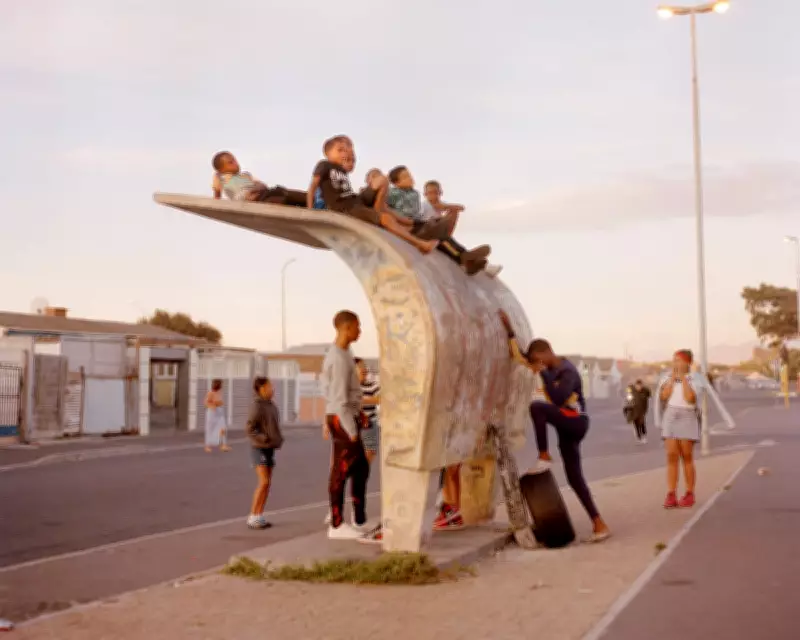
Laura Pannack’s The Journey Home documents the daily walk to and from school in Cape Town’s gang-governed Cape Flats, where the threat of violence shapes ordinary childhood routines. Made collaboratively with young participants, the work provides an intimate portrait of adolescence, danger, and resilience. In South Africa, a country marked by deep social divides, this simple daily ritual carries vastly different realities as young people navigate the constant threat of gang crossfire.
Florence Goupil: Luis Díaz, The Song of Invisible Birds
Florence Goupil’s work features Luis Díaz crossing the Alto Madre de Dios river under a red sky caused by fires in the southern Amazon region. Díaz works for the Peruvian ministry of culture as a protection agent for the Mashco-Piro people, serving as one of the few intermediaries who communicates directly with them. Although some encounters occur with their consent, Díaz has witnessed how clearly they express their desire to avoid the western world, which they see as destructive.
Evanna Devine: Exploring Antrim and Newtownabbey
This series comprises four photographic commissions and a public photography competition unfolding across the four seasons. Beginning with inspiration from Evanna Devine in spring, the project invites audiences to discover the landscapes, history, and heritage of Antrim and Newtownabbey through their year-round beauty, leading to the full competition launch in August 2026.
Toby Smith: Camera Obsolete?
Camera Obsolete? is a participatory installation and public exhibition confronting the collapse of photography’s mechanical era. Audiences are invited to destroy, dismantle, repair, or recast obsolete cameras into new sculptural forms. Part participation, part spectacle, and part material transformation, the exhibition forces questions of authorship, truth, and the erosion of photography as a physical, tangible medium.
Lean Lui: The White Barracks
The White Barracks imagines a fictional island inhabited by girl cadets engaged in endless military drills, using allegory to examine power, patriarchy, and the reproduction of ideology. Moving between fiction and documentary, Lean Lui asks what might emerge when inherited myths begin to fracture. The work reflects on how images circulate in the digital age, endlessly reproduced and stripped of context, shaping collective memory and normalising systems of control. Yet the cadets also carry the debris of history, fractured symbols, and institutional power.
Louise Desnos: Acedia
Acedia reflects on laziness, idleness, and introspection as both a personal state and a quiet form of resistance. Through images of stillness, drift, and everyday non-events, Louise Desnos explores time, doubt, and the fragile line between freedom and melancholy. In many of these images, very little happens. Signs of time remain discreet. Slowness, embodied by her subjects, suggests both a search for freedom and a space for introspection. Acedia asks whether laziness is a form of renunciation leading towards melancholy, or a kind of wisdom and clarity found in stillness.
Sabine Hess and Nicolas Polli: One Bed, Two Blankets, Eighty-Five Rules
This project by Hess and Polli explores the shared rituals, expectations, and tensions of a relationship through a set of imagined rules for living together. After meeting in Ticino, Switzerland, and continuing a long-distance relationship, the couple decided to move in together in 2023 and began a project about their shared life. The project plays with standards and ideas held, establishing rules for living harmoniously.
Belfast Buildings Trust and Joe Laverty: Still Standing
Still Standing is a collaborative photography project shaped by Belfast Buildings Trust, Belfast photo festival, and Joe Laverty for Creative Belfast, a partnership programme creating paid skills opportunities for young people across Belfast’s cultural and heritage sectors. Alongside leading the workshops, Laverty has his own photographic response to Belfast, bringing his long-standing interest in place, marginal spaces, and the quiet tensions of the built environment into dialogue with the perspectives of participants across generations.
Valentina Sinis: The Last Butterflies
The Last Butterflies follows female Kurdish guerrillas training in the mountains between Iraq and Iran, examining militancy, sacrifice, and political belief. Beyond combat alone, Sinis looks at how armed struggle intersects with gender, truth, solidarity, and survival. Many of the women come from Kurdish regions of Iran and belong to the Kurdistan Free Life party, while the Women’s Protection Forces form an all-female unit within that movement.
Thomas Holton: The Lams of Ludlow Street
The Lams of Ludlow Street is a long-term photographic portrait of a Chinese American family living in Manhattan’s Chinatown. Over more than two decades, Thomas Holton has used the work to move beyond stereotype and build a deeper understanding of family, identity, and belonging.
Thaddé Comar: How Was Your Dream?
How Was Your Dream? is a documentary photographic project created during the Hong Kong protests between June and October 2019. The work addresses new forms of demonstration and insurrection in an era shaped by increasingly seamless systems of control. The title refers to a phrase used by demonstrators to speak discreetly about their experiences of protest.
Vahram Aghasyan: Modality
Modality presents Armenian artist Vahram Aghasyan’s images of unfinished Soviet residential buildings suspended within a snow-covered Armenian landscape. Construction began in 1988 as part of a planned urban development intended to house people displaced by an earthquake, but the project was never completed. Photographed in 2008, and still unchanged decades later, these structures remain suspended between intention and realisation. The work reflects on interruption, failed futures, and the lingering presence of unrealised social ambition.
Paul McCambridge: MSC Napoli
In 2007, the UK container ship MSC Napoli was damaged in the Channel and deliberately beached in Lyme Bay to avoid a larger environmental disaster. This immersive exhibition by Paul McCambridge traces the aftermath of the MSC Napoli. The work reflects on labour, industry, salvage, and the changing meanings of a historic shipyard.
Alice Poyzer: Other Joys
Other Joys is a continuing body of work exploring the intensity of special interests through self-portraits, documentary images, and constructed scenes. Rooted in Alice Poyzer’s experience as an autistic woman, it becomes both an expression of autistic joy and a call for greater representation. The feeling surrounding a special interest can be difficult to describe. For many autistic people, it brings warmth, euphoria, and excitement. Poyzer began making this work as a way to communicate that feeling visually.