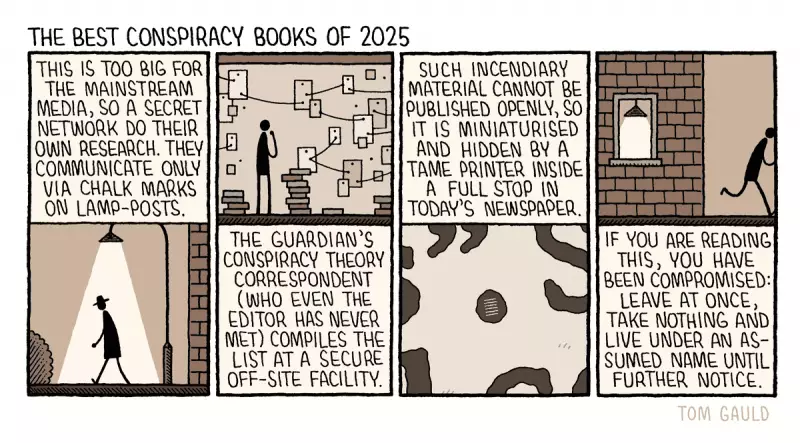
Acclaimed cartoonist Tom Gauld has turned his distinctive eye to the world of clandestine plots and hidden histories with his latest illustrated commentary for The Guardian. His cartoon, published on 7 December 2025, offers a witty and visually engaging guide to the most notable conspiracy theory books that have captured the public's imagination this year.
Decoding the Year's Most Talked-About Narratives
Gauld's single-panel cartoon presents a curated shelf of fictional titles, each representing a distinct flavour of contemporary conspiratorial thinking. The artwork cleverly categorises the year's output, moving beyond mere satire to provide a sharp cultural critique of the themes dominating the genre. The books depicted, while invented for the cartoon, are clear parodies of real-world trends, touching on areas from technology and politics to history and popular culture.
The genius of Gauld's work lies in its ability to condense complex cultural anxieties into simple, humorous book spines. Readers can instantly recognise the archetypes: the tech-centric panic, the rewritten historical narrative, the political deep-state thriller, and the celebrity-centred mystery. This visual summary speaks volumes about the stories society is telling itself, and which ones are finding a commercial foothold.

The Visual Language of Doubt and Belief
Employing his signature minimalist style, Gauld uses clean lines and sparse detail to powerful effect. The focus remains squarely on the fictional book titles and their clever, often ominous, names. The setting is a simple bookshelf, a universal symbol of knowledge and collection, which here houses tales of alternative knowledge and disputed facts.
This juxtaposition—the formal, orderly presentation of inherently disorderly and speculative ideas—is where the cartoon's humour and insight truly resonate. It prompts reflection on how even the most outlandish theories are now neatly packaged, marketed, and consumed alongside mainstream literature. Gauld doesn't just draw funny books; he illustrates the normalisation of conspiratorial thought within modern publishing.
More Than Just a Laugh: Cultural Commentary in Ink
While immediately amusing, Gauld's cartoon serves as a significant piece of cultural analysis. By cataloguing these imagined books at the close of 2025, he creates a time capsule of the year's predominant fears and suspicions. The cartoon acts as a mirror, reflecting back the specific paranoias that have gained traction, from concerns about artificial intelligence and governance to the perennial re-examination of historical events.
The work aligns with Gauld's established reputation for intelligent literary and artistic satire, seen regularly in his weekly cartoons for The Guardian and New Scientist. His ability to distill broad trends into a single, accessible image makes complex cultural conversations approachable. This piece continues that tradition, offering a gateway to discuss why certain conspiracy narratives thrive in a given moment and what their popularity reveals about the public mood.
Ultimately, Tom Gauld's guide to the best conspiracy books of 2025 is a testament to the power of cartooning as social commentary. It provides not a reading list, but a diagnosis of contemporary preoccupations, proving that a few well-drawn book spines can be as revealing as any long-form essay. The cartoon remains a standout piece of his 2025 output, cleverly capturing the spirit of its time through the imagined literature of shadow and doubt.