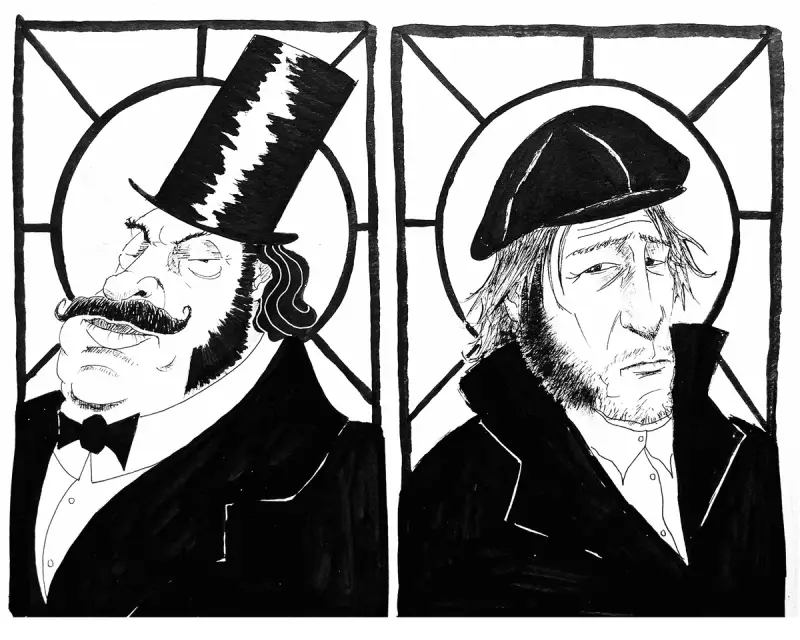
A sharply satirical poem by 19th century writer Thomas Love Peacock continues to resonate with modern readers for its biting critique of class inequality and religious hypocrisy. Rich or Poor, or Saint and Sinner exposes how Victorian Sunday Observance laws were unevenly applied, punishing the poor while allowing the wealthy to sin in privacy.
The Poem's Enduring Social Critique
Written during a period spanning both Regency and Victorian eras, Peacock's poem highlights the power of the Anglican establishment to prosecute the poor for failing to observe Sunday restrictions. The poem contrasts how the poor man's sins are glaring when buying greens on Sunday morning, while the rich man's equivalent transgressions remain hidden in the pomp of wealth and station.
Peacock, a prolific poet and novelist born in 1785 who lived until 1866, creates vivid vignettes of ordinary life. His work reflects social habits he observed firsthand, focusing particularly on how the wealthy could afford privacy to flout laws that trapped the less fortunate.

Structural Brilliance and Poetic Technique
The poem's structure itself reinforces its thematic concerns about inequality. Peacock employs a distinctive ABCCB rhyme scheme where the unrhymed A line in each stanza acquires symbolic force. This technical choice mirrors how society overlooks the rich man's rule-breaking while penalising the poor for similar actions.
Metrical patterns further emphasise the class divide. Three-beat and two-beat lines create a dialogue within each stanza, with the poor man's activities often described with hurried, dactylic rhythms, while the rich man's pursuits proceed with more sober accentual tread.
Contemporary Relevance and Modern Parallels
The poem's concluding verses explore travel options available to different classes, mentioning the then-modern third-class train versus the rich man's private carriage. Similarly, the wealthy enjoy yachting trips beyond the reach of sanctity's gaze, while the poor man's fourpenny boat excursion becomes a public spectacle that offends religious sensibilities.
As Brimley Johnson noted in his 1906 edition of Peacock's poems, the writer laughs at the theories of other people without expounding any for himself. Despite this apparent detachment, poems like Rich or Poor reveal a broader idealism in Peacock's view of human comedy and social justice.
The poem's enduring power lies in its exposure of how economic privilege enables rule-breaking behind closed doors, while poverty forces minor infractions into public view. This dynamic continues to find echoes in modern discussions about everything from tax avoidance schemes to the unequal application of laws across social classes.