Rebecca Perry's Debut Novel 'May We Feed the King' Explores History's Ambiguity
In a striking debut that defies conventional storytelling, poet Rebecca Perry presents May We Feed the King, a novel that meticulously reconstructs royal banquets while deliberately obscuring the broader historical narrative. This highly wrought puzzle-box of a book challenges readers to grapple with the elusive nature of truth in history, offering a rich tapestry of detail set against intentional ambiguity.
A Curator's Perspective on a Reluctant Monarch
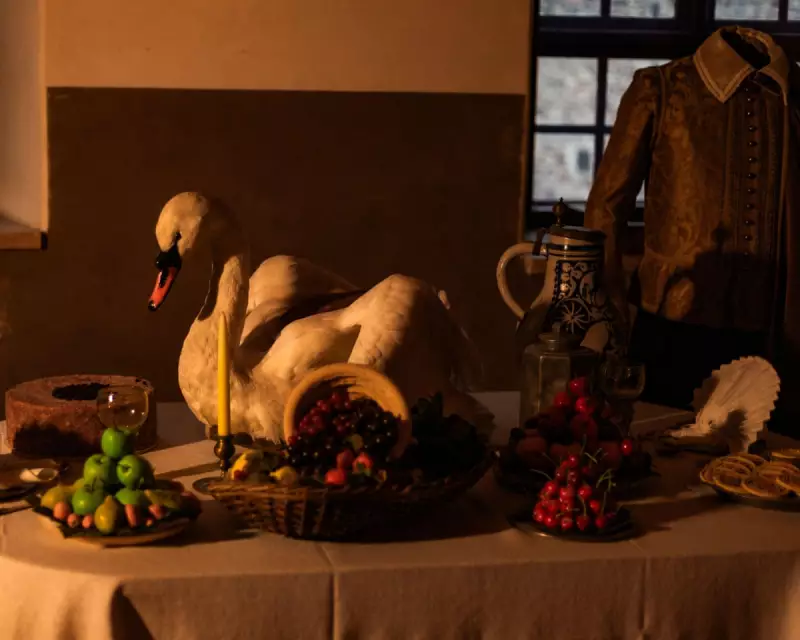
The narrative unfolds through the eyes of an unnamed curator, employed by a historic palace to dress its rooms for public viewing following a personal tragedy. This curator's world is one of precise historical recreation, where authentic foodstuffs can be ordered online at astonishing prices—a single half oyster shell replica costs £31.25. Through this lens, we're introduced to the brief reign of a medieval king who assumed power reluctantly after his brothers' deaths, only to refuse governance.
Perry, whose poetry has been shortlisted for the TS Eliot prize, brings a poet's precision to her prose. The novel operates like a mirrored jewel box, dazzling readers with rich details while simultaneously trapping them in uncertainty. The king's plight becomes a metaphor for the human condition—granted ultimate power yet finding himself imprisoned by it, unable to even pick an apple without summoning assistance.

Fragmented History and Modern Interpretation
As the curator discovers records of this forgotten monarch through the palace archivist, the narrative slips between past and present. We witness the king's court through fragmented glimpses—scenes viewed from doorways, half-heard conversations, rooms observed through windows. This technique creates the unsettling sensation that readers themselves are ghosts haunting the palace, trying to interpret momentous events from scattered clues.
The novel's structure reflects Perry's background in competitive trampolining, offering readers brief, tilted perspectives that never quite stabilize. Each chapter presents another piece of the historical puzzle, yet the complete picture remains deliberately elusive. This approach forces readers to confront their own desire for narrative certainty while demonstrating how little we can truly know about history—or even about our contemporaries.
The Frustration and Reward of Ambiguity
May We Feed the King richly rewards readers who approach it with curiosity, though not in the ways traditional novels might. Instead of providing answers, Perry makes readers watch their own minds "scrabble about, compulsively putting together the scattered pieces of the past." The king's greatest legacy, as the curator ultimately reveals to visitors, is "the very lack of an ending"—a defiant rejection of those who would force ambiguity into order.
Towards the novel's conclusion, as the curator releases the public to view the meticulously dressed historical scenes, they offer a final instruction that resonates throughout the reading experience: "Listen for everything and, above all, pay attention." This directive serves as both a key to understanding Perry's approach and a challenge to readers accustomed to more conventional narratives.
Published by Granta at £14.99, May We Feed the King represents a significant literary debut that will likely polarize readers—some will find its ambiguity frustrating, while others will appreciate its sophisticated exploration of historical interpretation. The novel stands as a testament to Perry's skill in creating a work that is both intellectually stimulating and emotionally resonant, forcing readers to sit with uncertainty while being richly entertained by the journey.