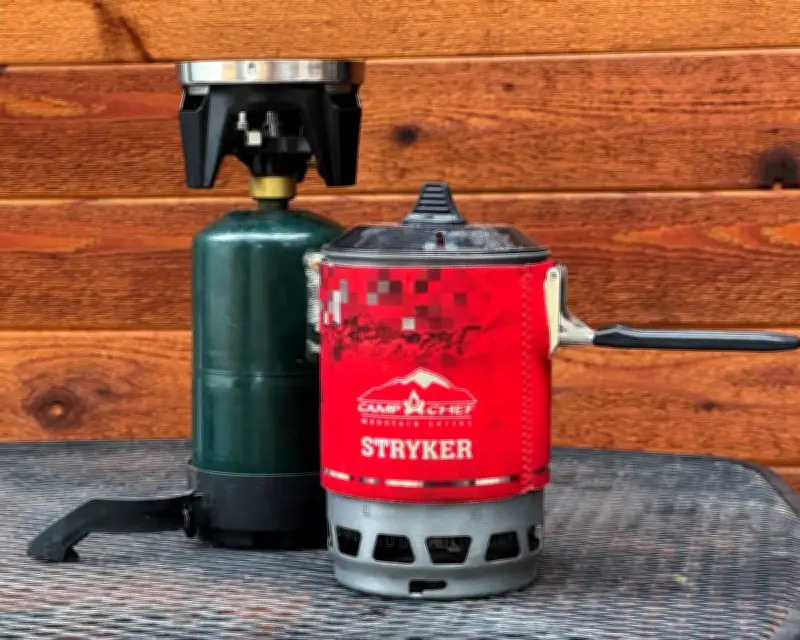
The Camp Chef Stryker is a better choice than a Jetboil for making hot coffee or tea while camping, according to a hands-on review by Nick Mokey in The Guardian. It boils water in under two minutes, uses cheaper and more readily available propane fuel, and costs less than comparable Jetboil models. The stove is available from $60 at Walmart or $125 at Amazon.
Why the Stryker beats the Jetboil
Mokey, who tested the stove on camping trips, says the Stryker is just as fast as the Jetboil Flash but easier to fuel. The Jetboil relies on isobutane canisters that are expensive and hard to find in rural areas. In contrast, the Stryker runs on propane, which is sold at most gas stations and can be refilled from a standard grill cylinder using a $22 certified refillable canister.
Propane also contains more energy per pound and works at lower temperatures, down to -43F. The Stryker’s integrated design uses corrugated metal fins at the base of the pot to capture heat that would otherwise escape, making it more efficient than a traditional stove. Mokey says it boils half a liter of water in 1 minute and 37 seconds, faster than his home gas stove.
Design improvements over Jetboil
The Stryker includes a tab on the lid for easier lifting, a spring-loaded handle for safe pouring, and a stabilizer ring that snaps onto the base of a tall propane canister to prevent tipping. The newer Stryker 200 model includes an adapter for use with either propane or isobutane, while the older Stryker 150 is propane-only.
Mokey notes that the Stryker weighs 1.2lb compared to 0.9lb for the Jetboil Flash, but he says the extra weight is worth it for the better performance. He also warns against using a cheap adapter to convert a Jetboil to propane, saying it destroyed the valve on his $100 Jetboil.
Efficiency and everyday use
The Stryker uses just 5 grams of propane to heat two cups of water, meaning a single 1lb propane cylinder can make 90 packages of ramen. Refilling a canister costs about $1, whereas Jetboil canisters are more expensive and require a special disposal tool.
Beyond camping, Mokey suggests using the stove for road trips, park picnics, or during a blackout. He has used it to heat water for washing dishes and making tea. The stove is part of The Guardian’s Filter series, which recommends buying fewer, better things.