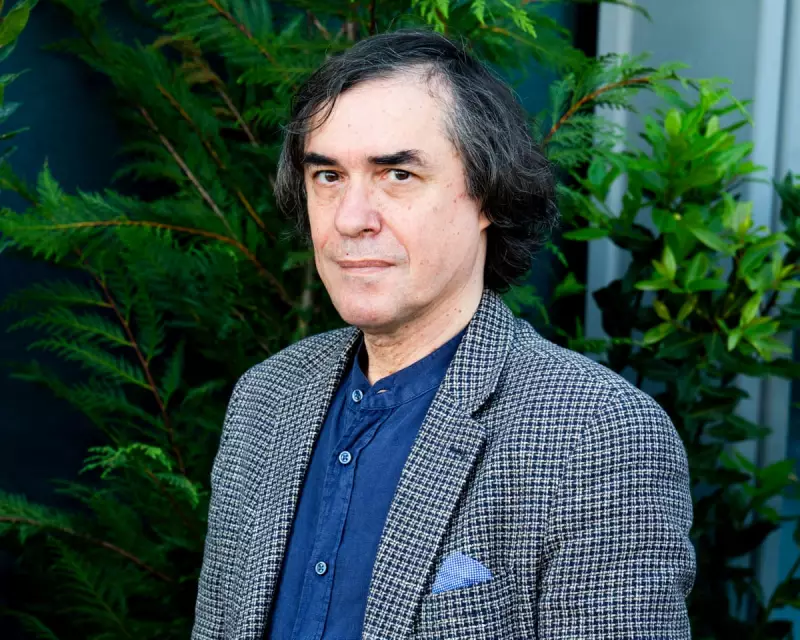
Romanian literary sensation Mircea Cărtărescu has opened up about his extraordinary journey from life under communist rule to international acclaim as his masterpiece, the Blinding trilogy, finally reaches British readers nearly three decades after its Romanian debut.
A Childhood Under Communism
Born on 1 June 1956, Cărtărescu grew up within Romania's communist regime, experiencing firsthand the restrictions that would later fuel his creative output. His father actively participated in the communist administration, making the family's experience of the regime's collapse particularly poignant.
"He went to the kitchen and put his red party book on the fire," Cărtărescu recalls of his father's reaction to Nicolae Ceaușescu's downfall in 1989. "He was crying all the time because he believed in communism and now he saw that everything was a lie."

The Blinding Trilogy: A Literary Revolution
Now published in English by Penguin Classics, The Left Wing forms the first part of Cărtărescu's critically acclaimed trilogy that was voted Romania's novel of the decade in 2010. The work has been compared to James Joyce's Ulysses for its transformative portrayal of Bucharest, though Cărtărescu's vision is distinctly darker.
"I took a stylistic and literary revenge against the people who stole my youth," the author declares from his Bucharest apartment, explaining the trilogy's visceral approach to depicting his birthplace.
The trilogy's structure mirrors a butterfly's form, with the first and third volumes representing wings and the middle book serving as the body. This symbolism extends throughout the work, reflecting Cărtărescu's lifelong fascination with lepidopterology, which he shares with his literary hero Vladimir Nabokov.
International Recognition and Nobel Speculation
In recent years, Cărtărescu's work has achieved the global recognition he long aspired toward. His novel Solenoid earned a place on the International Booker longlist this year, while German publication Der Spiegel included The Left Wing among its selection of the world's 100 finest books.
The author has been considered a serious contender for the Nobel Prize in Literature for the past decade, with bookmakers offering odds of 11/1 in both 2023 and 2025. Despite this attention, Cărtărescu maintains a philosophical perspective.
"I never waited for a call," he states. "I'm grateful to the people who consider me worthy of it, because to be seen as worthy of the Nobel prize, even if it's only a rumour, is an absolute honour."
Eastern European Literary Renaissance
Cărtărescu sees himself as part of a broader cultural movement, comparing the current flourishing of Eastern European literature to the Latin American boom of the 1960s and 70s that produced giants like Gabriel García Márquez and Mario Vargas Llosa.
"Many are absolutely non-commercial writers," he observes. "They never thought of making money or getting prizes; they were people who really loved literature. They are totally devoted to their art."
Despite his international success, Cărtărescu maintains a complex relationship with his homeland. He notes with concern the recent political shifts within Romania's diaspora, which numbers 3.1 million citizens living elsewhere in the EU.
Still, he remains hopeful about Romania's European future, describing the country's 2007 EU accession as "maybe the most important day in our history."
Blinding: The Left Wing by Mircea Cărtărescu, translated by Sean Cotter, is published by Penguin Classics.