David Bowie's Spiritual Journey: A New Perspective
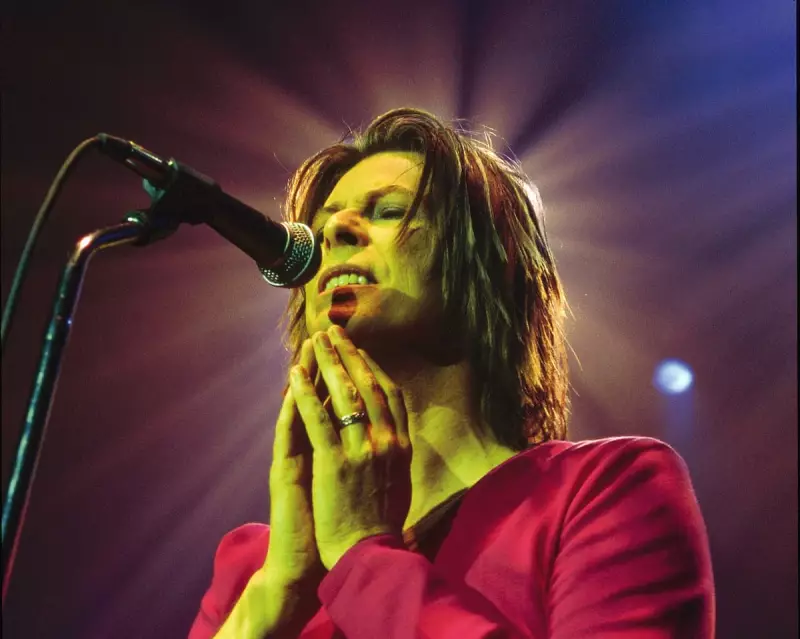
David Bowie performing in 1999. Photograph: Nicky J Sims/Redferns
Peter Ormerod's new book, David Bowie and the Search for Life, Death and God, offers an exhilarating account of the musician's deep spirituality and the quasi-religious nature of his artistic output. From the early days of Space Oddity to the haunting finality of Blackstar, Ormerod meticulously traces how Bowie's work transcends mere rock and roll to explore profound existential themes.
Bowie as Prophet of Modern Chaos
It has become a common refrain among fans to suggest that the world descended into chaos following Bowie's death in 2016. However, this perspective fundamentally misunderstands his legacy. Rather than representing a lost liberal order, Bowie accurately foresaw the fragmentation and turmoil that characterise contemporary society.

In his later years, Bowie perceived humanity entering a zone of chaos and disarray. This insight allowed him to be remarkably prescient about the internet's darker aspects—not its potential, but its inherent menace. His worldview, as expressed through his music, consistently depicted scenarios of destruction and societal collapse.
"This ain't rock'n'roll, this is genocide," Bowie declares at the opening of Diamond Dogs, setting the tone for much of his artistic vision. Those seeking comfort or reassurance would do well to look elsewhere, as Bowie's universe is one where order gives way to disaster.
Anticipating Political Turmoil
Bowie's work remarkably prefigured the political landscape that would later emerge, particularly what many now refer to as Trumpworld. Consider the lyrics from Under the God on the 1989 Tin Machine album:
- "Washington heads in the toilet bowl"
- "Don't see the supremacist hate"
- "Rightwing dicks in their boiler suits"
- "Picking out who to annihilate"
The only detail Bowie missed was the boiler suits. We inhabit what he described as a world of heathens, as suggested by the title of his brilliant 2002 album. Yet Bowie himself did not aspire to lead such an existence.
The Religious Framework of Bowie's Art
Ormerod's book approaches Bowie's life and music through a religious lens, which proves to be an exceptionally fitting framework. Bowie was, at his core, a religious artist whose spiritual journey began with Anglicanism at St Mary's Church in Bromley, where he sang in the choir.
The narrative continues through his immersion in Tibetan Buddhism during the late 1960s and his exploration of Aleister Crowley's occultism. Ormerod unpacks these religious preoccupations with compelling prose, though some philosophical references may feel somewhat superficial initially.
Where the book truly gains momentum is in its analysis of Bowie's later work. The chapter dedicated to the Heathen album stands out as particularly insightful, followed by detailed examinations of The Next Day and Blackstar, along with his final theatrical experiment, Lazarus.
Close Reading and Textual Analysis
Ormerod excels in treating Bowie's work as text worthy of close reading—an approach that all significant art deserves. By the book's conclusion, readers may find themselves joining Ormerod in what feels like a spiritual choir. The central argument posits that Bowie's creative drive stems from two essential sources: life and love.
When questioned about having a devotional practice, Bowie simply responded, "Life. I love life very much indeed." For much of his career, this love of life was counterbalanced by what Ormerod identifies as a certain incapacity for love, expressed through painful yearning and profound isolation—recurring themes throughout his music.
The Apophatic Nature of Bowie's Art
Ormerod identifies an apophatic quality in Bowie's work—a persistent tendency to negate propositions, saying "not this, not that, and not that either." This is particularly evident in his final song, I Can't Give Everything Away, the closing track on Blackstar, which merges deep emotion with refusal:

- "Saying no but meaning yes"
- "This is all I ever meant"
- "That's the message that I sent"
This tendency toward negation, what philosopher Simone Weil termed "decreation," places Bowie in the company of medieval Christian mystics like Marguerite Porete.
Bowie as Contemporary Saint
There exists a peculiar neo-medievalism within Bowie fandom. While he was not a messianic rock god—despite playing that role through the Ziggy Stardust persona—he functioned as a kind of saint for many. His extraordinary archive at the V&A East can be viewed as a vast reliquary that inspires pilgrimage, a distinctly medieval practice.
Ormerod, like many, is a convert to Bowie's artistic church. For him, listening to Bowie constitutes a religious experience. Religion does not merely influence Bowie's music; it permeates its very essence. It represents the moving core of his artistic expression, standing "at the centre of it all," as Bowie himself repeatedly declared on Blackstar.
Simon Critchley, philosopher and author of On Bowie, provides this perspective on Ormerod's work. David Bowie and the Search for Life, Death and God is published by Bloomsbury Continuum.