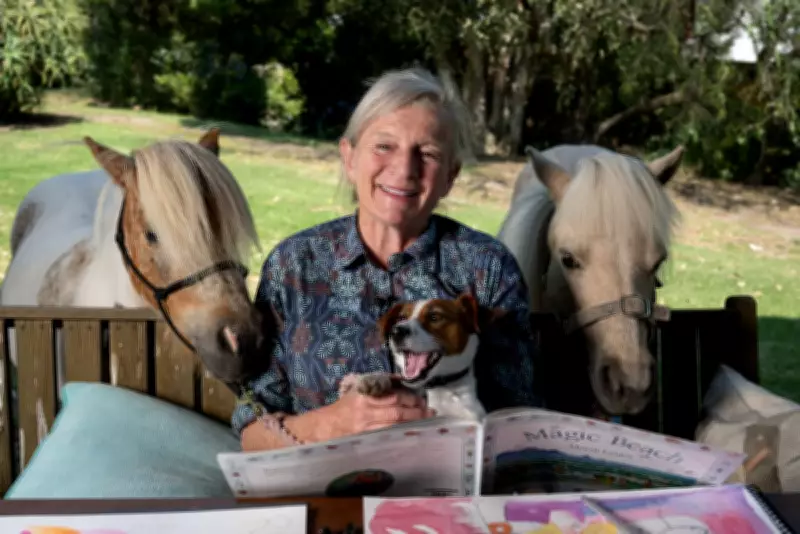
Nestled in the picturesque town of Nar Nar Goon, an hour's drive southeast of Melbourne, lies the creative sanctuary of Alison Lester, one of Australia's most cherished children's book authors. Surrounded by her dog Poppy and ponies Lily and Honey, Lester's home studio offers a window into the world that has inspired generations of young readers through her beloved picture books.
The Idyllic Studio That Fuels Imagination
For an author whose work celebrates nature's wonders, Lester's workspace perfectly reflects her artistic sensibilities. Her drafting table, adorned with paint palettes, brushes, and preliminary sketches, overlooks a lush garden that slopes gently toward a paddock where her four ponies graze contentedly. Two guinea fowl roam freely nearby, completing this pastoral scene that could easily feature in one of her illustrations.
"I hardly ever draw when I'm outside," Lester reveals. "I tend to just be out there in nature, absorbing it all, and then I return to create my own version of those experiences." This approach has defined her creative process throughout her prolific four-decade career.

A Studio Filled With Memories and Masterpieces
One wall of her studio serves as a visual diary of her artistic journey. Alongside collected pieces from travels across South America and Australia's Northern Territory hang original illustrations from her acclaimed works. Among these treasures is a beautiful 2013 illustration from Kissed by the Moon, depicting a baby smiling peacefully among flowers.
In a corner rests a distinctive broad-brimmed watermelon hat that has made appearances in both Are We There Yet? and the 1990 classic Magic Beach. This studio space, filled with such meaningful artifacts, represents the heart of Australian children's literature.
The Enduring Magic of Coastal Inspiration
Lester's connection to Australia's coastline runs deep, having grown up on a farm by the sea in South Gippsland. Her childhood experiences were immortalised in her 1992 picture book My Farm, while family summers at Walkerville South near Wilsons Promontory inspired what would become her most famous work.
"It's very wild and woolly," Lester describes the coastline that inspired Magic Beach. "It's on the edge of Bass Strait, so you get big storms coming through. But I guess it's like any place that you know so well, that you've been wandering around since you were a little kid, that you have your favourite little spots."
The book's journey to publication involved an interesting evolution. Originally centred on a girl called Meg who believes in a mermaid, Lester's editor suggested broadening the focus. This change resulted in the book's collective chorus celebrating adventures "at our beach, our magic beach" – a decision that helped create its enduring appeal.
From Slow Burn to Cultural Phenomenon
Despite eventually selling more than 500,000 copies and being adapted into a 2024 feature film, Magic Beach's success was gradual. "The book's eventual success made me more confident that I was on the right track," Lester reflects. "That I could do the books that resonated with me and they were going to be OK."
She now hears from multiple generations of readers: "People who had it when they were children, and now their kids have it. I'll probably get on to three generations soon." Lester attributes much of the book's local success to its quintessentially Australian subject matter – those coastal summers spent "surfing and splashing and jumping the waves."
The Creative Process: From Sick Bags to Storyboards
Lester's distinctive artistic style – softly grainy pencil drawings of cheerful characters and animals – remains instantly recognisable. "I think everything I do looks a little bit like a stuffed toy," she says with characteristic humility about her illustrations.
Her creative process begins with hand-drawn sketches using 2B or 6B pencils, which are then photocopied onto watercolour paper. "I've tried to be a digital artist, but I'm really just terrible at it," she admits. "I generally have a pretty good idea about what I want to draw before I start."

Inspiration can strike anywhere, as demonstrated by one particularly memorable creative moment. During a flight from Perth, Lester conceived the visual concept for the child in Kissed by the Moon and, finding no other suitable surface, sketched her idea on an aeroplane sick bag. This unusual canvas now resides in the archives of the National Centre for Australian Children's Literature.
A Personal Favourite Among Many Beloved Works
While books about family – Magic Beach, Are We There Yet?, My Farm – remain close to her heart, Lester confesses that Kissed by the Moon holds special significance. The concept came to her during a moonlit run: "I was running through this dappled moonlight, and I thought: this is kind of like being kissed by the moon."
"From then, I thought about all the different things the natural world could give to your child and how in many ways they're much more valuable than anything you can buy," she explains, capturing the essence of her philosophical approach to children's literature.
Continuing the Creative Journey
Lester's career began in 1985 with Clive Eats Alligators, following stints as a secondary art teacher and illustrator for other authors. More than forty years later, she continues to create, currently completing the final instalment in her series: Nicky Catches Koalas, which follows children travelling worldwide to help endangered animals.
On her studio desk rests a large storyboard collaged with masking tape, featuring sketches that have evolved over what Lester describes as "easily 10 years" of development. The project reflects her deep commitment to conservation, with annotations like "Correct tail" on a drawing of a northern quoll – verified by a conservationist for accuracy.
"I've been having a lovely time drawing sloths and Mexican wolves and white seahorses and finding out all these fabulous things people are doing to help them," she says with evident enthusiasm. "I love the natural world and being part of it."
As four of her fifty-plus books appear as finalists in Guardian Australia's best children's picture book poll, Lester expresses both surprise and gratitude: "I would be happy to have one, but to have four seems to be a bit of a miracle." Her enduring contribution to Australian children's literature continues to inspire new generations, proving that magic can indeed be found in both coastal adventures and creative studios alike.