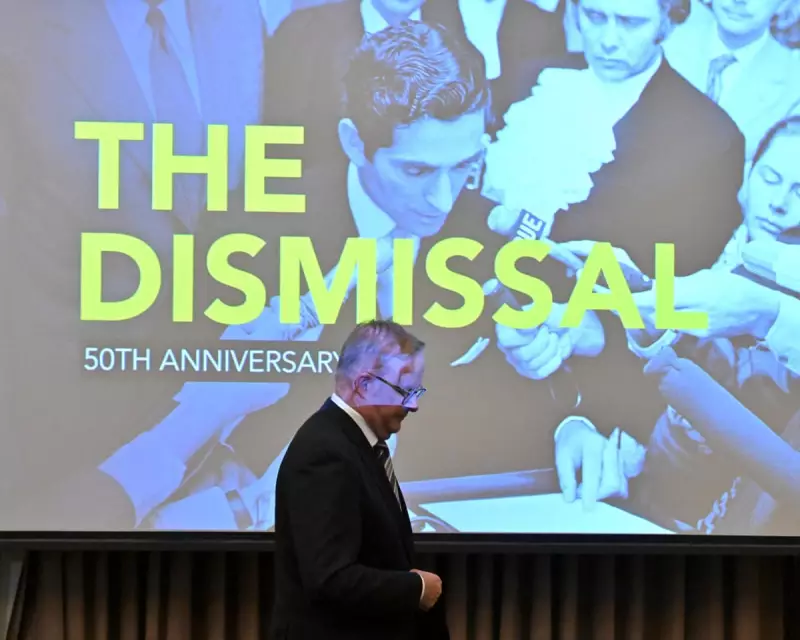
Fifty years after one of Australia's most dramatic political events, the dismissal of Prime Minister Gough Whitlam continues to shape the nation's political landscape. As current Prime Minister Anthony Albanese marks this significant anniversary, questions arise about how Whitlam's legacy might inform contemporary challenges, particularly the rapid rise of artificial intelligence.
The Enduring Impact of Whitlam's Dismissal
On Monday, Anthony Albanese attended a commemorative event at Old Parliament House in Canberra to mark the 50th anniversary of what many describe as Australia's bloodless coup. The dismissal of Gough Whitlam by the Crown in 1975, after less than three years in office, remains a pivotal moment in Australian political history, with suspicions of US involvement that persist to this day.
This event has fundamentally shaped the Labor party in two contradictory ways: it demonstrated both the resilience of Whitlam's ambition and the inherent dangers of pursuing such grandeur. The political trauma influenced subsequent Labor governments, from Hawke-Keating's more moderated economic reforms to the dramatic implosion of the Rudd-Gillard-Rudd era.
Whitlam's Values in Modern Australian Politics
Despite surface differences, the Albanese government carries distinct echoes of Whitlam's legacy in its DNA. Prime Minister Albanese himself served his political apprenticeship under Tom Uren, a key minister in Whitlam's government who survived the Thai-Burma railway.
The Medicare card that Albanese prominently carried during his election campaign directly traces back to Whitlam's creation of Australia's universal health system. Similarly, while Whitlam's government initially lacked female representation, his groundbreaking policies on equal pay and no-fault divorce laid the foundation for the majority women in Albanese's government today.
Artificial Intelligence: A Modern Challenge for Whitlam's Values
As the current government navigates what may be the most consequential technological challenge since the 1970s, Whitlam's approach to governance offers valuable insights. The rapid diffusion of artificial intelligence presents regulatory questions similar in scale to those Whitlam faced during his tenure.
Recent Guardian Essential Report data indicates that younger Australians are rapidly integrating AI into their work, personal lives, and even relationships. The regulatory approach remains contested, with industry advocates pushing for minimal intervention while unions and the public seek more comprehensive frameworks.
Whitlam would likely approach this challenge with several key principles. His assertion of Australian independence, demonstrated through his early recognition of China and scepticism of US imperialism, suggests he would resist framing AI development as a simple US-China race requiring regulatory concessions.
As a humanist rather than purely an economist, Whitlam would likely question industry productivity claims while critically analysing AI's impact on national identity. His commitment to cultural renaissance would make him particularly concerned about AI's use of copyrighted material to train models without proper compensation to artists and creators.
Finally, Whitlam's vision of Australia as a shaper rather than taker of technology, articulated in his government's 1974 white paper, suggests he would champion indigenous AI models serving purposes beyond shareholder value maximization and job displacement.
While historical parallels don't provide direct answers to contemporary technological challenges, they offer valuable frameworks for asking the right questions. Fifty years after his dismissal, Gough Whitlam's vision of an independent nation confident in its global position and determined to project its unique voice continues to resonate in Australian political discourse.