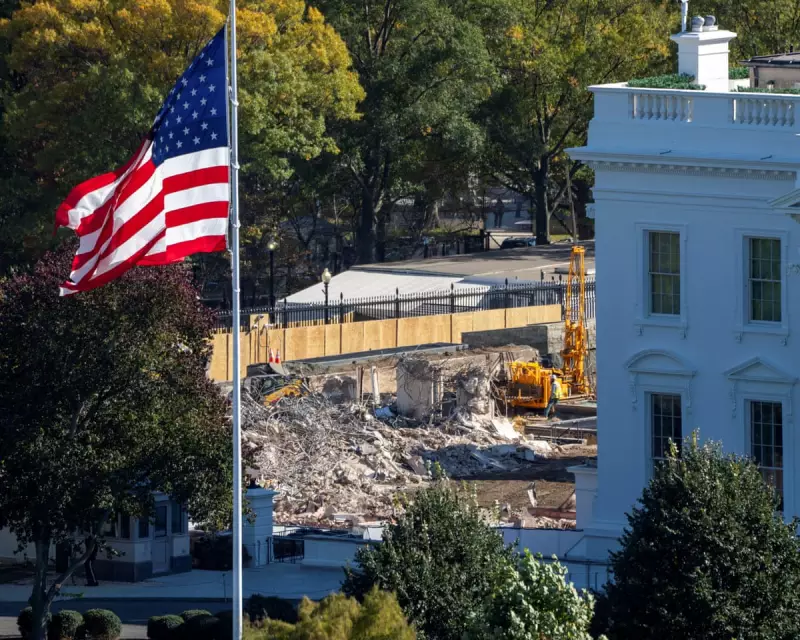
The administration of former US President Donald Trump has declared that the construction of a controversial new ballroom at the White House is a matter of national security, according to a recent court filing. This legal defence comes in response to a lawsuit seeking to halt the multi-million dollar project.
Legal Battle Over Historic Site
The administration's arguments were presented in a filing on Monday, answering a lawsuit launched just three days earlier by the National Trust for Historic Preservation. The preservation group had asked a federal judge to stop the ballroom project until it undergoes multiple independent reviews and secures approval from the US Congress.
In its response, the Trump administration included a declaration from the deputy director of the US Secret Service. The official stated that further work on the site of the demolished East Wing is essential to meet the agency's safety and security protocols. The government has even offered to share classified details with the presiding judge in a private setting, excluding the plaintiffs.
Project Details and Expanding Scope
The court documents provide the most detailed public insight into the ambitious project to date. They reveal that final plans for the ballroom are still not complete, despite ongoing demolition and preparatory work. According to John Stanwich, the National Park Service's liaison to the White House, below-ground work continues, with foundations scheduled to begin in January.
Critically, Stanwich noted that above-ground construction "is not anticipated to begin until April 2026, at the earliest". The project, which is privately funded, involves building a massive 90,000-square-foot ballroom at an estimated cost of $300 million, nearly doubling the size of the original White House before the East Wing was torn down in October.
Administration's Defence and Next Steps
The administration's legal strategy challenges the lawsuit on several fronts. It argues that claims regarding the East Wing's demolition are "moot" as the tear-down cannot be reversed. It also contends that issues about future construction are "unripe" because plans are not final, and that the plaintiff cannot prove "irreparable harm" with no above-ground work expected for years.
Furthermore, the filing asserts that the design reviews and consultations with bodies like the National Capital Planning Commission, which the lawsuit demands, "will soon be underway" without court intervention. A hearing in the case was scheduled for Tuesday in a federal court in Washington DC.
This lawsuit represents the most concrete effort yet to alter or stop President Trump's plans, which have drawn criticism from historic preservationists, architects, and political opponents. The legal tussle sets the stage for a significant clash between executive authority, national security claims, and historic preservation laws.