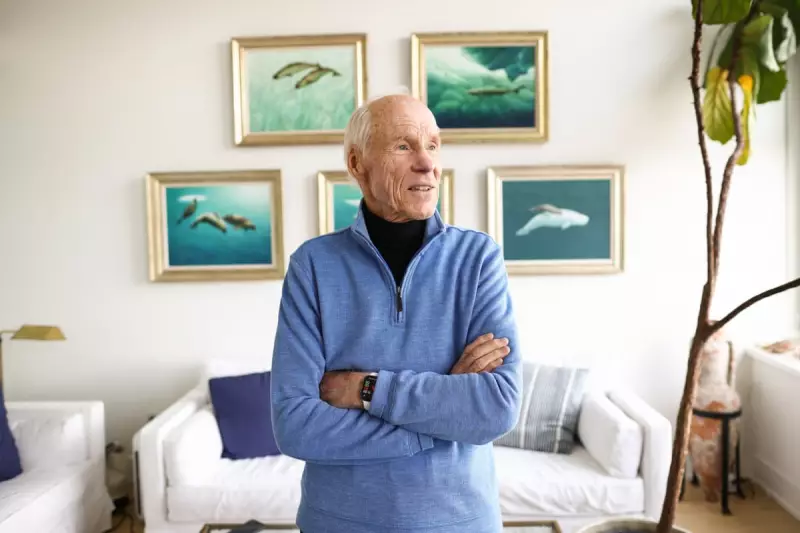
At 88 years old, the celebrated Canadian undersea explorer and physician Dr Joe MacInnis faces a familiar problem when recounting his extraordinary life: where to begin. With a career spanning decades at the forefront of oceanic discovery, the stories are as deep and numerous as the waters he has plumbed.
A Life Forged in the Depths
MacInnis's narrative could start with the heart-stopping moment he and Russian pilot Anatoly Sagalevich became entangled in a telephone wire inside the wreck of the RMS Titanic, trapped two and a half miles beneath the Atlantic surface. Or perhaps with the eerie sight of the SS Edmund Fitzgerald through a porthole, the massive freighter preserved in the icy depths of Lake Superior 50 years after its sudden, tragic loss.
It might begin with leading expeditions in the Canadian High Arctic to locate a British vessel crushed by ice, or diving off the Florida Keys amidst a reef curiously formed from 16th-century Spanish silver bars. For MacInnis, however, the true starting point is always the shipwrecks themselves—cataclysmic events where human endeavour met the ocean's raw, unforgiving power.
"In the final arc of your life, you start thinking of shipwrecks differently and they become a metaphor for understanding the forces of the world," he reflects from his Toronto home. "Above all, they help us grapple with one of the toughest things we have to do as humans: to reckon with the reality that we’re mortal."
The Golden Age of Undersea Exploration
MacInnis's career coincided with a pioneering era for ocean exploration. He was the first person to dive at the North Pole, led the team that built the first polar dive station (Sub-Igloo), and was among the first to film narwhals, bowheads, and beluga whales underwater. His collaborations read like a who's who of exploration, working alongside legends like Jacques Cousteau, Robert Ballard, and Buzz Aldrin.
He took Canada's former Prime Minister Pierre Trudeau diving in the Arctic and accompanied a 26-year-old Prince Charles under the ice. Furthermore, he was involved with the Franco-American team that located the Titanic in 1985 and later joined a Canadian-Russian expedition to film the wreck.
He views these international scientific collaborations during the Cold War as a "tiny step" towards its eventual collapse. "Here we were, working on science together in the ocean with two Cold War enemies," he notes. "It reflects what shipwrecks have taught me: in moments of crisis, we need each other. We’re in this together; none of us is as good as all of us."
From Discovery to Metaphor: Wrecks as Life's Teachers
In recent years, MacInnis's focus has shifted from the pure science and technology of exploration towards the human psychology revealed by maritime disasters. He is captivated by the question of how people react when their world is violently ripped apart.
"When the world is shredded before your eyes, how do you react? For me, wrecks have always been about the people who survived—or those that didn’t," he explains. "Because in our own lives, we can at times find ourselves scrambling to get to shore. I like to say that after years in the ocean, I’m an alpha coward with a PhD in fear."
This perspective fuels his current passion. Having recently suffered a heart attack and a minor stroke, MacInnis is acutely aware of his own mortality. "My soft pink body... is slowly falling apart. I’m frantically trying to put together my own lifeboat," he admits. "For the first time, really, I’m in my own shipwreck."
This personal reckoning has intensified his focus on the "global polycrisis"—a term encompassing geopolitical chaos and the climate emergency. He feels a fiery urgency to act, acknowledging his own substantial carbon footprint from a lifetime of expeditions. "If enough of us can get together and put the planet ahead of ourselves, we’ve got a chance with this. We really do," he asserts with characteristic optimism.
Among the artefacts from the deep in his home is a signed piece of foam from James Cameron's submersible, inscribed to "Dr Joe MacInnis, Legend, mentor, shipmate … friend." Another is a rusty link from the anchor chain of HMS Bounty, whose story of mutiny and survival he now sees in a new light.
"I thought of it as a story of mutiny with clear villains and heroes," he says of the Bounty. "Now, I see it as an incredible story of survival and leadership. And so there’s a sense of hope that comes from shipwreck, from the lifeboats we find ourselves in. It’s not a wishy-washy hope; it’s hope in action, it’s doing the right thing."
For Joe MacInnis, a lifetime spent unravelling the ocean's mysteries has culminated in a simple, powerful lesson. The sea, in all its terrifying beauty and destructive force, remains, as he puts it, "the greatest of all teachers."