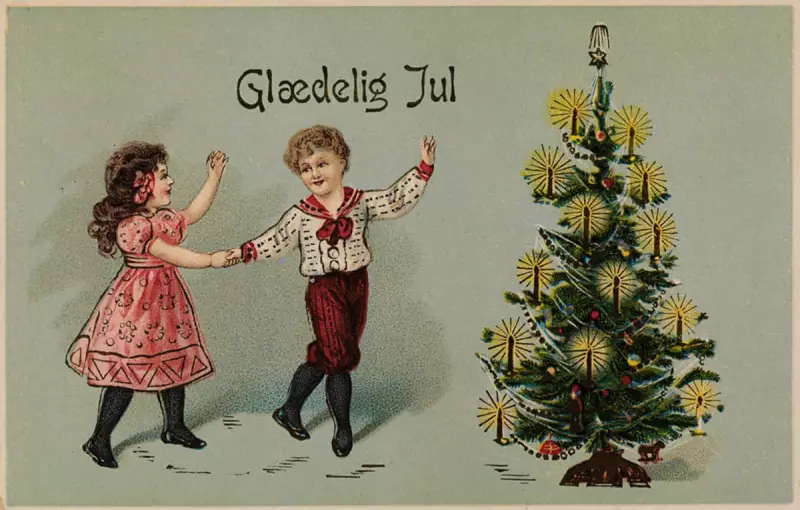
The festive tradition of bringing an evergreen tree into our homes each December is a custom steeped in ancient history, with roots stretching back to Roman times and branches spreading across Europe. A glimpse into a 1950 archive reveals the rich and varied story of the Christmas tree, from its pagan origins to its practical uses in Scandinavian life.
Ancient Roots: From Saturnalia to Christ's Thorn
The practice of decorating dwellings during the winter period appears to have originated with the Roman feast of Saturnalia. This week-long celebration, beginning on 17 December, honoured Saturn, one of Italy's oldest gods. Described as a time of "unrestrained disorder," it was also a period when business and courts closed, and social ranks were temporarily forgotten. Homes and temples were adorned with greenery, and gifts, including clay dolls for children, were exchanged.
With the advent of Christianity, holly, known as 'Christ's-thorn' in Germany and Scandinavia, became a primary decoration. However, botanical history suggests the true "Christ's-thorn" is likely the Paliurus Spina-Christi shrub, native to Asia. This plant, which can grow up to 15 feet tall, was reportedly used for the crown of thorns and can be cultivated in well-drained British garden soil.
The Rise of the Norway Spruce
For households with children, the Christmas tree eventually rivalled holly as the centrepiece of decorations. While various firs and pines are used, the most popular species is the Norway spruce (Picea excelsa). Evidence suggests it is one of Britain's oldest trees, present here in the remote tertiary geological period. After disappearing, it was reintroduced around the 16th century.
This spruce is a dominant forest tree across Europe. It thrives in the higher regions of Germany and Switzerland at altitudes up to 8,500 feet, predominates in Swedish woodlands and along Norway's fjords, and forms vast forests in Russia. In Britain, it can reach 80 feet, though it grows twice as tall in more favourable climates.
More Than Just Decoration: Practical Uses of the Spruce
The Norway spruce has long been valued for far more than its festive appearance. It provides:
- Masts for small vessels and telegraph poles.
- Scaffolding, flooring, and wood pulp for newsprint.
- Resin and pitch.
In Nordic countries, its applications were even more diverse. In Lapland and Bothnia, its long roots were fashioned into string and rope. Most poetically, in Norway, its fragrant branches were traditionally strewn over the floors of houses and churches, serving as a natural substitute for carpets.
The tree also has significant horticultural value. Its varieties are used for garden screening and shelter. Dwarf cultivars, some growing less than a quarter of an inch per year, are prized for rock gardens. Other attractive species include the weeping West Himalayan spruce (Picea Morinda) and the silver-marked Serbian spruce (Picea omorika), which thrives even in urban settings.
This historical journey, from Saturnalian halls to Norwegian churches and London's Trafalgar Square—which received its first annual gift tree from Oslo in 1953—showcases how a simple evergreen became a deeply rooted symbol of winter celebration, blending ancient custom with enduring utility.