Five decades after the death of Francisco Franco, Spain remains deeply divided over how to remember the dictator whose regime shaped the country for nearly forty years. As the nation marks this significant anniversary, troubling signs emerge that younger Spaniards are increasingly open to authoritarian rule, prompting urgent government action.
The Ghosts of Mingorrubio Cemetery
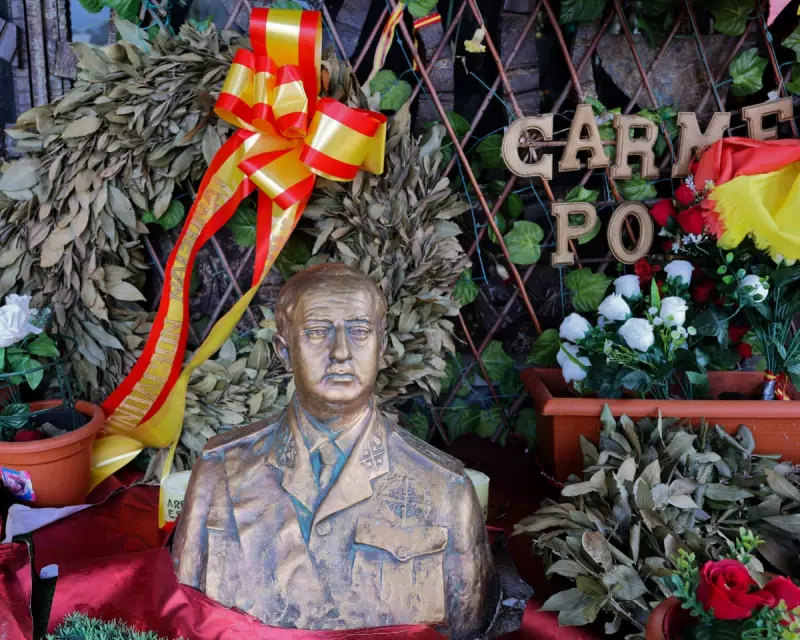
In the Mingorrubio municipal cemetery, where Madrid's northwestern suburbs meet the countryside, funeral wreaths and flowers still appear at the Franco family mausoleum. The site represents a dramatic downgrade from his original resting place at the Valley of the Fallen, with its 150-metre-high cross and bronze archangels.
Six years after his disinterment from that controversial monument, Franco rests among notorious company. Across the cemetery lies Luis Carrero Blanco, his prime minister assassinated by a bomb that launched his car 30 metres into the air. Also buried here are Dominican dictator Rafael Leónidas Trujillo and Carlos Arias Navarro, infamously known as the 'Butcher of Málaga' for his brutal civil war repressions.
It was Navarro who, fifty years ago this week, delivered the tearful television announcement: 'Spaniards, Franco has died.' He described the dictator as 'the exceptional man who, before God and before history, assumed the immense responsibility for the most demanding and sacrificial service to Spain.'
A Generation's Dangerous Disconnect
The current socialist-led government is using the anniversary to highlight Spain's transformation into a modern European democracy while sounding alarms about resurgent fascist sentiments. Surveys reveal approximately 24-25% of Spaniards aged 18-30 wouldn't mind living under an authoritarian regime, while another poll showed over 21% consider the Franco era 'good' or 'very good.'
'There is so much ignorance,' states Fernando Martínez López, Spain's secretary of state for democratic memory. He notes that generations of Spaniards, particularly those between 20 and 45, received minimal education about the civil war and dictatorship unless they had particularly interested teachers.
Ángel Víctor Torres, minister for territorial policy and democratic memory, observes disturbing trends among youth. 'Young people have a kind of disconnect,' he says. 'When I tell young people that there was a forced labour camp for gay people in Fuerteventura, they don't believe it.' Teachers report students embracing macho ideologies while expressing pseudo-nostalgia for a dictatorship they barely understand.
The Legacy of Forgetting and the Fight for Memory
This knowledge gap stems directly from Spain's transition to democracy. The 1977 amnesty law, granting impunity for crimes committed during the civil war and Franco regime, came with an unspoken 'pact of forgetting' designed to move the country forward by leaving the past behind.
Carlos Hernández de Miguel, author of 'Franco's Concentration Camps,' argues that while necessary concessions were made during the transition, they persisted too long. 'That allowed generations of Spaniards to grow up without knowing what happened in our country during the 20th century,' he states.
The political landscape remains fiercely divided over how to address this history. The conservative People's party (PP) previously cut historical memory funding to zero and criticises current democratic memory legislation as 'digging up grudges.' Meanwhile, the far-right Vox party dismisses anniversary events as 'absurd necrophilia that divides Spaniards.'
Despite progress including Franco's exhumation from the Valley of the Fallen - now being 'resignified' as the Valley of Cuelgamuros - anomalies persist. The National Francisco Franco Foundation continues selling memorabilia online until the government succeeds in shutting it down.
The physical scars also remain. While nearly 9,000 victims of Francoist repression have been exhumed recently, approximately 11,000 more await recovery from mass graves. Thousands more may never be found as their burial sites have been lost or built over.
Almudena Carracedo, director of the documentary 'The Silence of Others,' emphasises that Spain still lacks justice for regime victims. 'The important third pillar - justice - is still blocked by the 1977 amnesty law,' she explains. This imperfect reckoning with history has enabled revisionism and dangerous nostalgia.
'I would so love to say that Franco is dead,' Carracedo reflects. 'But today, with the resurgence of the alt-right, he is somehow still painfully present. All these youths who now raise their arms in fascist salutes were never really taught their history.'