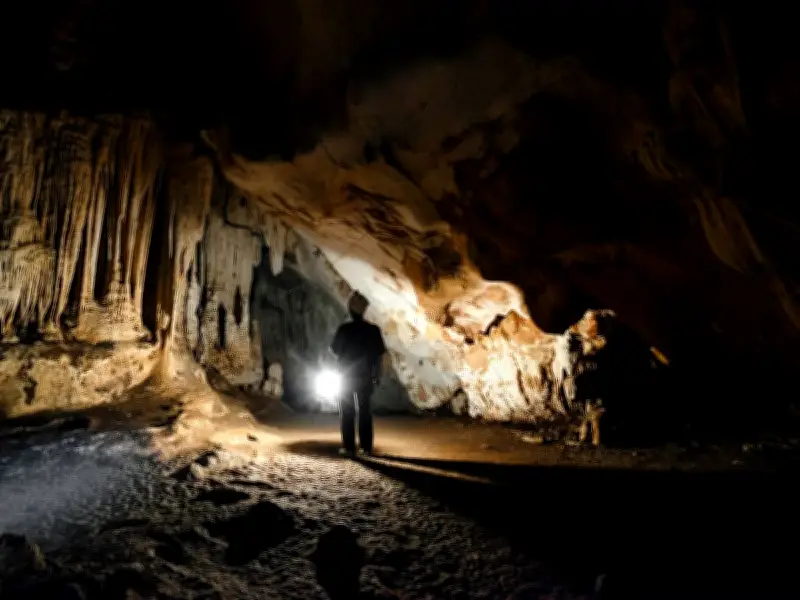
Hidden caves and tunnels beneath South London have long been the subject of folklore, with tales ranging from smugglers' routes to secret passages to the sea. While some stories have roots in fact, many remain firmly in the realm of legend. The caves, located around Mitcham, Beddington, Sutton, and Croydon, have sparked imaginations for over a century, but historical and geological evidence suggests a more mundane origin.
Historical references and local legends
The existence of the caves was referenced in an 1880 issue of the Croydon Review and Timetable. An article titled "Haunted," written by an anonymous author, described the caves as "shudderus," implying they were extraordinarily unsettling. The piece claimed the cave openings were known as a "robbers cave" located at Plough Lane near Bandon Hill in Mitcham, now better known as Beddington Caves.
Although the author recalled hearing rumours about the caves stretching all the way to Brighton, having explored them personally, he concluded: "There is northing very remarkable about them." He also recounted being told that the caves were discovered by a man who, while ploughing a field above them, unexpectedly tumbled into the "robbers den."

Local memories of the caves
The caves are relatively well-known among locals, with their entrance positioned near the Plough Inn pub on Plough Lane. It is now blocked off, but residents remember it being set within a steep embankment amongst some brambles opposite the pub, and they would descend into it.
Local resident Sue Chester recalled her trips to the caves: "As for the tunnels, we stumbled across them by accident. When we were teenagers [mid-1960s to the early 1970s], we went exploring and found the entrance. If you go to the Plough public house and look across the road to where the back gardens of the houses come down to meet the road, there amongst the brambles, is the entrance to one of the many tunnels."
"As teenagers, we used to go 'down the hole', as that's what it was, just a hole, no larger than a fox's burrow. Once inside, it would expand into a larger tunnel. Venturing further in, we discovered a large 'hall' spacious enough to host a small banquet. We used to play down there. Suddenly, they were blocked off. We later found out that the council had done this for safety reasons."
Theories and geological evidence
Steve Roud, author of London Lore, has observed that countless imaginative theories have emerged about the caves over the years. One such theory proposes they were used by Romans as an escape route from the nearby Beddington Villa during attacks. Other theories suggest the tunnels stretched as far as Nonsuch Park, connecting to the Tudor palace that once stood on the site. Local folklore also ties them to nearly every historic residence in the vicinity, including Carew Lodge and Beddington Manor.
One particularly chilling legend claims that the ghost of Sir Walter Raleigh still roams the caves, striking fear into all those daring enough to explore them. However, researcher Roud argues that the majority of these tales simply don't hold up against geological evidence. The area's rivers, chalk faces, and gravel beds suggest the caves could only span a few hundred yards at most, and were most likely dug out for sand extraction for industrial purposes.
Historical records and investigations
The tunnels fail to appear in any historical records until the 1860s, casting serious doubt on many of the older theories surrounding them. According to the Mysterious Mitcham website, the system appears to be a combination of natural and man-made elements. Upon inspecting the tunnels in 1940, the London Speliological Society concluded they were most probably the result of sand mining. Their investigation led them to the nearby Queen Elizabeth's Walk, where a manhole cover concealed an entrance to the caves.
Despite their findings, they were unable to secure permission to carry out a more comprehensive examination. The Chelsea Speliological Society also carried out an inspection of the system, though not until 1968, by which point little trace of the mines remained.

Historically, it is known that Beddington Cave formed part of the lease for the neighbouring inn during the 19th century, with the landlord making use of it as a cool, dark cellar in which to store barrels of alcohol. During the 1920s, an elderly parishioner by the name of Mr Roffey recounted stories to Rev. Thomas Bentham that he had heard as a child, concerning donkey trains carrying smuggled goods through the dead of night across the downs and into Beddington. These smugglers were also said to have hidden their contraband within the caves.
While many of the tales surrounding the caves may well be speculation, they cannot be dismissed out of hand. No thorough exploration of the cave system has ever been undertaken, and now that the entrances have been sealed off, it seems unlikely that one ever will be. As a result, none of the stories connected to the caves can be conclusively ruled out.