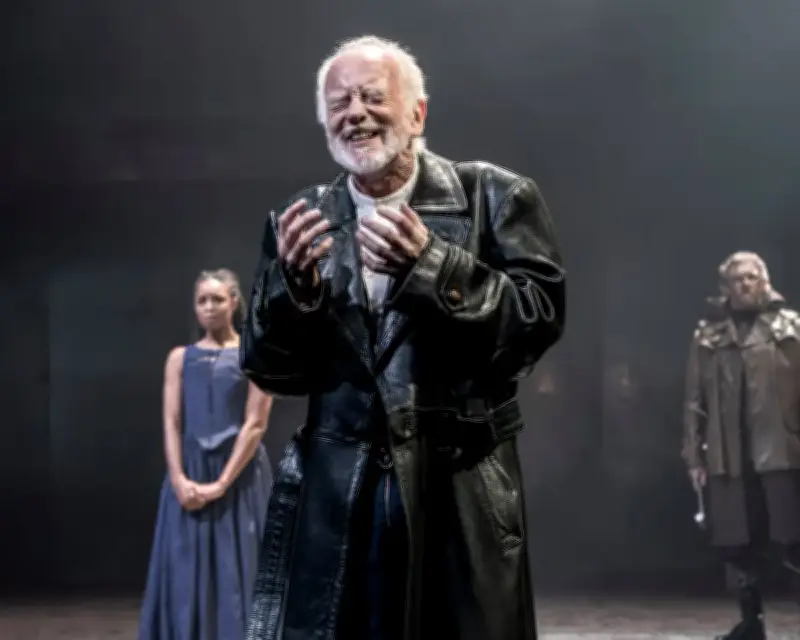
The word “nothing” is spoken four times in four lines in the opening scene of King Lear, among 30 uses across the play. This feels the key to Titus Halder’s Sheffield Crucible staging, which really makes something of nothingness, crowned by an unusually age-appropriate performer as the “fourscore and upward” English king: 82-year-old Ian McDiarmid.
A production of terminal uncertainty
The dark pit of Richard Kent’s design might be a nuclear after-blast. Like Peter Brook’s mid 20th-century stage and film versions, in a previous era of existentialist international tension, the interpretation radiates terminal uncertainty. Characters address pleas and prayers to “the gods” in the direction identified with heaven but with a growing knowing that nothing is there.
It is also clear that the kingdom Lear ruinously tries to divide between his three daughters is already past its rule-by date, probably due to his eccentric leadership. In a moment of apparent clarity during his mental decline, Lear says, “I will be jovial”, and this often unremarked line seems the base note to McDiarmid’s titanic performance.
McDiarmid's political demagogue
Giggling dirtily when speculating about his daughters having “issue”, he grins manically out of sync with situations. His threat to inflict “terrors” on the world even though he “does not know yet” what they are is not, as often, the forgetfulness of dementia but political bullshitting that wins a knowing laugh from the audience. Leaving his court unsure what he will say or do next, the erratic head of state is also transactional, giving real chill to the dismissal of the banished Cordelia: “Her price has fallen.”
But, while it might be no surprise if this Lear suddenly imposed tariffs on France, the portrait of power is much broader: this demagogue, unfashionably, admits fault and reaches forgiveness.
Bodily authenticity and verbal clarity
The acting paradox of Lear is that the textual extreme physical frailty must co-exist with the ability to carry Cordelia’s corpse and the vocal depth to serve the dense poetry. Because of this, middle-aged actors are often cast.
While birth-date realism raises obvious risks, McDiarmid perfectly combines bodily authenticity (the problem of transporting the dead daughter cleverly sidestepped) with absolute verbal clarity on the required range from explosion to self-reflective emotion. When Lear’s heart broke, so did mine.
Supporting cast and production
Fool – also seemingly a chief of staff cum carer to Lear – is Max Revell, a dancer with a background in breaking and popping. The result is a spectacularly gymnastic Fool, backflipped by the storm winds and illustrating the jester’s metaphor about a crab by twisting himself into one. Dramaturg Sophie Duncan’s skilled elision of variant texts emphasises Edmund, played by Fode Simbo with a manipulative charisma suggesting Gloucester’s bastard son as a cousin of Iago in Othello. Bebe Sanders’ dignified, wounded Cordelia highlights the bravery of this character in the dramatic scheme. Mark Holgate is powerful as a site-specific Yorkshire Kent.
The production is uniformly impressive but the wonder is McDiarmid, topping a remarkable career that combines a popular culture summit – Emperor Palpatine in the Star Wars movie franchise – with, now, this classical peak. At the Crucible theatre, Sheffield, until 19 September.