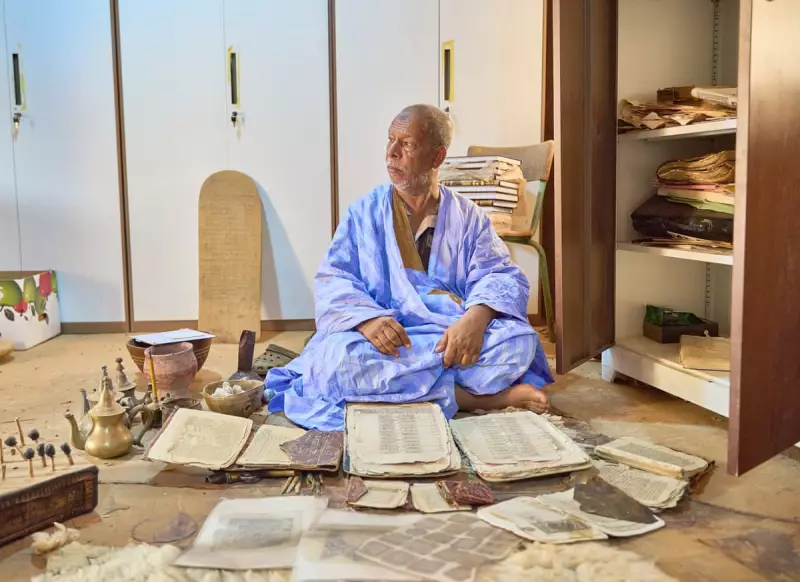
On a recent afternoon in the heart of the Sahara, 67-year-old Saif Islam, the custodian of the Al Ahmed Mahmoud family library, moved slowly through the courtyard of his ancient repository. Dressed in a flowing blue boubou, his presence commanded respect, a living link to a vanishing world.
Chinguetti, a tiny desert settlement in Mauritania, was once a thriving crossroads of knowledge and trade. Now, this UNESCO World Heritage site faces a triple threat: the relentless advance of desert sands, a dramatic collapse in tourism, and insecurity spilling over from neighbouring Mali.
The Sorbonne of the Desert
Chinguetti rose to prominence in the 13th century as a fortified ksar, a vital stop for caravans on trans-Saharan trade routes. It later became a gathering point for pilgrims travelling to Mecca and, over centuries, evolved into a renowned centre for Islamic and scientific scholarship.
Earning titles like 'the city of libraries' and 'the Sorbonne of the desert', it was designated the seventh holy city of Islam. Its family-run libraries became treasure troves, preserving religious and scientific manuscripts dating back to the 11th century.
"It's these books that gave it this history, this importance," said Islam, pointing to a 10th-century Qur'an with pages browned by age. "Without these old dusty books, Chinguetti would have been forgotten like any other abandoned town."
A Legacy Buried by Sand and Neglect
Today, the reality is stark. Of the estimated 30 libraries that once operated, only 12 family-run collections remain, collectively safeguarding over 2,000 volumes. These include priceless works on astronomy, mathematics, medicine, poetry, and legal jurisprudence.
Yet the desert is winning. Encroaching sand dunes now reach the height of some buildings' windows. The town's original population has largely moved to newer buildings outside the ancient ksar boundaries, a trend accelerated by severe droughts in the 1960s and 70s.
Compounding the physical threat is a dramatic drop in visitors. Tourist numbers have plummeted to barely 200 per season, down from hundreds daily in the past. Islam attributes this to the aftermath of the Covid-19 pandemic and the insecurity in Mali. For weeks, and sometimes months, no one visits his library.
The Fight for Survival
Despite its UNESCO status, residents say this recognition has not translated into sustained financial support. Promises of funding from public and private entities have largely gone unfulfilled.
Hope arrives in pockets. The Madrid-based non-profit Terrachidia, in collaboration with Mauritanian cultural authorities and the Spanish government's development agency, has helped restore several libraries using traditional building techniques.
Their work aims not just at preservation but at reviving the community. "Cities, like houses, are preserved when they are inhabited," said Mamen Moreno, Terrachidia’s co-founder, highlighting a recent project that brought local schoolchildren into the ksar.
For Saif Islam, the fight is personal. He returned to Chinguetti in 2015 after retiring from civil service in the capital, Nouakchott, to take up the role of custodian. "Chinguetti is Africa's spiritual capital," he asserts, expressing frustration that Europeans often show more interest than Arab compatriots or Mauritanian officials.
"Sadly, I see that Europeans are more interested in Chinguetti than Arabs or even Mauritanian officials," he laments. "Chinguetti is in distress. It needs everyone." His plea is a race against time to save ancient legacies from being swallowed by the sands of the Sahara and the sands of time.