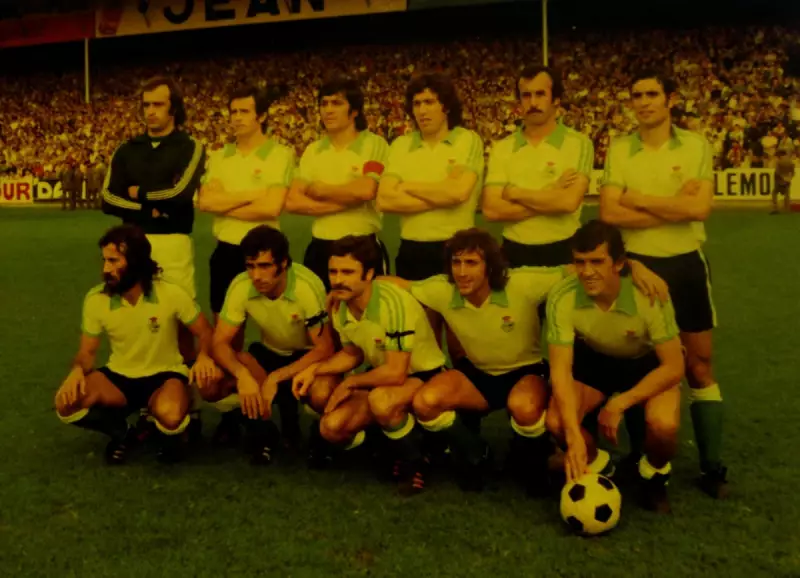
Fifty years ago, a simple act of defiance by two footballers in northern Spain reverberated far beyond the pitch, drawing the ire of a dying dictatorship and forging an unbreakable bond. In September 1975, Racing Santander players Aitor Aguirre and Sergio Manzanera staged a silent protest against the state executions ordered by General Francisco Franco, an act that would lead to police raids, death threats, and a shared legacy of courage.
A Silent Protest Forged in a Toilet
As their teammates filed out of the dressing room at the El Sardinero stadium for a match against Elche, Aguirre and Manzanera held back. Horrified by news of the execution of five political prisoners that Saturday, they felt compelled to act. Their weapon of choice was subtle: a pair of black bootlaces. "We slipped into the toilets," Aguirre recalled. "I tied one onto Sergio, and he tied one onto me, so they looked like armbands."
The pair, already united by opposition to the regime—Aguirre a Basque, Manzanera from a Republican Valencian family—then took to the field. Their gesture seemed to go unnoticed during a first half where Manzanera crossed for Aguirre to score. The reality was very different.
Armed Police and a Death Sentence
At half-time, the players' tunnel was packed with the grey uniforms of the feared Policía Armada. Facing around twenty armed officers, the duo were given an ultimatum: remove the armbands or face immediate arrest. They complied, believing their message had already been sent. "This would be in all the newspapers the next day," Aguirre reasoned.
The repercussions were severe and swift. Interrogated at a police station and then taken to court, prosecutors sought a five-year prison sentence. They escaped jail due to the lack of public disorder but were hit with a heavy fine. Back in a conservative Santander, life grew dangerous. Their mail was tampered with, they faced hostility in the streets, and the far-right paramilitary group Guerrilleros de Cristo Rey (Warriors of Christ the King) publicly sentenced them to death.
"I had two small children. My wife had to leave and take them to her mother's," said Aguirre. Manzanera, living alone, endured sleepless nights. "Every night I would listen to the elevator coming up in the early hours... I kept a shotgun next to the bed," he revealed.
A Lifelong Bond Forged in Defiance
The pressure only eased after Franco's death on 20 November 1975, which began Spain's transition to democracy. Fifty years later, the connection between the two men, now living hundreds of miles apart, remains profound, cemented by their shared stand.
"It gives me great satisfaction to know that I've contributed my tiny grain of sand to democracy, to trying to change something," Manzanera reflects. Aguirre is equally resolute: "I'm almost certain I'd do it again. It was an important milestone... and I'll carry that with me until they take me to the cemetery."
Their story, a poignant footnote in the final bloody chapter of the Franco regime, stands as a testament to how sport and courage can intersect under the shadow of tyranny.