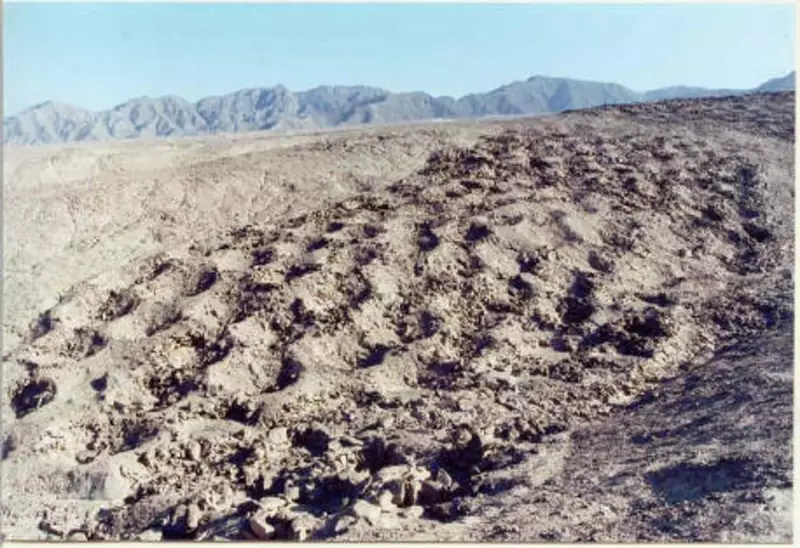
High in the arid hills of Peru's Pisco Valley, an ancient mystery continues to baffle archaeologists and historians alike. The Band of Holes, a vast collection of thousands of man-made depressions stretching across the landscape, has remained one of South America's most perplexing archaeological puzzles.
The Enigmatic Landscape Feature
Recent archaeological work led by Professor Charles Stanish from the University of South Florida has shed new light on this mysterious site. The Band of Holes consists of approximately 6,000 shallow pits carved into the rocky terrain, arranged in lines that extend for nearly a mile across the Cerro Viruela and Cerro Sangaya mountains.
Contrary to some sensational theories suggesting extraterrestrial involvement or elaborate astronomical purposes, the new research points toward more practical explanations. Professor Stanish's team discovered that the holes were likely constructed during the Late Intermediate period, between AD 1000 and 1400, predating the Inca Empire's dominance in the region.
Uncovering Practical Purposes
The archaeological investigation revealed compelling evidence about the holes' potential functions. Rather than serving as graves, defensive positions, or storage facilities as previously speculated, the research suggests they may have been part of an sophisticated agricultural or economic system.
"What makes the Band of Holes particularly fascinating is its scale and organisation," explains Professor Stanish. "The holes measure approximately three feet in diameter and depth, and they're arranged in precise lines that follow the natural contours of the mountainside."
The team's analysis indicates the structures might have supported poles for drying or processing agricultural products, possibly serving as an early form of mass production facility for goods traded along ancient routes.
Modern Technology Meets Ancient Mystery
Advanced technology has played a crucial role in recent investigations. Using drone photography and 3D mapping, researchers have been able to document the site with unprecedented precision. This has revealed patterns and relationships between the holes that weren't previously visible to ground-based observers.
The investigation also uncovered evidence of associated structures and pathways connecting the Band of Holes to other archaeological sites in the valley, suggesting it was part of a larger economic network rather than an isolated phenomenon.
Despite these new insights, many questions remain unanswered. The exact purpose of each individual hole and the reason for their specific arrangement continue to elude researchers, ensuring that the Band of Holes maintains its status as one of Peru's most intriguing archaeological mysteries.
As Professor Stanish notes, "Every answer we find seems to generate new questions. That's what makes archaeology so compelling – we're constantly rewriting our understanding of ancient civilizations."