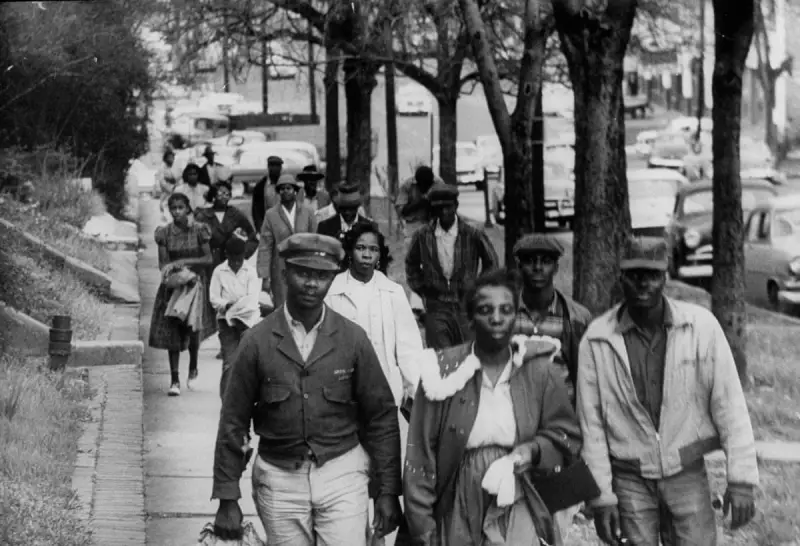
Seventy years ago, on 5 December 1955, a protest began in Montgomery, Alabama, that would become a cornerstone of the American civil rights movement. The Montgomery bus boycott is often remembered as a swift, decisive victory sparked by a single act of defiance. However, the true story is far more complex, involving years of groundwork, profound personal risk, and sustained collective action without any guarantee of success.
The Foundation of a Movement: Decades of Unseen Struggle
The popular fable often begins and ends with Rosa Parks refusing to give up her seat on 1 December 1955. Yet, by that date, Parks had been an activist for two decades. She worked tirelessly with the NAACP and union leader ED Nixon, fighting for voter registration and seeking justice for Black victims of violence, often with little visible progress. "It was very difficult to keep going when all our efforts seemed in vain," she later reflected on those pre-boycott years.
Parks was neither the first nor the only person to resist. In the decade before her arrest, a trickle of Montgomery residents had challenged bus segregation. Most notably, eight months earlier, 15-year-old Claudette Colvin was arrested for the same act. Parks herself fundraised for Colvin's defence. While Colvin's case did not ignite a mass movement, it was a critical link in a chain of injustices that brought the community to a breaking point. Movements are born from accumulation, not isolated incidents.
Courage in the Face of Certain Failure
What made Parks's stand uniquely powerful was the context of profound pessimism. After years of activism with scant reward, she had grown doubtful that mass change was possible. That summer, she reportedly told fellow activists, "There will never be a mass movement in Montgomery." When the bus driver demanded her seat, her refusal was not a calculated political stunt but a personal line in the sand. She acted despite the very real fear of violence and arrest, and with no evidence that her action would matter. As she explained, to move would be to approve of her own mistreatment.
The response was not instantaneous. The Women's Political Council (WPC), led by Jo Ann Robinson, had been planning for such a moment. Upon hearing of Parks's arrest, Robinson and two students risked their positions to mimeograph 35,000 leaflets overnight, calling for a one-day boycott. The leaflet's opening line—"Another woman has been arrested on the bus"—highlighted the pattern of abuse.
A Year of Sacrifice and Sustained Organisation
The success of the initial boycott day was a shock. Martin Luther King Jr., a relatively new pastor in town, described the empty buses as "a miracle." Yet, the decision to continue the protest indefinitely required a staggering logistical effort and immense personal sacrifice.
Contrary to the romantic image of a community simply walking, the boycott was sustained by a massively organised carpool system. The Montgomery Improvement Association (MIA) coordinated up to 20,000 rides daily from 40 pickup stations. Funding this operation fell to grassroots efforts, like the Club from Nowhere led by cook Georgia Gilmore, where women with little money baked and sold food to keep the movement alive.
The costs were severe. The Parkses lost their jobs and could not find steady work in Montgomery again. Seven weeks into the boycott, the Kings' home was bombed with Coretta Scott King and their infant daughter inside. Both sets of parents pleaded with them to leave, but Coretta's refusal to abandon the struggle was a pivotal moment. Meanwhile, the city fought back with legal harassment, ticketing carpool drivers and indicting 110 boycott leaders under an antiquated law.
The Legal Victory and the Real Legacy
The boycott's culmination was a legal triumph, but not from Rosa Parks's original case. Attorney Fred Gray filed a federal suit, Browder v. Gayle, fearing the state would thwart Parks's appeal. The plaintiffs were four other women: Aurelia Browder, Susie McDonald, Claudette Colvin, and Mary Louise Smith. Their case went to the U.S. Supreme Court, which ruled on 21 December 1956 that bus segregation was unconstitutional.
The true lesson of Montgomery is not one of a quick, easy win. It is a story of persistence in the face of uncertainty. If activists had waited for a "perfect" moment or a guaranteed strategy, the boycott would never have begun. It required acting despite fear, organising without a blueprint, and sacrificing without a promise of reward. As the historian notes, the movement's power lay in "the ability to keep going, amid fear and uncertainty, amid job loss and police harassment." In an era where calls for change are often met with demands for practicality and minimal disruption, the Montgomery bus boycott stands as a powerful testament to the courage required to challenge injustice long before victory is in sight.