The Man Who Challenged Death: Mick Meaney's 61-Day Ordeal
In an extraordinary feat of human endurance that captured global attention, Irish labourer Mick Meaney spent 61 consecutive days buried alive beneath a London builder's yard in 1968. This remarkable story, largely forgotten for decades, is now being revived in a powerful new documentary titled Beo Faoin bhFód (Buried Alive), scheduled for broadcast on Irish-language station TG4.
Driven by ambition and a desire to escape poverty, the Tipperary native embarked on this macabre challenge with little more than determination. His daughter Mary Meaney recalls in the film: "He was another Irishman, they are now called the forgotten Irish, they were over there working with a pick and shovel and sending the money back to their families."
Underground in Kilburn: The Record-Breaking Stunt
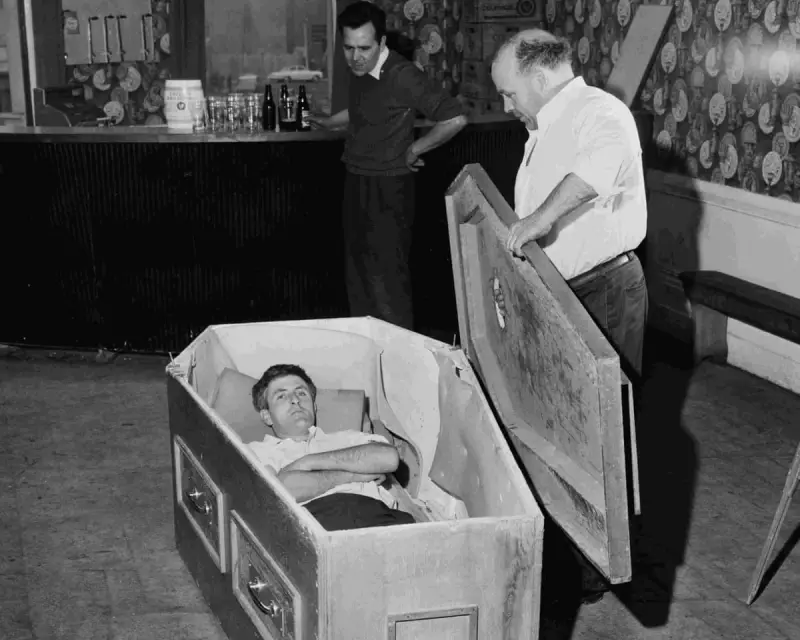
The incredible journey began on 21 February 1968, when Meaney's specially constructed coffin - measuring 6ft 3in long and 2ft 6in wide - was paraded through the streets of Kilburn, London's Irish heartland. Cheered on by well-wishers and television crews, the 33-year-old was lowered into a prepared pit, with only an air pipe and supply tube connecting him to the world above.
Meaney teamed up with Michael 'Butty' Sugrue, a colourful circus performer turned publican who masterminded the spectacle. Sugrue staged an initial wake at his pub, the Admiral Nelson, before the coffin was transported to a builder's yard owned by contractor Mick Keane.
Life underground developed its own rhythm. Meaney maintained a strict routine, waking at 7am daily to perform confined exercises, apply body ointment, and communicate with the outside world via a telephone line connected directly to the Admiral Nelson. Celebrities including boxer Henry Cooper took calls, while Sugrue charged patrons for the privilege of speaking to the buried man.
Despite competing for attention with the Vietnam War and Martin Luther King's assassination, public interest sustained through the 61-day ordeal. On 22 April 1968, Meaney emerged triumphant before cheering crowds, declaring: "I'd like to go for a hundred days more. I'm delighted to be the champion of the world."
Fleeting Fame and Lasting Legacy
Tragically, the fortune Meaney hoped for never materialised. Allegations emerged that Sugrue had swindled his star performer, with promised world tours and a Gillette sponsorship deal failing to appear. Mary Meaney, who was just three when her father returned to Ireland, remembers: "He came back without as much as the price of a bottle of milk in his pocket."
Further disappointment followed when the Guinness Book of Records declined to officially recognise his achievement, and rival 'burial artists' questioned his credentials. Later in 1968, former nun Emma Smith would claim a 101-day burial in Skegness, though under different conditions.
Meaney eventually returned to a quiet life in Ireland, working for Cork County Council until his death in 2003. His daughter reflects: "He could live an ordinary life, working class, ordinary, but he craved this extraordinary life. Breaking the world record made him feel, 'I'm somebody'."
Directed by Daire Collins, the new documentary combines archival footage with heartfelt interviews, ensuring that Mick Meaney's incredible story of ambition, endurance and ultimately, humanity, will be remembered by new generations.