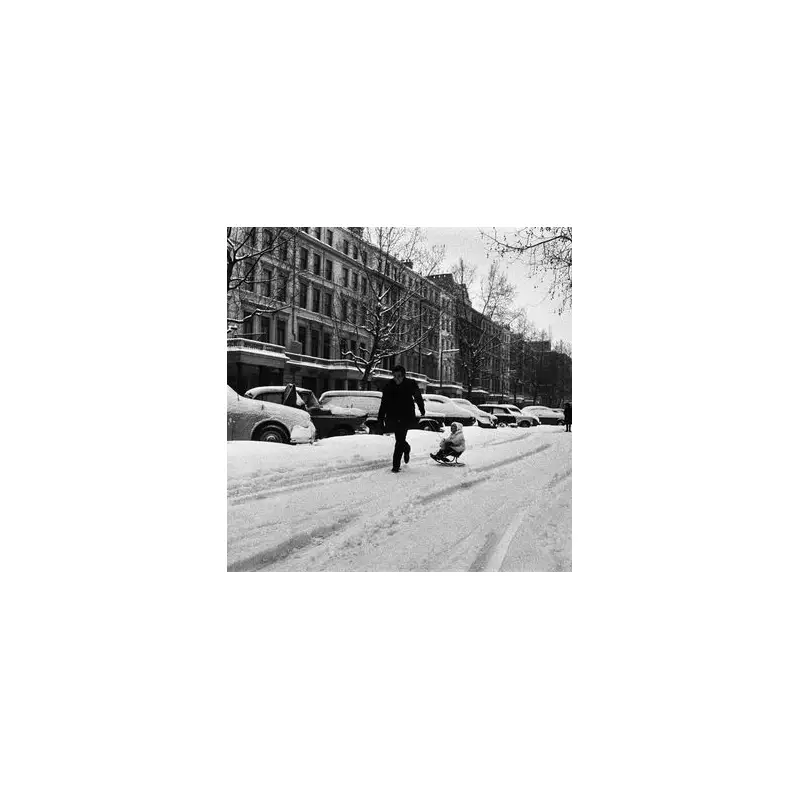
For Londoners accustomed to the capital's typically mild and damp climate, the idea of a prolonged, bone-chilling winter seems almost fictional. Yet, for an entire generation, the memory of the brutal winter of 1962-63 remains etched in history as the 'Big Freeze' – a period when London was transformed into a frosty wonderland and brought to a virtual standstill.
The Onset of the Big Freeze
The deep freeze took hold in late December 1962 and refused to loosen its grip until early March 1963. Contemporary newspaper reports from the time claimed it snowed for what felt like months on end. This was not just a brief cold snap; it was a sustained assault of Arctic conditions that would become the coldest winter in London's recent history.
One meteorological survey conducted that winter revealed a staggering statistic: snow lay on the ground for 69 consecutive days. At its peak, the blanket of white was more than 30 centimetres deep, paralysing the city's usual bustle and creating scenes more akin to the Alps than central London.
A Capital Transformed by Ice
The plummeting temperatures had a dramatic effect on the UK's waterways. Iconic London landmarks succumbed to the ice; the lake in St James's Park and the swimming pool at Brockwell Lido froze solid. The cold was so intense that it even caused the sea off the coast of Whitstable and waterfalls in Wales to turn to ice.
Remarkably, the upper reaches of the River Thames also froze over, though the icy clutches stopped short of Central London. The Grand Union Canal at Little Venice became a solid sheet of ice, trapping canal boats in a frozen tableau.
Londoners' Resilient and Playful Spirit
Faced with such extraordinary conditions, Londoners displayed their characteristic resilience and humour. Rather than hibernate, many decided to embrace the unprecedented weather. Photographs from the era capture this spirit vividly.
Milkmen adapted their rounds by strapping on skis to deliver essential pints to snowed-in households. In Earl's Court, a thrill-seeker was photographed being pulled along on skis behind a car. Meanwhile, on The Serpentine in Hyde Park, British competitive figure skater Diana Clifton-Peach took to the ice, demonstrating a professional grace amidst the public chaos.
Life, however, was not all fun and games. The city's infrastructure struggled to cope. Buses carefully navigated snow-covered streets like Fleet Street under the watchful eye of policemen. Men were seen shovelling tonnes of snow from around the Statue of Eros in Piccadilly Circus, and postmen trudged heroically through deep drifts to deliver the mail.
The sporting world was also disrupted. At White Hart Lane, dedicated Tottenham Hotspur fans were seen sweeping snow from the pitch lines prior to a cup tie, while on another day, a postponed match led to fans amusing themselves with a large-scale snowball fight outside the gates.
Perhaps one of the most striking images of personal fortitude is that of a swimmer breaking through the thick ice at Brockwell Lido for a bracing dip in the freezing waters below.
The Big Freeze of 1963 stands as a powerful reminder of nature's ability to disrupt even the greatest of cities. It is a chapter of London's history defined by both extreme challenge and the enduring, adaptable spirit of its people.