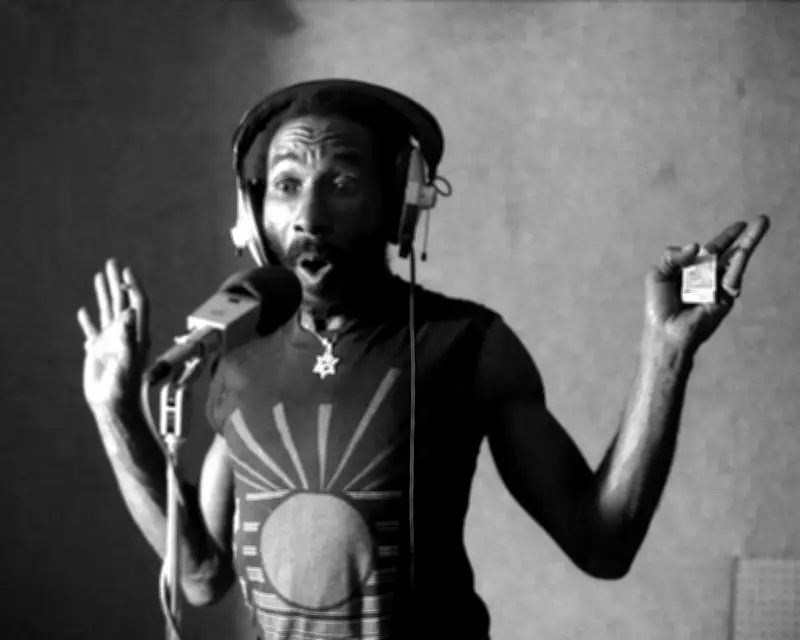
Two new books, a posthumous album, and a wave of classic reissues are prompting a reassessment of reggae producer Lee 'Scratch' Perry, five years after his death. The projects aim to shift focus from his chaotic reputation to his musical innovations.
Initiation by the Thames
When reggae historian David Katz first met Perry in London in the late 1980s, the producer demanded Katz present him with 13 stones from his home country. Unable to return to the US, Katz retrieved stones from the River Thames. Perry then unscrewed a TV monitor, placed the stones inside, and resumed work. Later, Katz attempted to mic an Alsatian dog. This bizarre initiation, Katz says, was Perry's way of testing him and introducing him to his unique approach.
Musical Legacy
Perry helped shape Bob Marley and the Wailers' sound on albums like Soul Rebel and Soul Revolution before a royalties dispute. He produced Super Ape, considered the most important dub record ever, and ran the Black Ark studio, where he created a decade of roots reggae. His productions featured crying babies, sub-bass, and melodic sensibility. Artists like the Beastie Boys, the Clash, and Keith Richards sought his counsel; John Lydon reportedly tracked him down at the Black Ark, though Lydon's representatives deny this.
New Projects
Katz's book Dub Revolution, out July 2, explores reggae through practitioners like Perry. The illustrated book Lee 'Scratch' Perry: Black Ark reveals studio secrets. Perry's 'final' album, Spatial, No Problem, a collaboration with German electro outfit Mouse on Mars, was recorded two years before his death. Reissues include the Congos' Ark of the Covenant.
Beyond the Persona
Perry's later years saw him in fluorescent clothes, with dyed hair, speaking in riddles and calling himself a 'madman'. He turned interviews into farce, as when Krishnan Guru-Murthy interviewed him in 2009. Perry answered in rhyming couplets, saying, 'I kill the devil brain, so that the devil can't reign.' When Jools Holland asked why he placed a toaster on a breeze block, Perry replied, 'It means that I'm a toaster.'
Adrian Sherwood, Perry's longtime collaborator, says Perry loved mischief. At a screening of a documentary, Perry elbowed Sherwood and laughed whenever he baffled an interviewer. Sherwood says, 'He always loved mischief.'
Obeah and the Black Ark
Perry's belief in obeah, a West African spiritual practice, influenced his life and work. He claimed the sound of clashing stones at a quarry directed him to Kingston, where he worked for Studio One's Coxsone Dodd. He discovered the Maytals, worked with Delroy Wilson, and had hits like Chicken Scratch.
The Black Ark, completed in 1973 in Kingston's Washington Gardens, had a rudimentary setup: a mixing desk bought for £35 in London, a drum kit reportedly owned by Ringo Starr, and a four-track Teac 3340. Perry blew weed smoke into the desk, poured whisky and urine on equipment, and buried recordings in the garden. Edward George, of the Strangeness of Dub radio series, says the Ark was part community centre, part spiritual sanctuary: 'The idea of the Ark was that it would be something through which black people could be saved and rescued through music.'
Chaos and Fire
The Black Ark's open-door policy led to chaos. Perry closed it to outsiders in 1978, and after a botched redesign, he threw faulty equipment into a septic tank. In 1982, he set a fire to 'cleanse' the space, burning down the control room. He maintained it was intentional; family members said it was an accident.
Genius in the Music
Despite classics like Super Ape and Heart of the Congos, some fans prefer Perry's earlier work. Katz says, 'When you listen to those records, what he achieved, it's astounding. The circus stuff is a diversion: the genius is in the music.' Sherwood adds, 'What upset me in later years was people marvelling at him as some kind of joke.'
At a recent Mouse on Mars performance at Barbican Centre's Pit theatre, a shrine to Perry featured a 'We Love Bob Marley' mug, an empty Wray & Nephew rum bottle, apples, and a candle. Vocalist Louis Chude-Sokei had taken field recordings at the Black Ark site, which played as he repeated, 'This is a testament.'