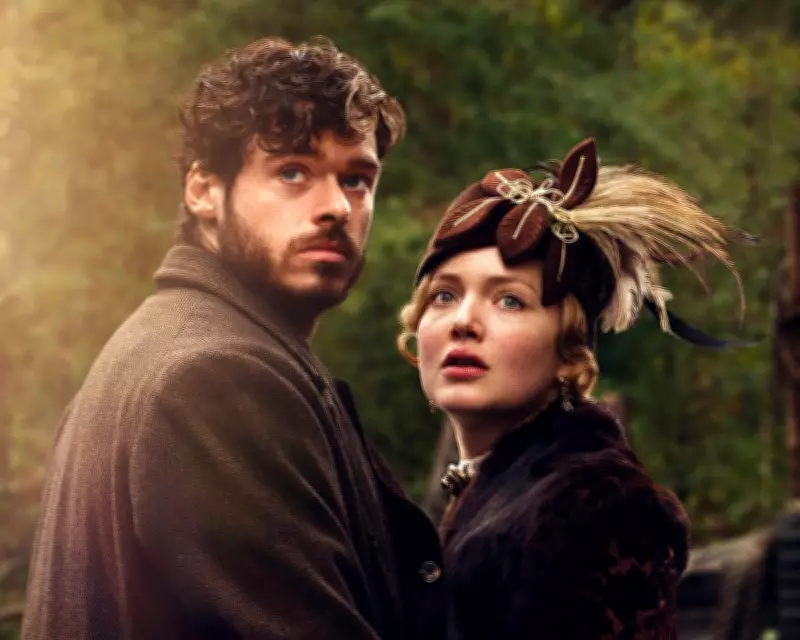
Richard Madden and Holliday Grainger in Lady Chatterley's Lover, 2015. Photograph: Josh Barratt/BBC Pictures/Hartswood Films.
The Comic Legacy of a Controversial Novel
D.H. Lawrence, not known for his humor, considered Lady Chatterley's Lover a serious novel about the sacred nature of sex. However, as Guy Cuthbertson demonstrates in his entertaining book 'Lady C: The Long, Sensational Life of Lady Chatterley's Lover,' the novel and its aftermath generated considerable laughter. From unintentionally funny scenes—like Connie and Mellors garlanding each other's naked bodies with flowers—to playful acknowledgments of carnal absurdity, the book's humor is undeniable. The fallout included customs seizures, high court antics, and countless skits and cartoons. Cuthbertson notes, 'It's not a comic novel as such, but one way or another, it created laughter.'
Cultural Permeation
The novel's influence extends far beyond literature. On a steam railway in Devon, a carriage named Lady Chatterley exists. Boots, blouses, thongs, earrings, pens, postcards, and saris bear her name. Endless jokey variations on the title abound: Lady Chatterley's Pullover, Lady Chatterley's Loofah, Lady Loverley's Chatter, and more. Allusions appear in lonely hearts ads, fancy dress parades, and even sex scandals involving figures like John Profumo and David Mellor, where jokes about moral decrepitude followed the unbanning of the book.
The Trial of 1960
The biggest sniggers came during the 1960 obscenity trial, Regina v Penguin Books. Prosecutor Mervyn Griffith-Jones famously asked, 'Is it a book that you would even wish your wife or your servants to read?' The defense called 35 witnesses, graded A to D by potential impact, including E.M. Forster, Rebecca West, and the Bishop of Woolwich. English lecturer Richard Hoggart was the star performer. The prosecution called no writers, though Evelyn Waugh and Enid Blyton favored the ban. The jury spent a pre-trial week reading the book in armchairs at the Old Bailey, with morning coffee provided. Despite the judge's inclination for a guilty verdict, they acquitted. On the first day of sales, 400 people queued outside Foyles in London. The paperback quickly sold 2 million copies.
Influence on Artists
Among those in the gallery was Sylvia Plath, who had bought an expurgated copy as a student and, after marrying Ted Hughes, confided to her diary that she was living 'with her own gamekeeper.' The novel left its mark on George Orwell's fiction and Stella Gibbons's Cold Comfort Farm. Philip Larkin thought it a 'grand' book, and he organized a special exhibition to celebrate its release. Entertainers were drawn to Lady C: Screaming Lord Sutch recited extracts on pirate radio; David Bowie named it a favorite and wore red trousers as Mellors recommended; Jimmy Edwards chose it on Desert Island Discs. The novel appeared in Mad Men, a Tom Lehrer song, and film versions featuring Joanna Lumley and Sylvia Kristel. Only Field and Stream found it deficient as a guide to gamekeeping.
Global Controversy
Despite its deeply English setting, the novel caused worldwide controversy. In the US, it was debated in the Senate. In Japan, translator Itō Sei was found guilty of obscenity. In Egypt, the wife of King Farouk kept a paperback copy by her bed. Readers hid it in plain brown covers or inside more wholesome books to avoid shame.
Modern Sensibilities
Today, what might offend readers is not the sexual candor or four-letter words, but Mellors's doom-laden, homophobic philosophizing and Connie's antisemitism. Lawrence's choice to put Clifford in a wheelchair to emphasize weakness has also caused upset. Cuthbertson, a diligent researcher, has trawled archives and even examined the trial judge's copy of the book, with its highlighted rude words. He underplays Kate Millett's attack on the novel's phallocentrism to keep things light. The result is an enjoyable social history, more saucy Ealing Studios comedy than earnest Leavisite sermonising.