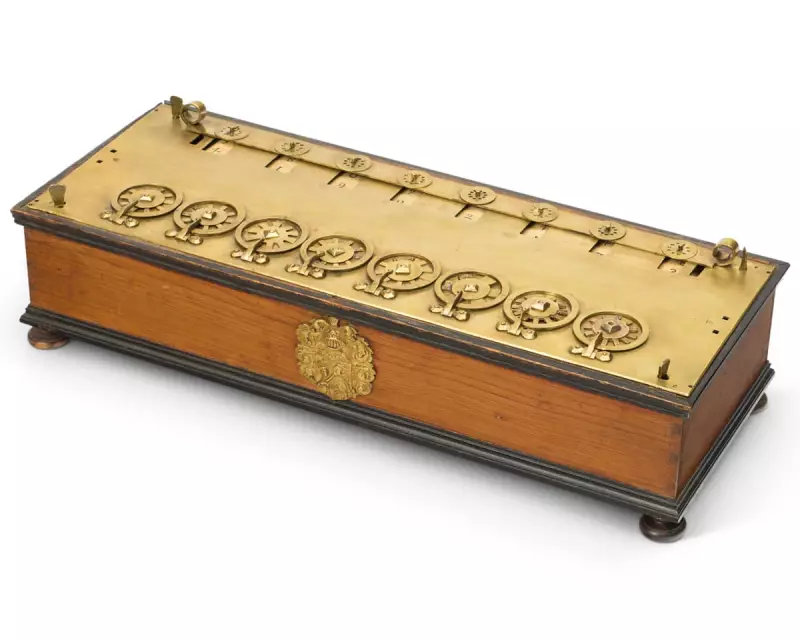
A rare 17th-century calculating machine that was expected to fetch over €2 million at auction has been dramatically withdrawn from sale after a French court blocked its potential export from the country.
Court halts historic calculator sale
La Pascaline, designed by renowned French mathematician and inventor Blaise Pascal in 1642 when he was just 19 years old, was provisionally suspended from Christie's auction following an urgent legal challenge. The Paris administrative court intervened late on Tuesday, preventing the issuance of an export certificate for what experts describe as "the most important scientific instrument ever offered at auction".
The court stated that given its exceptional historical and scientific significance, the device is likely to be classified as a "national treasure" under French cultural protection laws. This classification would permanently prohibit the instrument from leaving France, preserving it for the nation's scientific heritage.
Scientific community mounts defence
The court's decision came in response to an impassioned appeal from prominent French scientists and researchers, including 2021 Nobel physics laureate Giorgio Parisi. In a powerful op-ed published by Le Monde, the academic group argued that La Pascaline represents "the origin of modern computing" and called France "the cradle of the computing adventure".
The scientists condemned what they described as an "astounding blunder" by French authorities who initially granted Christie's export authorisation. They expressed dismay at what they perceived as governmental disinterest in the nation's scientific heritage, particularly given that 2023 marked the 400th anniversary of Pascal's birth.
Key arguments presented by the scientific community included:
- La Pascaline represents a revolutionary moment in technological history
- Each of the eight surviving machines has unique characteristics
- This particular example remains little-studied by researchers
- Public ownership would enable proper academic examination
Christie's complies with court order
In response to the legal ruling, Christie's announced the immediate suspension of the sale, which formed part of an auction of the library belonging to the late collector Léon Parcé. The auction house stated it was acting "in accordance with the instructions of our client" while awaiting the court's final decision, which could take several months to reach.
The instrument has been in private hands since 1942 and represents one of only eight authentic Pascalines known to exist worldwide. Christie's had previously described these machines as representing "the first attempt in history to substitute the work of a machine for that of the human mind".
Pascal's calculating revolution
Blaise Pascal developed his revolutionary calculating devices to assist his father, who was responsible for managing tax revenue collections in northern France. The young philosopher and mathematician sought to "mechanise mental calculation" through sophisticated geared mechanisms that could handle complex arithmetic.
Pascal created several models of his machine, each designed for specific purposes and using different measurement units. The example withdrawn from auction was configured for surveyors, calculating in traditional units including:
- Feet
- Inches
- Fathoms
This particular model demonstrates the versatility of Pascal's design, which could be adapted for decimal calculations, commercial transactions, or tax-related mathematics.
French cultural authorities under scrutiny
The French culture ministry defended its initial decision to grant an export certificate, explaining that standard procedures had been followed. Two independent experts - one from the National Centre of Arts and Crafts and another from the Louvre museum - had approved the export application back in May.
However, scientists argued that French institutions should have been given opportunity to mount a acquisition bid before export permission was granted. They noted that while five Pascalines already reside in French public collections (with two others in Germany), each machine possesses distinct features that merit individual study.
The controversy highlights ongoing tensions between private ownership of cultural artefacts and national heritage preservation, particularly for objects of exceptional scientific importance. The final court ruling, expected later this year, will determine whether La Pascaline joins other French national treasures in public collections or whether it might eventually return to the international art market.