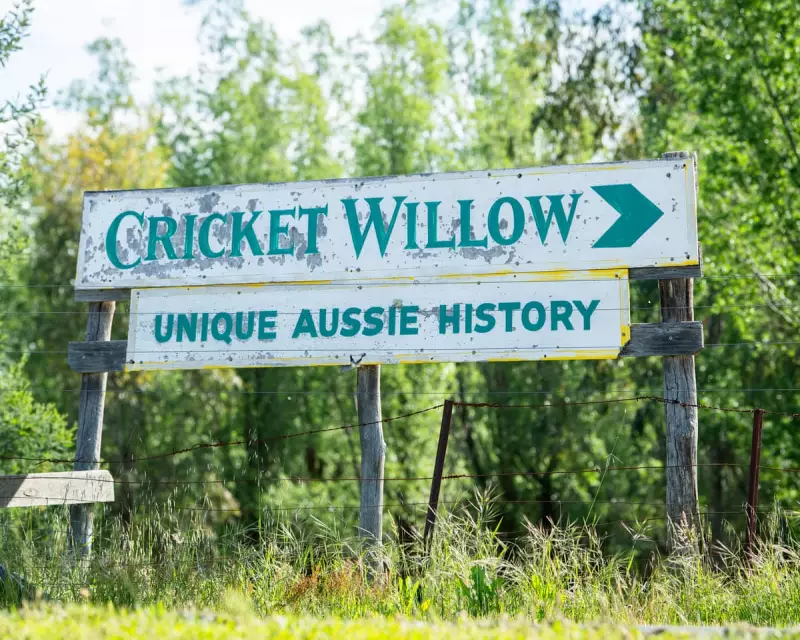
Nestled in the rolling hills of Shepherds Flat, Victoria's Central Highlands, lies Cricket Willow - a remarkable boutique oval and museum where Australia's rich cricket heritage comes alive. On a crisp November afternoon, Ian Tinetti watches the wind rustle through his English Willow grove as local teams Newstead and Hepburn prepare for battle on his self-made ground.
The Birth of Australian Bat Making
Cricket Willow's extraordinary origin story dates back to 1902, during an Ashes Test at the Melbourne Cricket Ground. Umpire Robert Crockett remarked to England captain Archie MacLaren that Australia lacked its own cultivated willow for bat production. This casual observation sparked a revolution in Australian cricket equipment.
Six months later, several Salix alba Caerulea cuttings arrived from England in a thermos flask. Only one survived the arduous sea journey, which Crockett promptly delivered to his brother James in Shepherds Flat. The single surviving cutting thrived on the family property, eventually growing into thousands of trees that still stand today on what's now known as the Tinetti land.
From Bradman to Modern Masters
When the original willow reached maturity, the Crockett family began crafting cricket bats that would make history. Seven members of Don Bradman's legendary 1948 Invincibles, who toured England without losing a single match, wielded bats made from Crockett willow.
The business flourished until Slazenger Dunlop acquired it in the 1960s. Soaring demand for quality willow nearly exhausted Shepherds Flat's resources until Aquilino Tinetti - Ian's father and a talented wicketkeeper-batter - stepped in to preserve the precious grove.
Ian Tinetti's connection to cricket willow followed him throughout his life - from engineering studies in Melbourne to service in the Vietnam War. "I was the only bloke there with a bat," he recalls with a smile.
A Field of Dreams Realised
The inspiration for Cricket Willow struck during a family movie night watching Kevin Costner in Field of Dreams. "It was our daughter Fiona who said, 'why don't you do something like him?'" Ian explains. "We started the next day."
Through sheer determination and family effort, they transformed a rocky slope into a velvet-like outfield, opening Cricket Willow in 1999 for Ian's 50th birthday. The main building replicates Shepherds Flat's historic general store, while the former milking shed became a bat-making workshop.
Today, visitors can witness the complete bat-making process - "from bud to bat" - thanks to modern "pod shavers" Lachlan Fisher and Julian Millichamp, who revived the traditional craft in Shepherds Flat.
Preserving Heritage for Future Generations
The Cricket Gallery showcases an eclectic collection celebrating the area's Swiss-Italian heritage, forestry history, and agricultural roots. The museum honours the 1850s migrants who found the landscape reminiscent of their Alpine homeland, with Mount Franklin providing a familiar backdrop.
Yet uncertainty looms over Cricket Willow's future. With the Tinetti children pursuing careers in Geelong and Bendigo, Ian contemplates what comes next. "Steve Waugh visited recently and we discussed the future," he reveals. "The dream is that someone might take it on, but I just don't know. It's the link to the past that's important - so much is lost when that's broken."
As Ian and his wife Trish prepare to travel to Perth for family commitments and to watch the Ashes, Cricket Willow stands as a testament to six generations of resilience, craftsmanship, and undying passion for cricket. For visitors like Bob Dawson, on his fourth visit, the experience remains unparalleled: "It's such a stunning setting with all the history - I really don't know whether there'd be anything else like it."