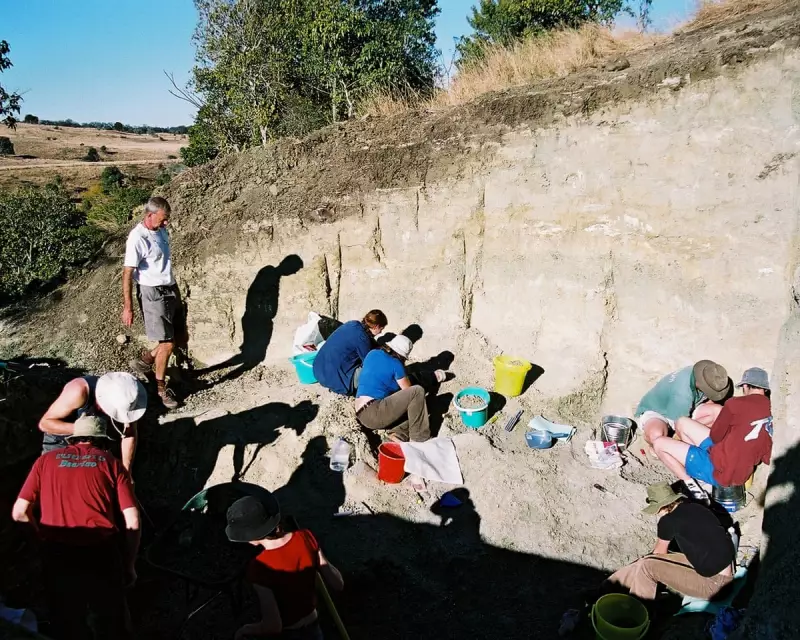
In a remarkable discovery that rewrites Australia's ancient history, scientists have confirmed the identification of the oldest crocodilian eggshells ever found on the continent. The 55-million-year-old fragments were unearthed in an unlikely location – a grazier's back yard in Murgon, Queensland.
The Murgon Fossil Deposit
The eggshells were collected throughout the 1990s at a fossil-rich site in Murgon, approximately 270km north-west of Brisbane, but only recently underwent detailed analysis. This delay between collection and examination has yielded an extraordinary payoff, revealing crucial information about Australia's prehistoric predators.
New research published in the Journal of Vertebrate Paleontology suggests these ancient eggshells likely belong to an extinct group of crocodiles known as mekosuchines. This finding is particularly significant because modern saltwater and freshwater crocodiles only arrived in Australia around 3.8 million years ago.
Australia's 'Weird Crocs'
Study co-author Professor Michael Archer, a palaeontologist at the University of New South Wales, emphasised the importance of these ancient creatures. "Before they got here, these weird mekosuchine crocs were all over the place," Archer stated.
Some mekosuchines developed extraordinary adaptations, including the ridge-headed crocodile, nicknamed the "drop croc" due to theories that it climbed trees and dropped onto unsuspecting prey passing below. "The idea of 'drop crocs' isn't as crazy as it sounds," Archer explained. "We probably did have crocodiles that were spending time in the trees and jumping out on prey."
The fossil eggshells found at Murgon are believed to belong to an earlier genus of mekosuchines known as Kambara. "We know we're looking at the oldest crocodile eggshells certainly in Australia," Archer confirmed. "The Kambara mekosuchines are the first ones we know of this whole group."
Scientific Analysis and Significance
The research focused on 12 fossil eggshells that were incidentally collected over several years in the 1990s. The recent analysis was led by Dr Xavier Panadès i Blas of the Miquel Crusafont Catalan Institute of Palaeontology in Barcelona.
Dr Panadès i Blas highlighted the importance of eggshells in palaeontological research. He noted that eggshells "preserve microstructural and geochemical signals that tell us not only what kinds of animals laid them, but also where they nested and how they bred." He advocated for eggshells to become "a routine, standard component of palaeontological research – collected, curated and analysed alongside bones and teeth."
Professor Archer pointed out that the structure of the mekosuchine eggshells "do not resemble any other crocodilian eggshells," indicating their association with a crocodile group unique to Australia. The relationship of these crocodiles to other global species remains mysterious. "All we do know is that when the salt and freshwater crocodiles did get into Australia... that was the beginning of the end for this particular group," Archer added.
Dr Matthew McCurry, a vertebrate palaeontologist at the Australian Museum who was not involved in the research, contextualised the discovery. He noted that mekosuchines were "representative of the fact that crocodiles in the past did a lot more than they do in modern ecosystems."
Dr McCurry elaborated on the diversity of ancient crocodiles: "If we go right back to the Cretaceous period, crocodiles did a huge range of different things: some were fully marine and had paddle-like limbs, some fed on plants exclusively." He also emphasised the rarity of such finds, noting that while bones and teeth fossilise relatively easily, and trackways are the second most common fossil type, eggs are comparatively more rare.
This groundbreaking study not only identifies Australia's oldest crocodile eggshells but also opens new windows into understanding the behaviour and evolution of these fascinating prehistoric creatures that once dominated the Australian landscape.