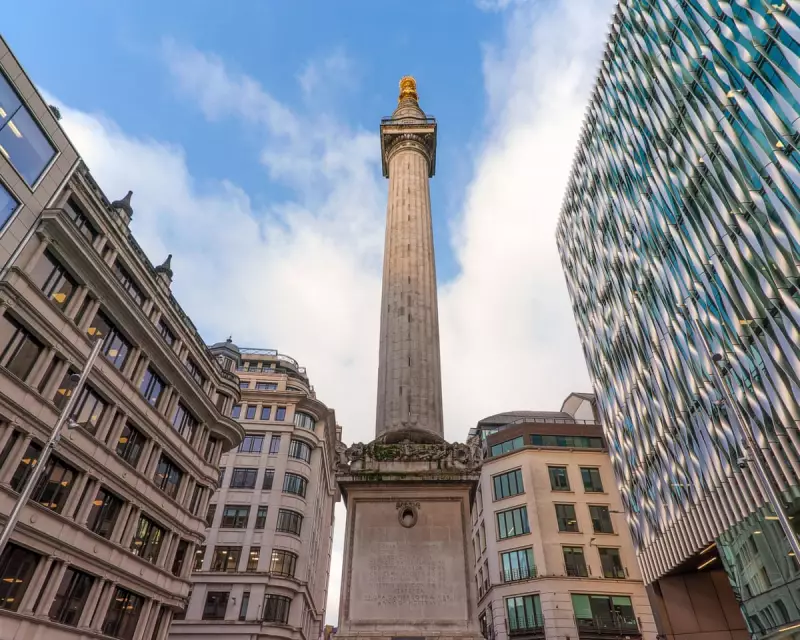
Standing tall in the City of London, The Monument column commemorates the Great Fire of London with more than just historical significance. Constructed from Portland stone, this iconic structure is teeming with Jurassic oyster shells and prehistoric shrimp burrows, offering a tangible connection to Earth's distant past right in the heart of the modern metropolis.
Urban Geology: London's Hidden Geological Treasures
How often do we consider the stones that form the backdrop to our daily urban lives? For Dr Ruth Siddall, a distinguished geologist and passionate advocate of urban geology, this question occupies her thoughts constantly. Her expertise reveals that London's architecture serves as an unwitting showcase of Earth science through the ages, with building materials sourced from across the globe telling stories that span billions of years.
A Walking Tour Through Geological Time
Joining Dr Siddall on one of her guided walking tours offers a remarkable perspective on the capital's built environment. "London is unique in that it has no local building stones of its own," she explains. "Situated in a basin of clay, every stone you see around us has been imported from elsewhere, creating a geological tapestry that spans continents and epochs."
Her enthusiasm for street-level geology began in Athens during the early 1990s, where post-PhD work cataloguing rocks from Greek ruins sparked a lifelong fascination. Drawing inspiration from her former colleague Eric Robinson, a pioneer of urban geology, she now sees her adopted home through completely new eyes.
Remarkable Discoveries Around Every Corner
During a typical two-hour tour, participants encounter sedimentary, igneous and metamorphic rocks from locations as diverse as Australia, Brazil and China. Each stone type was carefully selected by architects for its aesthetic qualities, but their geological stories remain largely unknown to the passing public.
Outside a travel agency, Dr Siddall identifies serpentinite, a Cretaceous stone from the Italian Alps. A pub pillar reveals itself as smooth 290-million-year-old larvikite from Norway, formed from magma that cooled kilometres beneath the Earth's surface. The pavement slabs beneath visitors' feet turn out to be York stone, a 310-million-year-old fine-grained sandstone from the Peak District that once formed a prehistoric riverbed.
Fossils in Plain Sight
Perhaps most astonishing are the fossils embedded within London's walls. On Plantation Lane in the Square Mile, between the windows of a tapas restaurant, a 150-million-year-old ammonite stares mutely at passersby. This limestone wall also contains remnants of ancient nautiloids and squid-like belemnites, creating what Dr Siddall describes as "a mineralised aquarium hiding in plain sight."
Near St Paul's Cathedral, the steps contain 30-centimetre-long fossilised orthocones, while the limestone exterior of a wine bar displays an even rarer find: a small vertebrate bone from 150 million years ago, possibly from a pterosaur. "We might never know exactly what creature it came from," Dr Siddall admits, "but that's part of the mystery and wonder."
Extraterrestrial Connections
One of the tour's most extraordinary stops reveals gneiss from a meteorite impact crater in South Africa, now forming the exterior of a co-working space on Houndsditch. Approximately 6,000 miles from its place of origin, the stone's surface still displays crack-like veins of black impact glass containing traces of the meteorite's extraterrestrial minerals. This remarkable material crashed to Earth a staggering two billion years ago.
The Great Fire's Geological Legacy
The Monument itself represents a pivotal moment in London's architectural and geological history. While the Romans first imported stone building blocks to London, it was the Great Fire of 1666 and subsequent reconstruction that accelerated the use of natural, hard-wearing materials throughout the capital. The Portland stone used in The Monument's construction perfectly illustrates this shift toward more durable architecture.
Making Geology Accessible
Around ten years ago, Dr Siddall partnered with fellow geologist Dave Wallis to establish London Pavement Geology, a website and app providing free comprehensive listings of geological interest sites around the capital and increasingly in other UK towns and cities. Her guided walks, offered through the longstanding tour company London Walks, run on a roughly monthly basis starting each spring.
"When you peer at something usually considered unremarkable, people do stare at you," Dr Siddall acknowledges with a smile. "But when you're hurdling geological epochs at every corner, who gives a schist?" Her tours attract curious looks but transform ordinary urban landscapes into extraordinary journeys through deep time, where patatas bravas meet prehistoric cephalopods and modern architecture reveals ancient Earth histories.