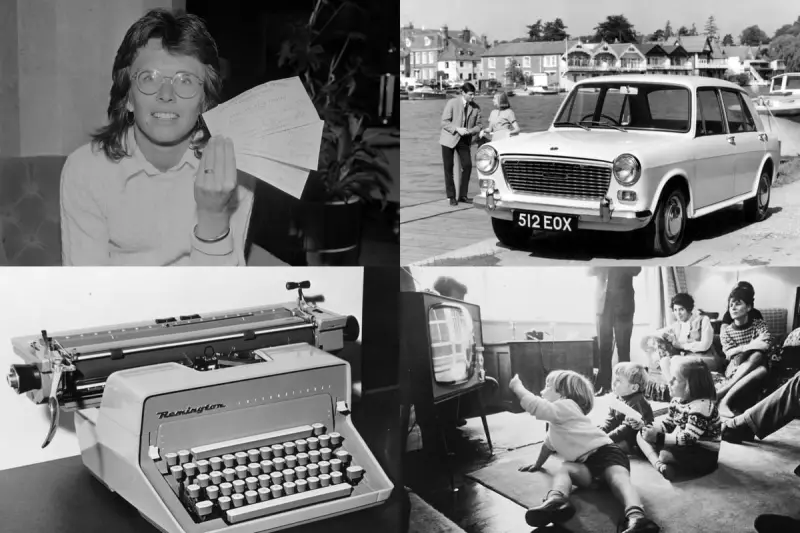
For those who grew up in the 1960s and 70s, daily life was soundtracked by the click of a typewriter and the whirr of a film being wound on. While modern technology is second nature to younger generations, many commonplace items from this vibrant era would leave them utterly perplexed.
The Lost Arts of the Living Room
Imagine a world where changing the television channel required physical effort. In the early days of TV, viewers had to manually tune their sets using a dial. Remote controls were a rarity throughout the 60s and 70s, meaning couch potatoes had to regularly leave the sofa. If the picture turned snowy, the solution was an awkward fiddle with the set-top antenna. This process was simplified, of course, by the fact there were only three channels before the 80s, and just two before BBC2 launched in 1964.
Family entertainment often involved a slide projector. Before social media feeds, the best way to showcase your holiday snaps was to invite neighbours over for a slideshow. While not overly complicated, there was a key trick: you had to remember to load the slides upside down for the image to project correctly onto the screen.
On The Road and In The Office
Starting a car on a cold morning was a hands-on procedure. Most vehicles featured a manual choke, a knob that needed to be pulled out to enrich the fuel mixture. Many people have fond memories of their parents pulling the choke out and using a clothes peg to hold it in place. Although vital for ignition, this handy lever also frequently served as an impromptu handbag hook.
Office life was dominated by the sound of the typewriter. The keyboard layout was familiar, but the machine demanded more from its operator. When a small bell dinged, you had to manually return the carriage to start a new line—a far cry from the automatic return on today's word processors.
Capturing Moments and Making Payments
Photography required patience and precision. With a typical 35mm film camera, every shot was precious. You only had 24 or 36 exposures per roll, with no option to delete and retry. After taking a photo, you had to remember to wind the film on manually. Once the roll was finished, it needed to be rewound before being carefully sent off for development. The wait to see your photos could take days, often filled with anxiety that your precious memories hadn't been mixed up at the lab.
Communication, too, was a slower affair. Although the push-button phone was introduced in 1963, rotary phones remained a common sight throughout the 70s. Dialling a number was a time-consuming process, especially if it contained multiple 9s, which required the dial to travel almost a full circle.
Financial transactions were heavily reliant on the humble cheque book. Before the dominance of credit cards and mobile banking, everyone carried a chequebook. For many younger people today, the only cheques they encounter are birthday or Christmas gifts from older relatives. While they may have cashed them, the process of correctly filling out a cheque—with the payee's name, the amount in words and numbers, and a signature—is a forgotten art.
These seven items are more than just relics; they are reminders of a tactile, patient era. They required a direct, physical interaction that has been largely replaced by seamless digital processes. For the generation that grew up with them, they are nostalgic treasures. For today's youth, they are fascinating puzzles from a bygone age.