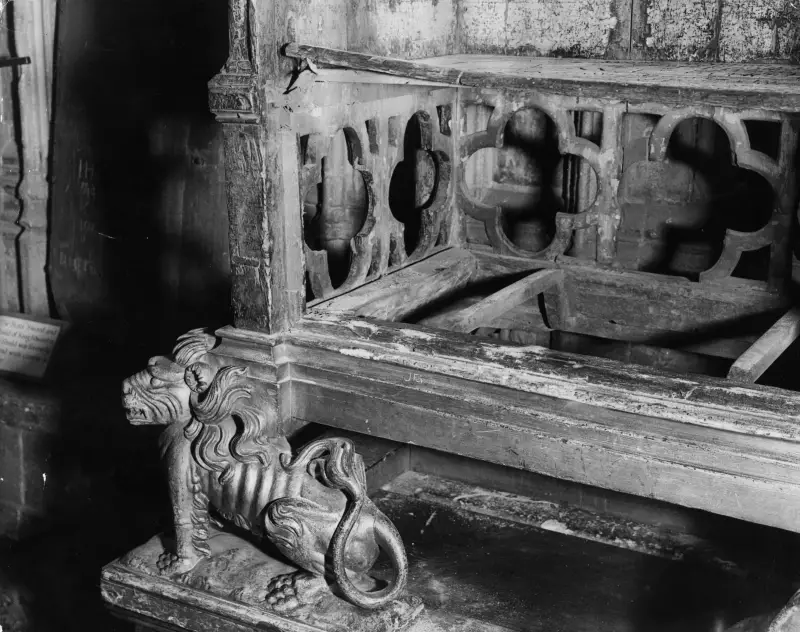
In the early hours of Christmas Day 1950, a group of young Scottish nationalists pulled off one of the most audacious symbolic thefts in British history. They broke into Westminster Abbey and stole the Stone of Destiny, also known as the Stone of Scone, the ancient coronation stone of Scottish kings. This act was a dramatic protest aimed at reigniting the cause of Scottish Home Rule.
A Nation and a Movement in Austerity
Britain in the winter of 1950-51 was a weary, battered place. The nation was still recovering from the immense toll of the Second World War. Clement Attlee’s Labour government clung to power by a thread after the February 1950 election, its senior ministers exhausted. The National Debt stood at a staggering 200 per cent of GDP, and hundreds of thousands of troops remained deployed globally, with 5,000 British personnel now embroiled in the Korean War.
Against this backdrop of national fatigue, the campaign for Scottish self-government found new energy. The Scottish Covenant Association, led by John MacCormick, advocated for a devolved Scottish parliament. MacCormick’s election as Rector of the University of Glasgow in October 1950 inspired one of his campaign managers, a 25-year-old law student named Ian Hamilton.
The Plot and the Christmas Eve Break-In
Hamilton conceived a bold plan to steal the Stone of Scone from Westminster Abbey, where it had been kept since 1296 after being seized by King Edward I as a trophy of war. The 336lb red sandstone block was embedded in the base of the Coronation Chair, a potent symbol of English sovereignty over Scotland.
With financial backing from Glasgow councillor and stonemason Robert Gray, Hamilton assembled a team. It included fellow student Gavin Vernon, domestic science student Kay Matheson, and civil engineering student Alan Stuart. On 23 December, they drove two Ford Anglias from Glasgow to London.
Their first attempt on Christmas Eve failed when Hamilton, hiding in the abbey, was discovered by a nightwatchman and sent away. Undeterred, the group returned in the early hours of Christmas Day. After observing the guards, they found a way in through a works yard near Poets’ Corner and reached St George’s Chapel.
A Comedy of Errors and a Broken Stone
The heist quickly took a farcical turn. After managing to pry the heavy Stone from beneath the Coronation Chair, the students promptly dropped it, causing it to break into two pieces. What followed was a scene reminiscent of an Ealing comedy.
Matheson took the smaller fragment and drove to a friend in the Midlands before returning to Scotland by train. Hamilton and Stuart, with the larger piece causing their car’s springs to sag visibly, drove to Kent, hid the stone in a field, and then travelled home separately.
The theft was discovered later on Christmas Day. The authorities’ response was immediate and unprecedented: the border between England and Scotland was closed for the first time in 400 years. Yet, the Stone remained hidden in that Kentish field.
Recovery, Repair, and Royal Anxiety
In early 1951, Hamilton and associates retrieved both parts of the Stone and brought them to Glasgow, where Robert Gray expertly repaired it. Intriguingly, he placed a brass rod containing a secret message inside the stone during the repair. The contents of that note remain unknown to this day.
The reaction in establishment circles was severe. King George VI was outraged. With the King in poor health—he would undergo lung surgery in 1951—courtiers feared his potential death and a coronation for the new Queen, Elizabeth, without the sacred stone.
Under mounting pressure, the group decided to return the Stone. In April 1951, they left it on the high altar of Arbroath Abbey, the site of the 1320 Declaration of Arbroath which asserted Scotland’s independence, and informed the police. It was returned to Westminster Abbey in February 1952, shortly after King George VI’s funeral.
Aftermath and a Legacy of Symbolism
All four students were interviewed by police, and all except Hamilton admitted their involvement. However, the Attorney General, Sir Hartley Shawcross, announced in the House of Commons that no criminal proceedings would be brought, dismissing the act as "vulgar vandalism" but not in the public interest to prosecute.
The stunt provided a fleeting morale boost for the then-beleaguered Scottish National Party, which had won fewer than 10,000 votes in the 1950 election. It did not translate into immediate political success, but Hamilton and his comrades became folk heroes in nationalist circles.
The Stone’s story had a final chapter in 1996. With the SNP’s political strength growing, Conservative Scottish Secretary Michael Forsyth arranged for the Stone’s permanent return to Scotland. It was displayed in Edinburgh Castle until 2024, when it was moved to its new home at Perth Museum. Forsyth’s gesture, however, did not save his seat; he and every other Scottish Conservative MP lost in the 1997 election.
The 1950 heist remains a captivating tale of youthful idealism, symbolic protest, and historical resonance, a unique footnote in the long and complex story of the British Isles.