Tea Renaissance in Georgia
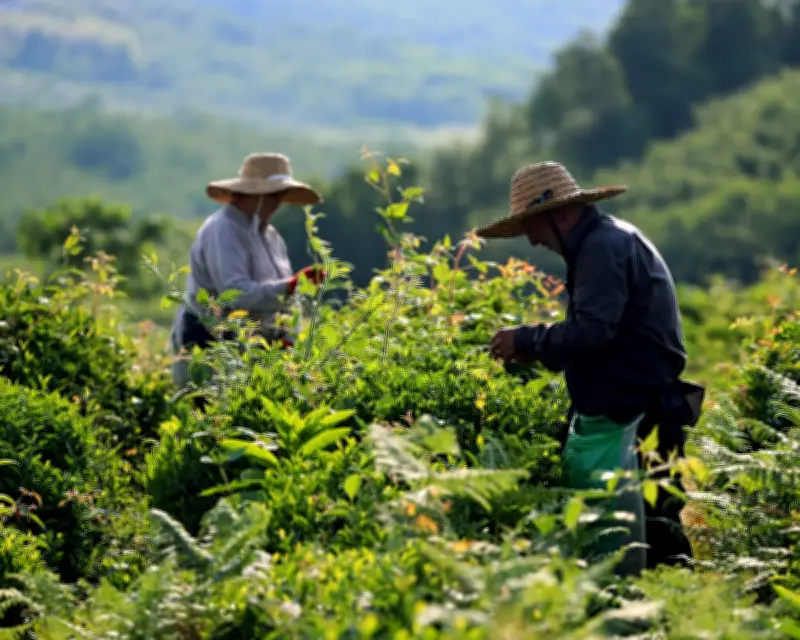
Rainclouds shroud the Caucasus mountains as the day's harvest begins on a rural estate in western Georgia. A tea picker moves quickly between bushes, plucking only the greenest, most recent growth. When Pati began picking tea leaves as a teenager, this was a Soviet collective farm. After the collapse, it was abandoned until new growers cleared the forest in the 2010s.
Today, those leaves are in high demand. Luxury tea importers across Europe and the US have discovered what the Soviets knew: Georgia's humid Black Sea air and cold Caucasus winters make it ideal for tea, now with a focus on quality over volume.
Quality Over Quantity
"These plants are obviously very happy where they are because it just tastes incredible," said Ana Dane of New York-based In Pursuit of Tea, a supplier to Michelin three-star restaurant Eleven Madison Park. "They were just exquisitely-produced teas," she said, describing her first taste from Renegade Tea Estate in Georgia's Imereti region.

Georgia's subtropical coast makes it one of the northernmost places where tea grows. Cold mountain winters force bushes into seven-month dormancy, boosting polyphenol content and producing a sweeter leaf. Winters also kill pests, allowing organic standards.
EU Support and Political Hurdles
The EU poured money into Georgia's tea industry to revitalise the economy, but that stalled when the Kremlin-leaning Georgian Dream party withdrew from accession talks. Despite this, Georgian growers are making significant inroads.
Tea may have arrived via the Silk Road, but the first recorded cultivation was in the early 1800s, when a Georgian prince planted bushes near Ozurgeti. The Russian Empire later looked to Georgia for a steady supply, and Soviet collectivisation made the Guria region the USSR's production centre. By the 1980s, Georgia was the fifth-largest tea producer in the world.
Memories of the Soviet Era
Lika Megreladze, who grew up in the 1970s, recalls visiting her mother at the Institute of Tea and Subtropical Cultures. "All big empires, they really want to have their own tea," she says. "The Russian Empire really wanted to have their own tea." She remembers international students from Vietnam, Sri Lanka, and Yemen and collects Soviet-era magazines featuring tea pickers.
When the Soviet Union collapsed, so did Georgia's tea industry. The revival was spurred by Shota Bitadze, a young engineer in Tbilisi who imported Chinese herbs during a medicine shortage and then turned to tea.
Revival Efforts
"We had situations where people had tea bushes in their garden, but they didn't know how to make tea with their hands," said Giorgi Bitadze, Shota's son. In 2006, the Bitadzes founded the Georgian Organic Tea Producers Association with 16 other families and opened the Bitadze Tea Museum in Tbilisi.
From 800 hectares of active tea production in 2014, the number rose to 1,900 hectares in 2019, supported by a government programme financing up to 70%-90% of costs to rehabilitate abandoned Soviet-era plantations.
Breaking into Western Markets
While tea drinkers in Ukraine, Poland, and Belarus have purchased tea through the association, "getting past the Iron Curtain is a struggle," said Timothy Merkel, an American tour guide who created the Georgian Tea Makers website and previously ran a company aiming to sell Georgian tea in the UK.
Nevertheless, many growers are succeeding. In Paris, Palais des Thés has increased orders from Georgia 12-fold since 2019. In New York, Royal Cathay and In Pursuit of Tea stock Georgian leaves.
"The first step was not to export to Russia," said Nika Sioridze, co-founder of GreenGold. "It's not a stable market." Sioridze and Baka Babunashvili cleared 25 hectares of former plantations, renovated a Soviet-era silk factory, began fermenting tea in clay qvevri, and opened a tasting room in Tbilisi.
Through experimentation, they developed new teas. While drying leaves for green tea, Sioridze saw smoke and feared he had burnt them. "And then we realised that we have not burnt the tea, we have roasted it," he said, speaking of the Phoenix tea. "I'm burning it and it's alive again, a new life."