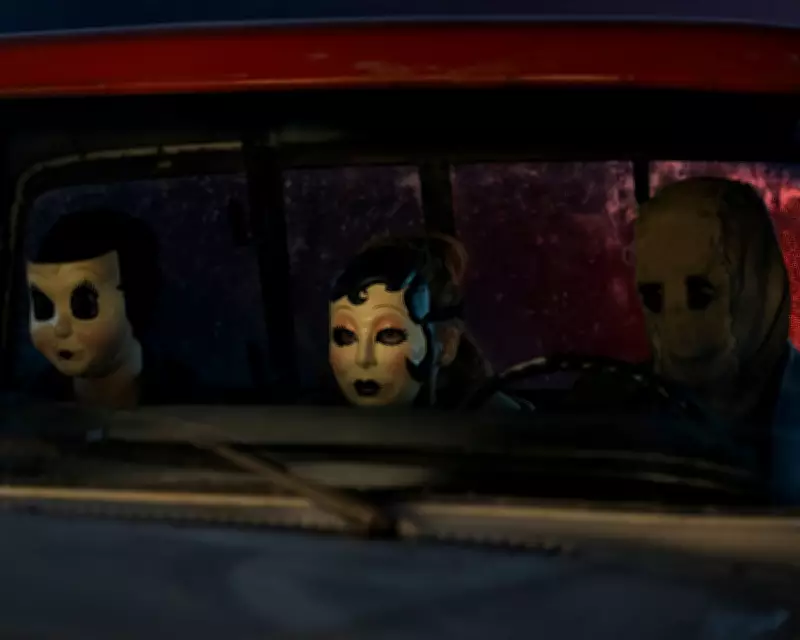
The Strangers: Chapter 3 marks the final instalment in Renny Harlin's horror trilogy, a series that has struggled to justify its existence from the outset. Shot back-to-back in Bratislava during late 2022, with subsequent reshoots following the lukewarm reception to the first chapter, this concluding film arrives as a dutiful but uninspired piece of cinema that fails to recapture the chilling simplicity of the 2008 original.
A Trilogy Built on Shaky Foundations
The fundamental issue with this trilogy lies in its decision to expand what was originally a self-contained, morally ambiguous narrative into a sprawling three-part saga. What began as a taut home invasion thriller has been stretched thin across multiple films, with The Strangers: Chapter 3 suffering most from this overextension. The more light that director Renny Harlin and his collaborators shed on this universe, the more generic and conventional it becomes, losing the unsettling ambiguity that made the first film memorable.
Characters Lost in the Woods
The film continues the story of Maya, portrayed by Riverdale alumna Madelaine Petsch, who finds herself navigating a devout woodland community while being pursued by masked assailants. These killers, previously numbering three but now reduced to two, have developed ulterior motives that are gradually revealed throughout the narrative. Supporting characters include the tattooed survivor Gregory, played by Gabriel Basso, and the perpetually suspicious Sheriff Rotter, brought to life by Richard Brake, whose connection to the murderous events finally becomes clear.

New blood arrives in the form of Maya's sister Debbie, portrayed by Hollyoaks veteran and recent Oscar-winning short filmmaker Rachel Shenton, who arrives seeking answers only to become embroiled in another cycle of predictable stalk-and-slash sequences. Despite this expanded cast, the character development remains superficial, with many performers seemingly hoping for more substantial material than the script provides.
Missed Opportunities and Antiquated Pacing
Somewhere beneath the surface lies a potentially compelling exploration of community complicity – the unnerving notion of an all-American society that tolerates violence as long as it's directed at outsiders. Unfortunately, this thematic thread is handled with characteristic heavy-handedness, tied up in workmanlike fashion that fails to generate genuine tension or social commentary.
The film's pacing feels particularly dated, reminiscent of horror conventions that would have seemed antiquated even during Wes Craven's Scream era. Extended sequences of pregnant pauses and drawn-out suspense fail to mask the fundamental problem: there simply wasn't enough substantive plot to sustain an entire trilogy. Approximately thirty minutes of the runtime feel particularly padded, reinforcing the suspicion that this story was artificially extended beyond its natural limits.
Final Verdict on a Forgettable Conclusion
While the 2008 original endures as a solid example of American ordeal cinema – perfect for sleepover viewing with its contained terror and moral ambiguity – this concluding chapter, like its immediate predecessors, occupies an unfortunate space between historical footnote and outright cinematic detritus. It drifts through the cinematic landscape with all the impact of a plastic bag caught in a stiff breeze, leaving minimal impression beyond relief that the trilogy has finally reached its conclusion.
The Strangers: Chapter 3 represents the culmination of a creative misstep – taking a simple, effective premise and stretching it beyond recognition without adding meaningful depth or innovation. For horror enthusiasts, it serves as a cautionary tale about the dangers of unnecessary franchise expansion in an era witnessing a genuine horror renaissance elsewhere in the genre.