The Descent, the 2005 cave horror classic, was born from a train journey and a childhood memory of unfathomable darkness. Director Neil Marshall, fresh from the success of Dog Soldiers, pitched a zombie-on-an-oil-rig film to Celador Films, but was told it was too expensive. On the train back to Newcastle, he asked himself what would make a truly scary, contained horror film. The answer: caves.
From Lead Mine to Screen: The Genesis of The Descent
Marshall drew on a school trip to a lead mine where the guide instructed everyone to turn off their lights. He experienced a darkness he couldn't fathom, which became the film's visual and emotional core. The director wanted realism: in caving, the only light is what you carry. This meant large portions of the screen were in total darkness, with characters illuminating scenes only when they turned and shone a light. Darkness was his friend, but it required meticulous planning.
Each character had a lighting source, from a torch to a box of matches. Director of photography Sam McCurdy and Marshall discussed potential lighting sources, structuring the film around who had which light at which time. This gave a lighting scheme: fire with Sarah, torch with Juno. The film contains no real caves. It was a mix of sets by Simon Bowles, matte paintings, and a miniature set by Leigh Took. The waterfall was not water but salt.

Designing the Crawlers: Nosferatu Meets Iggy Pop
Marshall wanted the crawlers to look basic, without too many lines or details. The challenge was making them scary yet human, as they represent cavemen who stayed in the dark rather than those who left to build cabins. Visually, they were a hybrid of Nosferatu and Iggy Pop. Movement-wise, they were like spiders: perfectly still, then suddenly moving at 100 miles an hour, then stopping again. Marshall conceptualised the film as Sarah's descent into being a primal savage, undergoing a rebirth to survive, though uncertain if she could return to society.
Shauna Macdonald, who played Sarah, initially expected a film full of sexy, blood-covered women, given the era of FHM and Loaded. But the script was excellent, focusing on a grieving mother who needed to be physically strong and brave. She felt compelled to take the part, unsure if she could pull it off.
Filming with Real Fear: The Actors' Experience
The actors were not allowed to see the crawlers or any pictures of them. Macdonald was the first to see one, as filming was chronological once they entered the caves. The others asked what it looked like, but she only saw it from a distance, noting it was grey or white, slimy, and resembled Gollum. Marshall kept them apart, which heightened the fear. When faced with the crawlers, Macdonald was leapt at by a really scary man, basically naked, who had trained for months. The actors found the crawlers' animalistic nature unnerving, feeling like they were fighting a pack with its own dynamics.
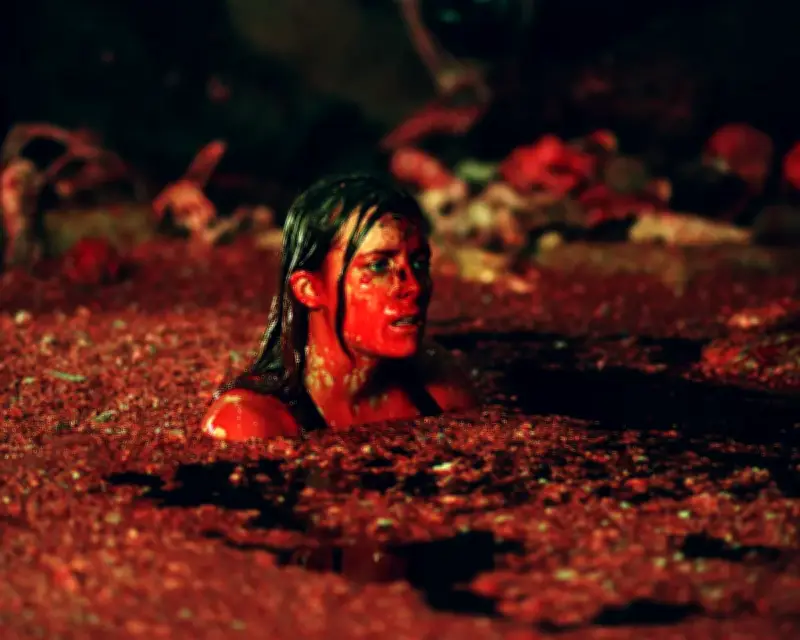
The sequence where Sarah enters survival mode was intense. Macdonald had a dying scene with Alex Reid, who played Beth, making it look easy despite having an ice pick through her neck. Then Macdonald caves Beth's head in with a stone. She gets leapt on by a child crawler, who was only 11, and crushes his head with her boot—actually stamping on a cauliflower. The mother fight sequence follows, where one mother kills another to survive. Macdonald described the eye-gouging as very, very satisfying. Another crawler is bashed in the head. Finally, she emerges from a pool of blood, which was an overflowed Jacuzzi. A stunt girl did the run and jump because the pool was too shallow to insure an actor. Macdonald just emerged and took the glory.
Legacy and Bond: Girl Power and Lasting Friendship
The press focused on "girl power," but the actors pointed out the violence they inflicted on each other. Macdonald noted that the real girl power was how fiercely they supported each other, continuing to do so for over 21 years. They have a WhatsApp group and meet regularly. She wonders if the bond was due to the film or the shared experience of being thrown into a cave, suggesting that such an experience bonds people for life. The Descent is now available on 4K UHD.