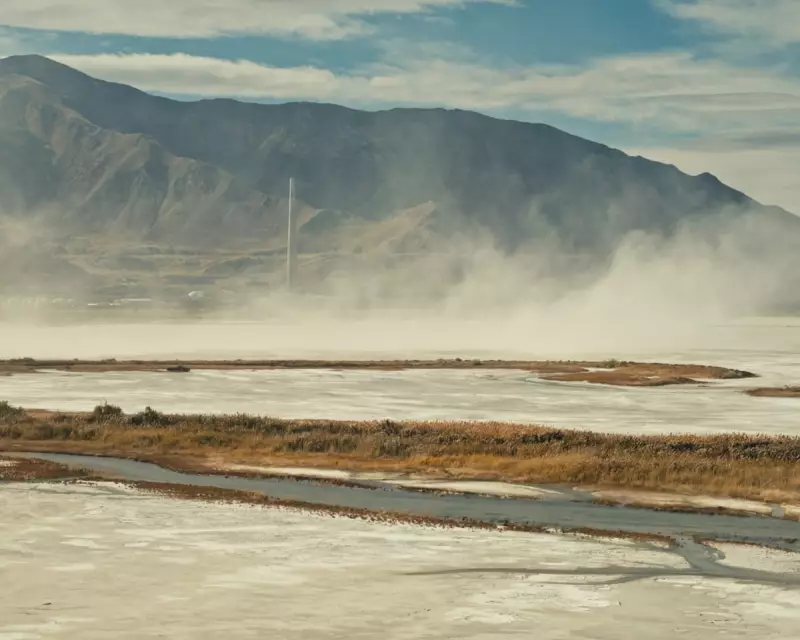
The Sundance Film Festival, which commenced its final edition in Park City, Utah, on 22 January, has long been a beacon for independent cinema. However, this year's event is marked by a sobering new documentary that shifts focus from entertainment to an urgent environmental warning. Titled The Lake, directed by Abby Ellis, the film delves into the catastrophic decline of the Great Salt Lake, an issue described as an "environmental nuclear bomb" poised to devastate the region.
A Looming Ecological Disaster
Scientists featured in the documentary reveal that the Great Salt Lake, the largest saline lake in the western hemisphere, is on the brink of vanishing entirely within a few years. This potential disappearance threatens the health of over 2.8 million residents in Utah, exposing them to toxic dust clouds laden with mercury, arsenic, and selenium from the dried-up lakebed. The air quality in Salt Lake City, already worse than Los Angeles, could deteriorate further, leading to severe respiratory and cancer-related issues.
Historical Context and Current Crisis
Often referred to as "America's Dead Sea," though four times larger than its Middle Eastern counterpart, the Great Salt Lake has lost 73% of its water and 60% of its surface area due to excessive water diversion for agriculture and other uses. In 2022, it hit a record low, with its surface area now under 1,000 square miles, down from three times that in the 1980s. This decline not only endangers public health but also threatens birdlife, recreational activities, and the local economy, including lucrative mineral extraction and ski resorts in nearby mountains like Park City.

Scientific Warnings and Comparisons
Ecologist Ben Abbott from Brigham Young University, a key voice in the film, emphasizes the urgency, stating, "I don't think people realize how close to the edge we are." Three years ago, Abbott and over 30 other scientists co-authored a report predicting the lake's disappearance within five years without major intervention. The documentary draws ominous parallels to other ecological disasters, such as California's Owens Lake, Iran's Lake Urmia, and the Aral Sea, all of which suffered irreversible damage from similar water mismanagement.
Governance and Advocacy Challenges
The Lake explores the complex political and social dynamics in Utah, a state with a Mormon-majority population. While scientists like Abbott advocate for a radical overhaul of water use, which diverts over 80% of the lake's inflow to agriculture, state officials like Great Salt Lake Commissioner Brian Steed pursue a more moderate approach. Steed seeks compromise with farmers, who depend on water in this arid region, but as Abbott warns, "winning slowly is losing" in the face of such a dire crisis.
Hopeful Initiatives and Future Prospects
Despite the challenges, the documentary highlights recent efforts to save the lake. In September, Governor Spencer Cox convened a roundtable that prioritized restoration and dedicated $200 million in philanthropic funds. A new charter aims to reach healthier lake levels by 2034, coinciding with Salt Lake City hosting the Winter Olympics. With Leonardo DiCaprio joining as an executive producer, the film maintains a hopeful outlook, suggesting that saving the Great Salt Lake is not an impossible task if action is taken swiftly.
The Lake is currently screening at the Sundance Film Festival and is seeking wider distribution, aiming to raise global awareness about this critical environmental issue.