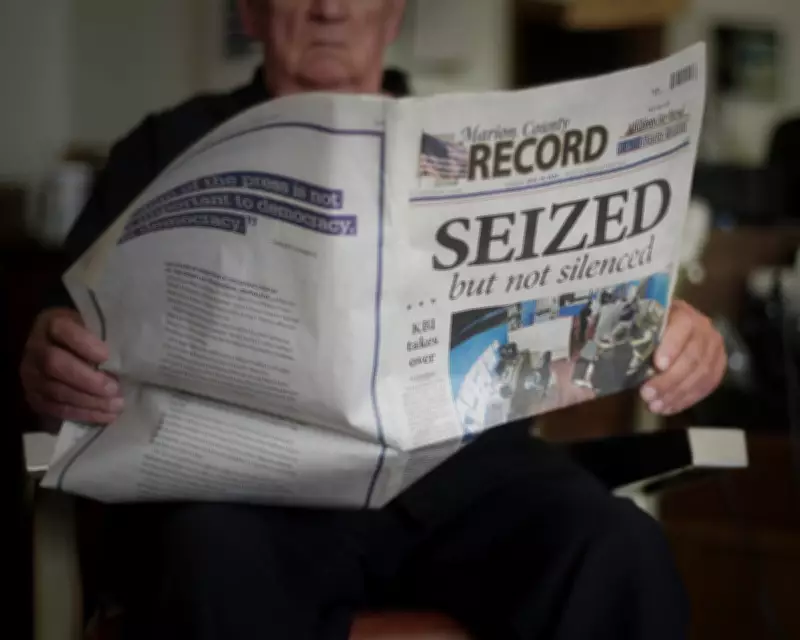
Seized Review: A Captivating Documentary That Goes Inside a Shocking Newspaper Raid
The Sundance Film Festival presents a powerful documentary that expands the story of the Marion County Record and the forces that tried to destroy it. This film offers a charming yet deeply concerning look at freedom of the press in contemporary America, providing unprecedented access to a story that captured international attention.
The Raid That Shook a Small Town
On 11 August 2023, police officers executed a search warrant on the offices of the Marion County Record, a small family-owned newspaper in central Kansas. Local law enforcement seized computers, cell phones, and reporting materials from all staff members, as well as from the homes of one city council member and paper co-owner Eric Meyer. The operation proceeded without incident until officers encountered the impassioned resistance of Meyer's 98-year-old mother Joan, the paper's other co-owner, who threw her walker to the ground and declared the raid "Nazi stuff."
"This is illegal," Eric Meyer warned the officers during the confrontation, as captured in the documentary. "You're going to be on national news tonight." His prediction proved accurate. Though Marion is a rural town of approximately 1,900 residents located about 60 miles north of Wichita, the raid quickly became international news. It emerged as a potent symbol of press freedom under attack in a country where political leaders have routinely declared media to be "the enemy of the people."

Tragic Consequences and Complex Realities
In national press coverage, the story was quick, troubling, and ultimately tragic. It was revealed that Joan Meyer, described as "stressed beyond her limits" by the raid, died of a heart attack the following day. However, in Marion itself, the story unfolded with the complexity, idiosyncrasy, and gossipy nature typical of small-town dynamics. Personal histories and long-standing resentments became refracted under the national spotlight, creating a multifaceted narrative that defied simple explanation.
Directed by Sharon Liese, Seized accomplishes the difficult task of bridging these two perspectives without jarring the viewer. The documentary allows local characters to complicate the story while never losing sight of its broader significance. Filmed in and around Marion beginning a year after the incident, this clear-eyed documentary mercifully rejects the common impulse among large media outlets to flatten a local saga into a tidy and politically expedient narrative.
Colorful Characters and Contradictory Perspectives
The documentary's subjects, presented in a brisk 94 minutes, are as colorful as any fictional movie characters. They are given room to demonstrate the contradictions that serve, as one resident describes it, as a "microcosm of America." Liese demonstrates sharp insight into how political ideologies warp under close inspection and personal stakes. Some residents respect the paper's willingness to criticize town leaders, while others wish it would stop printing embarrassing police records of every single arrest. Some view Meyer, a proud and stubborn man, as a bully. A majority seem mostly upset that he cited children's letters to Santa, an annual newspaper tradition, as evidence of the education gap following the Covid-19 pandemic.
The Bizarre Chain of Events Leading to the Raid
Beyond fascinating vox pop surveys, Seized offers the most thorough explanation yet of what led to the raid, which proves equal parts sinister and amusingly petty. In simplified terms, the paper received a tip from a restaurateur's ex-best friend that she was driving without a license. The woman in question then accused the paper of identity theft. She was allegedly involved with the police chief, who initiated the raid. The former mayor became involved, and a judge somehow signed off on the search warrant. While this chain of events appears quintessentially small-town, Liese makes clear through interviews with several Kansas metro reporters that none of these circumstances should ever have merited a search warrant.

The Newspaper's Struggle to Continue
In the current timeline, Meyer's paper strives to continue operations with just one veteran reporter, Phyllis Zorn, who emerges as a delectably tart old-timer. The staff also includes office manager Cheri Bentz and cub reporter Finn Hartnett, loaned from New York. Hartnett, a soft-spoken and endearingly affectless twenty-something openly desperate for any job, serves as the outsider's view into both the idiosyncrasies of Marion County and the work of hyper-local reporting in 2025. His crash course in old-school newspaper work—how to use a landline, why to make calls—makes for some of the film's most enjoyable scenes, alongside tributes to the hilariously feisty Joan Meyer, a longtime steward of the town's memory.
Nuanced Tensions and Unanswered Questions
At times, viewers might wish the film would dig deeper, particularly as it establishes understandable, nuanced tension between Meyer, a stalwart who views journalism as a "calling" worthy of poor pay and negative reactions, and Hartnett, a social media native more wary of backlash and concerned with the paper's local reputation. This tension becomes particularly apparent when Meyer receives national awards for press freedom while simultaneously seeking $10 million in civil suits against the county—far more than insurance coverage would provide.
Yet who can blame him when press freedom remains so gallingly tenuous in the United States? Just days before the film's Sundance premiere, the FBI raided the home of a Washington Post reporter, whose newspaper is owned by billionaire Trump ally Jeff Bezos. These names remain, somewhat frustratingly, outside the film's scope. While viewers can probably guess political affiliations, there is no direct mention of the attention black hole in charge of national politics.
A Defense of Press Freedom Through Specificity
Though questions remain about how idiosyncratic personal politics translate upward, this focus probably serves the documentary best. Seized ultimately stands as a defense of the press through precise specificity on the smallest scale. "This is not a particularly corrupt town," Hartnett notes on his final day of work. "I think that, to an extent, people just aren't used to having a local newspaper these days." How sad, and how commendable, then, that the Marion County Record soldiers on against all odds.
Seized is currently screening at the Sundance Film Festival and is actively seeking distribution, offering audiences a crucial examination of press freedom, community journalism, and the complex realities of small-town America.