Saipan: The Roy Keane Film Redefining Football Cinema
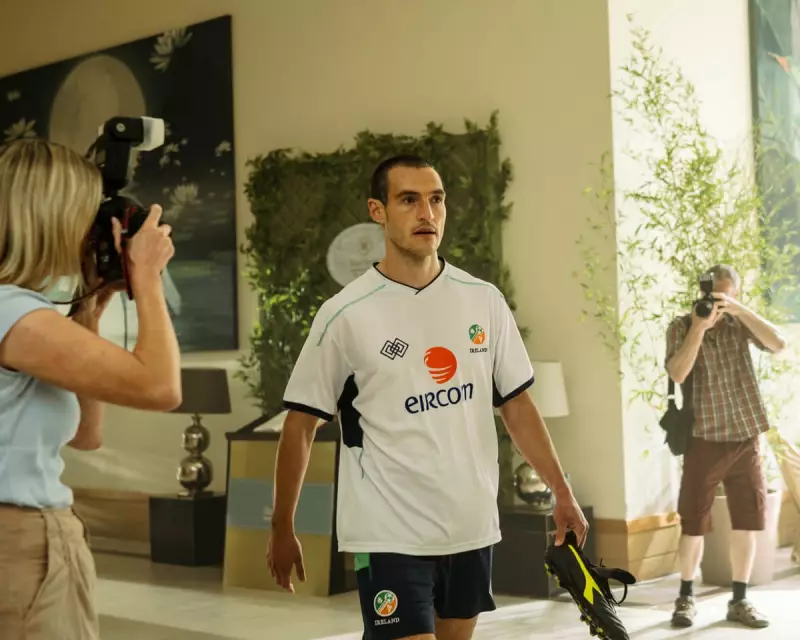
The forthcoming movie Saipan, which dramatises the infamous 2002 World Cup schism between Irish football manager Mick McCarthy and captain Roy Keane, has become a surprise hit in its native Ireland and is now opening in UK cinemas. Rather than attempting to recreate match action, this film represents a new wave of football cinema that prioritises human drama and psychological tension over sporting spectacle.
A Different Kind of Football Film
The most compelling football moment in Saipan occurs not on a pitch but on a tennis court. In a telling scene, Éanna Hardwicke as Roy Keane demonstrates his technical prowess by killing a ball dead with his instep, establishing his sporting credentials without needing to show actual match footage. The film primarily unfolds within the confines of a decrepit hotel, focusing instead on the clash of personalities and egos that led to Keane's dramatic departure from the tournament before it began.
Screenwriter Paul Fraser explains his approach: "Ninety minutes is what we get in a game, give or take. Films are also 90 minutes. And the experience of the two things are fundamentally different. I don't think I've really felt some of the emotions that I feel at a game of football in a film. The emotion that you get from going to a game is insane - sometimes I think I'm going to have a heart attack. That just doesn't really transfer over too well."

Learning from Football Film History
Fraser brings particular insight to this project, having previously collaborated with Shane Meadows on an abortive football film that eventually transformed into the boxing drama TwentyFourSeven. Their initial attempt to capture grassroots football proved challenging, with Fraser noting: "We felt that football, for some reason, didn't lend itself too well, visually, to cinema. Escape to Victory is a brilliant film, but there's something about the football sequences in there that feels a bit flat."
This realisation informed his approach to Saipan, which consciously avoids what Fraser calls "the most boring, generalised kind of narrative" of last-minute winners and predictable sporting tropes. Instead, he focuses on the human dimension, believing stories about figures like Keane, McCarthy, or Paul Gascoigne offer richer material when filmmakers "focus in on people" rather than match action.
The Evolution of Football on Screen
Stephen Glynn, a film lecturer at De Montfort University and author of The British Football Film, identifies significant shifts in how football has been portrayed on screen. "Certainly before the second world war, professional football was really not seen by studio executives as appropriate for a cultural product," he notes. "When you reach the 60s you start to get the pop star footballers like George Best, but really it's more in the last 30 years since people like Nick Hornby kickstarted a more middle-class interest in football that the interest in making movies has grown too."
Despite this increased interest, the 21st century has produced numerous football film failures, from Mike Bassett: England Manager to the Goal! trilogy and the FIFA-funded United Passions. Glynn identifies a fundamental problem: "Most footballers can't act. You know, hello, David Beckham in Goal! So any film with a claim to realism sort of falls down when it tries to do the match action. Fans know it's fake because we expect full framing from football."
Navigating Fact and Fiction
Saipan has generated both critical acclaim and controversy in Ireland, with some pundits and former players questioning its historical accuracy. Former international Kevin Kilbane wrote scathingly about perceived liberties taken with events, particularly regarding drinking culture within the Irish camp.
Fraser addresses these concerns directly: "I didn't speak to any player or any actual person who was there, so it's a story. It's a made-up story. What did Mark Twain say? Don't let truth get in the way of a good story. I think one of the players said something like five stars for the film, but no stars for the accuracy. And I think that would have been something that would start to bog me down."

The screenwriter deliberately maintained distance from actual participants, believing this allowed greater creative freedom to explore universal themes of masculinity, national identity during Ireland's Celtic Tiger era, and the pressure of living under a global spotlight. "When the producers brought me the idea, I think they wanted someone who was slightly detached," Fraser explains. "This has been described as being the most important unimportant event in Irish history. For me, I just remember that moment when Keane was walking the dog in the country lane after coming home and that was my sort of in."
A New Direction for Sports Cinema
Saipan represents a significant departure from traditional sports films, joining a growing trend that includes compelling football documentaries like Zidane: A 21st Century Portrait and Diego Maradona. These works succeed by capturing personality and psychology rather than attempting to replicate match action that inevitably appears artificial on screen.
The film's success in Ireland suggests audiences are responding to this human-focused approach, appreciating the exploration of working-class backgrounds colliding with global celebrity, and the examination of how personal conflicts can assume national significance. As football continues to dominate global culture, Saipan demonstrates that the most compelling stories often occur off the pitch, in hotel corridors and tense meetings rather than in the final minutes of crucial matches.
This new wave of football cinema acknowledges the limitations of recreating sporting action while embracing the rich dramatic potential of the personalities, conflicts, and cultural contexts that surround the beautiful game. By focusing on what Fraser calls "the humanity that lay underneath these two feuding athletes," Saipan offers a template for future sports films that prioritise psychological depth over predictable sporting narratives.