John Wilson's Concrete Documentary Premieres at Sundance Festival
When the Sundance film festival lineup was announced last December, one entry immediately captured attention with its perfect, tantalising premise. The History of Concrete, a documentary by filmmaker John Wilson, promised something extraordinary: "After attending a workshop on how to write and sell a Hallmark movie, filmmaker John Wilson tries to use the same formula to sell a documentary about concrete." This seemingly absurd concept has now materialised into what critics are calling a triumph of modern documentary filmmaking.
From HBO Success to Feature Debut
John Wilson, emerging from the Nathan Fielder school of meandering, bone-dry observational comedy, has established himself as a master of the contemporary documentary-essay-memoir format. His peerless HBO series How To With John Wilson, executive produced by Fielder, spanned three near-perfect seasons that transformed spoofs of practical guides into profound meditations on modern urban existence. Each half-hour episode represented a magic trick of elaborate, bizarre tangents expertly reined in at the crucial moment.
For devoted fans of the show – arguably the finest television series about New York City this decade – Wilson's feature documentary debut became an essential viewing experience. The subject matter, focusing on perhaps the most iconic element of urban landscapes, promised the unique perspective that has become Wilson's trademark.

An Extended Episode with Added Absurdity
The History of Concrete essentially functions as a 100-minute version of a How To episode, complete with additional diversions and the enhanced absurdity of Wilson's newfound celebrity status. His signature greeting – "Hey, New York" – belies a peculiar moment to commence filming. With his HBO series concluded after earning him a Times Square billboard and Emmy recognition, Wilson finds himself navigating an alien, distinctly 2020s level of mid-tier success.
The filmmaker's face now appears on black-market cannabis products, he receives collaboration offers from fast-food chains, and he has become the answer to a Jeopardy! question that stumps contestants. Most remarkably, someone on TikTok employs an AI-generated version of his voice to sell gutter systems. As Wilson confides in his characteristically stilted, nasal narration, determining direction for his next creative endeavour proves challenging.
The Hallmark Formula Meets Documentary Reality
The documentary's unconventional genesis emerged from the Writer's Guild of America's 2023 strike activities, when the union offered members a workshop titled "How To Make and Sell A Hallmark Movie." Wilson, with his sixth sense for oddity thoroughly engaged, returned with a risible montage of practical advice: trauma remains acceptable if concluding optimistically, filming should occur in Canada, and filmmakers should avoid The Big City Girl Goes Home trope in the post-girlboss era.
A genuine Hallmark production called 'Twas the Date Before Christmas, concerning an affordable housing developer attempting to purchase a candle shop, sparked Wilson's realisation: if Hallmark can tackle property development, why shouldn't he sell concrete? As he astutely observes – a thought that lingers with viewers – there exists genuine embarrassment in knowing so little about something that dominates our visual environment.
Building on Previous Success
This approach represents an evolution of Wilson's established methodology. The History of Concrete functions essentially as a sequel to How To's exceptional second episode about scaffolding, which demonstrated that with sufficient close attention, even the most mundane subjects can transform into fascinating portals exploring universal human themes. Through Wilson's distinctive narration, an $8 billion industry of metal poles and planks designed to prevent building fragments from striking pedestrians raised profound questions about safety costs and how seemingly temporary structures become permanent fixtures.

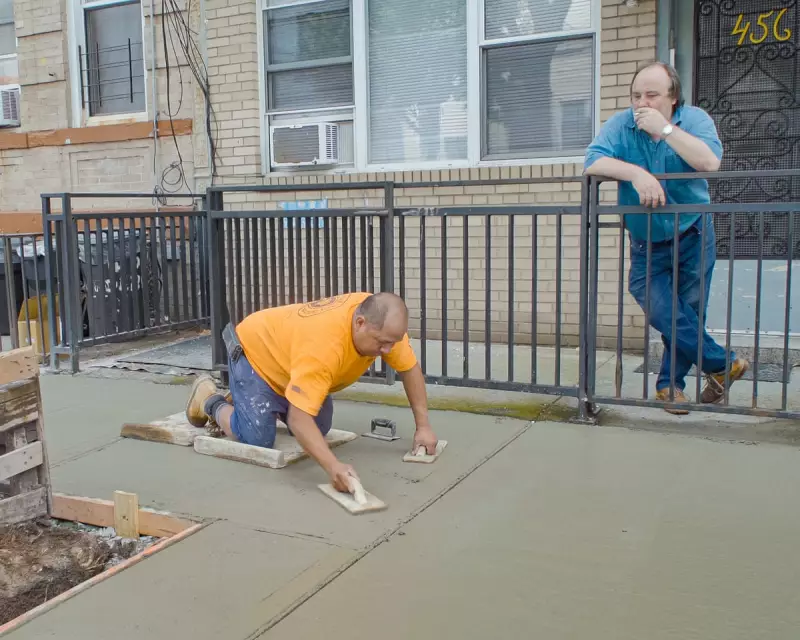
Similarly, through Wilson's perspective and Cori Wapnowska's precise editing, concrete – reportedly the planet's second most-used material after water, comprising our fractured roads and gum-stained pavements – becomes simultaneously a symbol of decay and a metaphor for hardscrabble, imperfect transformation.
Enhanced Instincts Amidst Growing Recognition
Thematic and stylistic repetition in this instance does not indicate creative stagnation. Wilson's niche, sporadic fame appears to have only heightened his singular magpie instinct for discordant, mismatched, and gloriously profane elements. He stands perhaps as the sole individual capable of filming an exclusive Los Angeles dinner with Kim Kardashian and an Ohio driver's education class with equivalent offbeat curiosity.
The documentary delivers abundant hilarity and wonder through Wilson's gold-standard visual collages and eccentric tangents, ranging from junior bricklaying competitions to a 3,100-mile race around a single Queens block. True to form, Wilson discovers borderline unbelievable characters who deliver unforgettable lines like "mean Gene the embalming machine!" while ensuring their appearances never descend into mockery.
Navigating Structural Challenges
Nevertheless, the connective tissue occasionally feels somewhat loose and baggy, even by Wilson's admirably relaxed standards. During certain segments, particularly in the film's slightly lagging final third, Wilson appears more interested in pursuing absurdity – simply observing how far following a genuine eccentric might lead – than establishing cohesive thematic points.
Although Hallmark's advice included mixing serious elements with audience hooks, several informative tangents concerning affordable housing, New York's deteriorating infrastructure, and obstructive NIMBY-ism dissipate before fully delivering their impact, as if Wilson hesitated to become excessively polemical.
A Substantial Achievement Despite Minor Flaws
Ultimately, Wilson successfully sticks the landing. As a standalone film, The History of Concrete remains consistently laugh-out-loud funny, compelling, and surprising, despite running approximately twenty minutes longer than ideal. The documentary, naturally, explores far more than merely concrete. It contemplates languishing during transitional periods and the difficulty of convincing oneself to progress forward.
The film addresses the challenge of continuing documentary production amidst vanishing budgets and media consolidation. It examines false security sensations, haunting impermanence, and moving forward despite imperfections – gum stains and all. The History of Concrete represents, in essence, an exploration of the genuinely difficult aspects of contemporary existence. The documentary is currently screening at the Sundance film festival while actively seeking distribution opportunities.