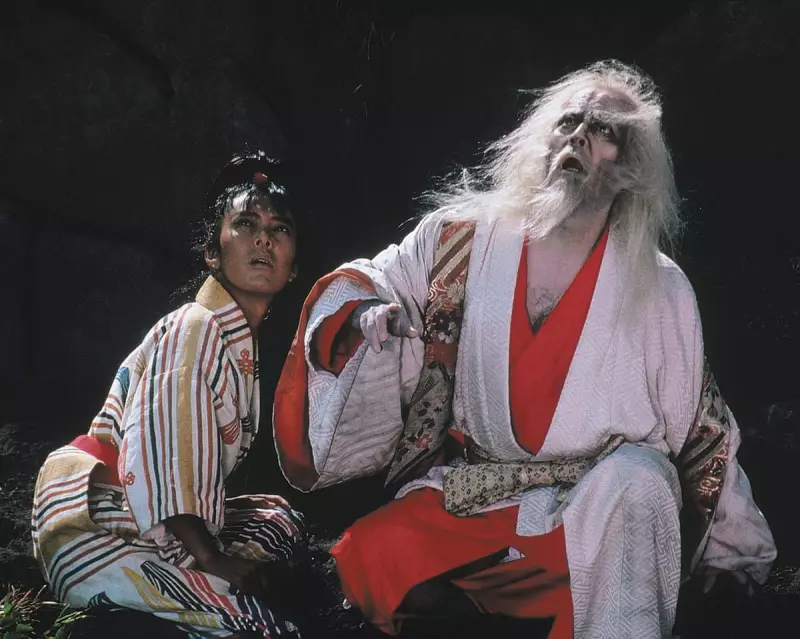
The world of cinema has lost one of its true greats with the passing of Tatsuya Nakadai, the legendary Japanese actor whose remarkable career spanned decades and genres. He was 92 years old.
The Eyes That Captivated a Generation
Though blessed with the classic features of a 1950s matinee idol, it was Tatsuya Nakadai's extraordinary eyes that truly captured audiences. These large, expressive brown saucers could convey everything from youthful innocence to unsettling intensity, at times appearing to protrude from their sockets with dramatic force.
This unforgettable gaze served him perfectly in what many consider his career-defining moment: the centrepiece scene of Akira Kurosawa's 1985 epic Ran, an adaptation of Shakespeare's King Lear. As Nakadai's warlord character is cast out from his burning castle, his glare of impending madness becomes almost unbearable to watch.

A Formative Partnership and Breakthrough Role
That same piercing quality had earlier earned Nakadai his first leading role when director Masaki Kobayashi cast him as the pacifist antihero in the monumental war trilogy The Human Condition (1959-61). The nine-hour epic follows its protagonist's tragic fate, freezing to death in the Manchurian wilderness.
"He later told me that as he was imagining that final scene, and the look in [the protagonist's] eyes when he has partly lost his mind, 'The eyes I saw in my mind were yours, Nakadai,'" the actor once recalled of his collaboration with Kobayashi.
This marked the beginning of an extraordinary creative partnership that would see Nakadai work with Kobayashi on eleven films, while his six collaborations with Kurosawa produced some of Japanese cinema's most enduring masterpieces.
Versatility Across Genres and Iconic Rivalries
With theatrical training underpinning his craft, Nakadai demonstrated incredible range across more than 150 film credits. His portfolio spanned the vigorous swordplay of Kurosawa's early 1960s chanbara classics, the high-minded realism of The Human Condition, domestic melodrama such as Mikio Naruse's When a Woman Ascends the Stairs (1960), and avant-garde psychodrama like The Face of Another (1966).
Nakadai often found himself effectively paired with the great screen presence Toshiro Mifune, whom he respected as his senpai (elder). When Kurosawa needed an equal adversary to Mifune's character in Yojimbo (1961), he instructed Nakadai to play the prowling killer as a "snake" to counter Mifune's "stray dog".
Their on-screen rivalry reached another peak in Sanjuro (1962), featuring a shockingly graphic blood geyser for the era when Mifune's character dispatches Nakadai's henchman. Variety later noted that "teaming Mifune and Nakadai is, to a samurai film, the equivalent of having John Wayne and Lee Marvin in the same cast."
The Outsider Spirit and Lasting Legacy
Throughout his career, Nakadai demonstrated a consistent attraction to playing nonconformists and outsiders who challenged establishment values. From the disabled seducer in Kon Ichikawa's 1958 temple drama Conflagration to the disfigured industrial worker in The Face of Another, he brought depth to characters operating outside societal norms.
His performance in Kobayashi's Harakiri (1962) as a devastated ronin (masterless samurai) exposing the hollow cruelty of the samurai bushido code remains one of his most powerful roles. Nakadai belonged to a generation born into imperial Japan but too young to fight in the Second World War, coming of age amidst postwar wreckage which informed his sceptical perspective.
Born Tomohisa Nakadai in south-west Tokyo, he experienced poverty after his bus driver father died during his childhood. His mother worked as an assistant dressmaker to support Nakadai, his elder half-sister, and his younger siblings.
Despite financial struggles, he enrolled at the Haiyuza acting school, embracing its shingeki ethos of realism that moved Japanese acting beyond the stylisation of kabuki and noh theatre. An avid fan of western films, he particularly admired Marlon Brando's performance in On the Waterfront (1954).

Nakadai maintained his commitment to theatre throughout his life, performing in productions of Shakespeare, Sophocles, and Gorky. In 1975, he founded the Mumeijuku acting school with his wife, actor and director Yasuko Miyazaki, whom he had married in 1957. The school operated from the same tenement building where he had grown up in poverty.
Following advice from American Method acting guru Lee Strasberg, Nakadai became selective about his students, with graduates including Koji Yakusho, recent star of Wim Wenders' Perfect Days (2024).
Nakadai continued working steadily after the decline of the Japanese studio system in the 1970s. His final collaborations with Kurosawa included Kagemusha (1980), where he replaced Shintaro Katsu after the actor fell out with the director, and Ran (1985). Though only 51 during the filming of Ran, Nakadai was becoming an elder statesman of Japanese culture.
His contributions were formally recognised with Japan's Medal with Purple Ribbon for artistic achievements in 1996 and the prestigious Order of Culture in 2015.
In one of his final film roles, Lear on the Shore (2017), Nakadai returned to Shakespearean territory, playing an ageing actor who escapes his retirement home.
Reflecting on his extraordinary career in 2019, he told Tokyo Journal: "I hesitated before I began, thinking acting seemed difficult. But once I began, I never looked back."
Nakadai is survived by his daughter, Nao. His wife Yasuko died in 1996.