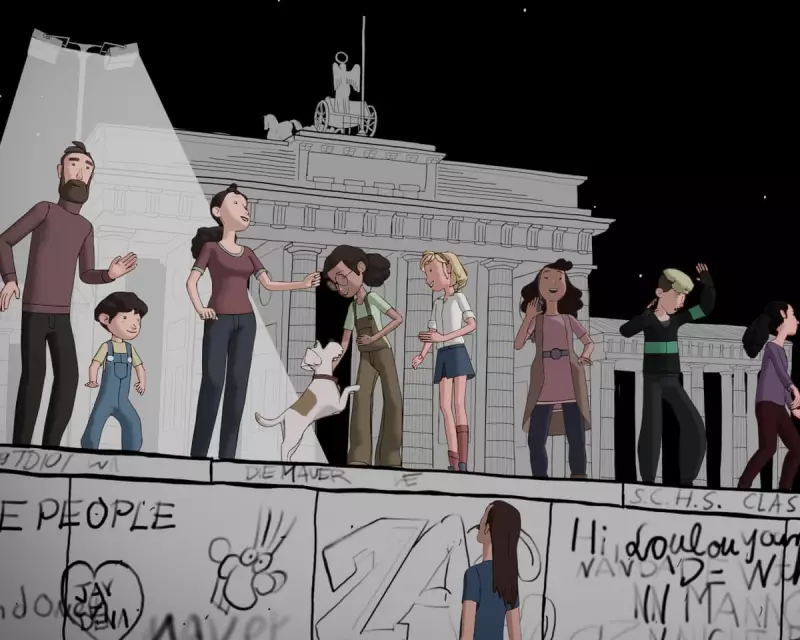
A groundbreaking German children's television series that explores life in communist East Germany has been honoured with an International Emmy award, proving that complex historical topics can successfully engage young audiences.
Blending Animation With Real History
Auf Fritzis Spuren (In Fritzi's Footsteps) tells the compelling story of a 12-year-old girl growing up in Leipzig during the final years of the German Democratic Republic. The innovative six-part series combines animated sequences with real-life interviews and present-day footage to create an immersive historical experience.
The programme made German television history on Monday evening in New York when it became the first German children's programme to win an International Emmy in the Kids: Factual & Entertainment category. This remarkable achievement comes after 16 years of development work by the creators.

Breaking Barriers in Children's Programming
Lead actor Julian Janssen emphasised the programme's significance, stating: "It definitely shows that no topic is too difficult for children. It's precisely the difficult topics that should be addressed."
The series follows two animated characters, Julian and Anna, who travel back in time to the GDR as protests against the communist regime begin to build. Throughout their journey, they encounter real people who grew up under communism and share their personal experiences.
Co-director Ralf Kukula expressed his astonishment at the award: "We are completely stunned to have won with this topic. Political content for children isn't usually the focus of such programmes. The fact that the story of a small girl from Leipzig who experienced the collapse of communism has now reached New York and won a big prize is sensational for us."
Educational Impact and Historical Significance
The series, aimed at children aged eight to twelve and their families, has been praised by critics for demonstrating "how exciting history can be". It covers various aspects of everyday life in East Germany, from classrooms to coal mines and the punk scene, seamlessly blending documentary and fictional elements.
Anke Lindemann, editorial head of child and family programming for Central German Broadcasting (MDR), highlighted the personal significance of the production: "When you come from the GDR, and grew up there like I did, and you know that - through this production - part of your childhood is being explained to children of today about what it was like, that's quite special."
The series begins by explaining the East German authorities' official justification for building the Berlin Wall as an "anti-fascist" protection barrier and introduces viewers to the feared Stasi secret police. It culminates in the euphoric days surrounding the fall of the Berlin Wall in 1989.
Kukula, who also wrote the script, noted the importance of capturing this historical moment: "We wanted to show what it was like when Germany was the happiest country in the world. I think it's very important that we are able to remember that again."
At a time when Germany faces new divisions, the creators hope the series will spark intergenerational conversations and remind people of their shared history. The programme now joins other successful productions like The Lives of Others and Deutschland 83 in bringing the GDR experience to wider audiences.