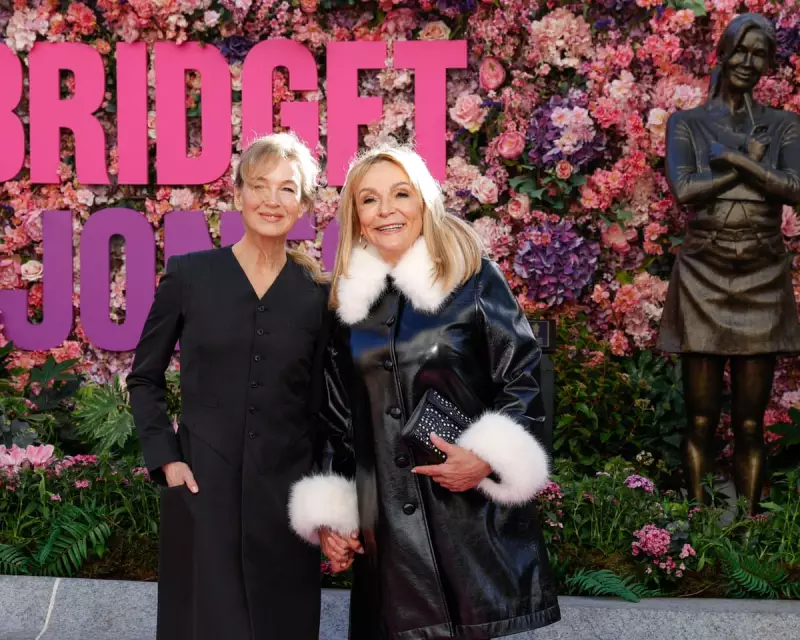
Britain's favourite singleton has been permanently immortalised in the heart of London, as a life-size bronze statue of Bridget Jones was unveiled in Leicester Square on Monday morning.
A Star-Studded Unveiling Ceremony
The ceremony brought together the creative forces behind the beloved character, with author Helen Fielding and Oscar-winning actress Renée Zellweger joining comedian Sally Phillips for the big reveal. The statue depicts Bridget in her signature creased miniskirt and gaping cardigan, clutching her diary and pen rather than her traditional cigarette and glass of chardonnay.
The artwork joins other famous fictional characters in Westminster council's Scenes in the Square initiative, including Paddington Bear and Harry Potter, reinforcing Leicester Square's status as London's premier cinema hub. The location hosts four major multiplexes and most of the capital's red-carpet film premieres.

The Creative Team's Verdict
Zellweger, who has played Bridget in four films generating a combined $900 million at the global box office, described the experience as "really so weird, but it's really cute." She admitted she never expected to see herself immortalised in this way while still alive, recalling that her main ambition when making the first film 24 years ago was simply "hoping I wouldn't get fired."
Fielding, who first created the character in a newspaper column thirty years ago, expressed delight at the permanent tribute to her creation. The Bridget Jones novels have since been translated into more than 40 languages, becoming a global phenomenon that redefined the romantic comedy heroine.
Anatomy of a Bronze Bridget
The statue presents some interesting artistic choices, combining elements from different eras of Bridget's story. As Sally Phillips noted, "She's Mad About the Boy-era weight with Bridget Jones's Diary-era clothes." The cardigan features three undone bottom buttons, creating the impression of a slight overhang at the beltline that Fielding described as having "a little bit sort of hanging over."
Notably absent are Bridget's famous "mummy knickers," with a representative from 3D Eye studio explaining that sculpting in clay probably works in a similar way to sculpting pants when it comes to smoothing silhouettes.
Eric Fellner, co-chair of Working Title films, praised the statue's capture of Bridget's essential attitude, noting that "portraiture is difficult enough, but doing it in 3D is even more challenging."
Bridget's Enduring Cultural Legacy
Fielding reflected on why her character continues to resonate with new generations, particularly Gen Z. "When I first wrote Bridget, we were just being hit by mass media Photoshopping magazines," she said. "But Gen Z have got it a hundred-thousand times worse because they're not just seeing that at a distance. They're seeing their friends filtered."
She identified Bridget's appeal as stemming from "the gap between how we all feel we're expected to be and how we actually are." Unlike superheroes or wizards, Bridget's power lies in her very human imperfections and her quintessentially British qualities of kindness, friendship, and the ability to laugh at herself.
The author expressed hope that visitors might bring packets of chocolate and Silk Cut cigarettes to place at the statue's feet, creating a modern pilgrimage site similar to the scene in her novel where Bridget lays flowers at Kensington Palace following Princess Diana's death.
Future of the Franchise and Industry Reflections
With the fourth film, Bridget Jones: Mad About the Boy, taking £46 million in the UK and becoming the second highest-grossing film of the year, director Mark Morris expressed hope for a fifth instalment. The film's straight-to-streaming release in America disappointed both Morris and Fellner, who argued that good stories deserve the "communal shared experience" of cinema.
Fellner drew comparisons between Fielding and JK Rowling, another female author whose creation (Harry Potter) is honoured in Leicester Square. "Creativity from one individual can become this massive thing on a global scale," he said, emphasising the importance of supporting creative industries in Britain.

Fielding, who hails from Leeds, used the occasion to call for more equitable distribution of arts funding beyond London, noting that "the north-south divide in Britain is much bigger than in most westernised countries." She credited northern comedy traditions with influencing Bridget's characteristic humour of "bringing fancy things down to earth."
As the crowds dispersed and the specially laid pink carpet grew somewhat muddied, the small bronze figure with her winsome face and uncertain buttoning began to feel like a permanent fixture in London's cultural landscape. Fielding acknowledged that "it may not be there in three centuries," but celebrated that "nevertheless it is quite a lovely thing that Bridget means something in this country."