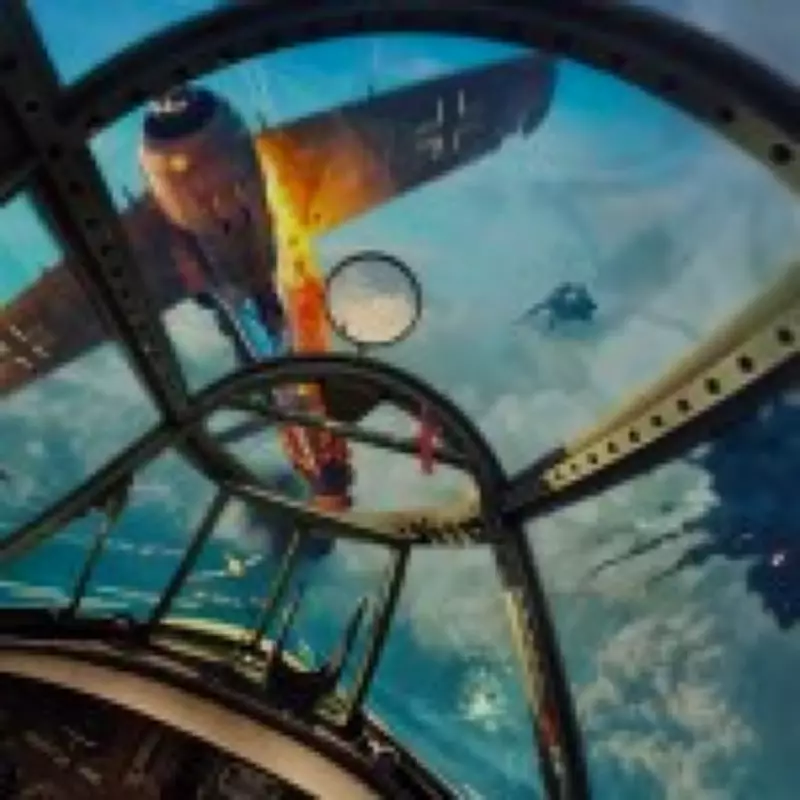
The creators behind the popular free-to-play title War Thunder have launched a new, more concentrated flight simulation experience that boasts some of the most impressive virtual reality support available on the PlayStation 5 console. Aces Of Thunder promises to immerse players in the perilous world of Second World War aerial combat, where life expectancy for pilots could be measured in mere weeks during intense conflicts like the Battle of Britain.
Authentic Aviation Challenges
For contemporary gamers accustomed to modern comforts, the extreme risks faced by wartime aviators remain largely foreign territory. This historical distance forms part of the fascination with simulating such conditions, offering at least a secondary understanding of what those courageous airmen confronted daily. After a prolonged period marked by "coming soon" announcements that frustrated prospective players on social media platforms, Aces Of Thunder has finally arrived for widespread public experience.
Veterans of Gaijin's War Thunder will recognise certain familiar elements, though this new offering contains only a fraction of its predecessor's aircraft selection and multiplayer options. Where it distinguishes itself significantly is through its substantial single-player component and, crucially, its native compatibility with PlayStation VR2 hardware – a feature War Thunder reserves exclusively for PC users.

Demanding Flight Mechanics
Those raised on more contemporary flight simulators like Ace Combat may experience considerable adjustment. Rather than portraying players as battlefield-dominating heroes whose presence alone can sway conflicts, Aces Of Thunder positions you as just another pilot among many. Your contributions to chipping away at enemy forces and supporting the broader war effort are acknowledged, but initially valued considerably less than those of more experienced colleagues.
This relative insignificance stems largely from the sheer challenge of operating these historical aircraft. Although primarily featuring fighter planes rather than bombers – granting reasonable aerial agility – these machines are between 80 and 110 years old, completely devoid of modern fly-by-wire assistance systems. Execute overly steep banking manoeuvres or fail to maintain adequate throttle during climbs, and you risk stalling or entering unrecoverable tailspins.
Virtual Reality Implementation
The absence of a heads-up display further intensifies the simulation. Within virtual reality environments, determining when your aircraft has sustained damage can prove particularly tricky. You'll frequently hear bullets whistling past or penetrating the metallic fuselage, occasionally taking a round that instantly kills your pilot. Other times, you might notice unusual sluggishness in controls, only discovering upon bailing out via parachute that your tail section has vanished or a substantial portion of wing has been sheared away.
Friend-or-foe identification presents another significant hurdle without HUD assistance. Aircraft liveries remain indistinguishable until you're practically on top of them, and while blue rectangular indicators appear when approaching allied planes, developing an instinctive recognition of friendly versus enemy silhouettes becomes essential for avoiding tragic friendly fire incidents.
Combat Realism And Progression
It's genuinely remarkable that aerial warfare proved feasible with such limited technological support. Enemy ground forces become practically invisible among bombed-out urban ruins as you streak overhead at 400 kilometres per hour, while the sheer vastness of the sky only becomes apparent during prolonged flights toward distant specks that may or may not represent enemy bomber formations you're tasked with destroying.
Through persistent practice and conscious avoidance of reckless manoeuvres, gradual mastery eventually emerges once players accept they're not portraying some sort of airborne Rambo. During initial familiarisation phases with specific aircraft, the most achievable objectives might involve inflicting minor damage while minimising fatalities. Successfully positioning behind a bomber to disintegrate sections with machine gun fire, or effectively strafing enemy tank columns until at least one erupts in flames, provides legitimate cause for celebration during the learning process.

Control Scheme Considerations
Aces Of Thunder benefits tremendously from excellent VR implementation, with meticulously detailed aircraft, cockpit interiors, and terrestrial landscapes combining to create compelling immersion. All instrumentation dials function as they would in genuine period aircraft, displaying altitude, airspeed, climb rates, and artificial horizon data, though only the control stick, throttle, and flaps prove interactive – remaining levers and switches serve purely cosmetic purposes.
While virtual joystick operation might initially appear the optimal control method, maintaining extended hand positions throughout complete missions proves excessively fatiguing, as does attempting subtle attitude adjustments for precision aiming. Superior alternatives include using the PlayStation Sense controllers' analogue sticks, or ideally employing a Thrustmaster T-Flight HOTAS setup – currently the sole compatible throttle and joystick combination for PlayStation 5. This latter option delivers the most refined flight experience, though regrettably cannot navigate menu systems, necessitating continued Sense controller connectivity and resulting in disembodied, leather-gauntlet-clad virtual hands lingering within cockpit spaces.
Notable Omissions And Multiplayer
More concerning is the complete absence of structured training programmes. A three-page virtual instruction manual exists within the game, yet fails to explain fundamental operations like landing gear retraction, let alone flap utilisation protocols or bomb deployment mechanics. Players inevitably muddle through via trial and error, but this represents a peculiar oversight.
Dedicated simulation enthusiasts might also disapprove of auto-trim being enabled by default, eliminating the need for constant slight backward stick pressure to maintain level flight – technically authentic but not particularly enjoyable for purists. Those demanding absolute realism or simply craving additional punishment can disable this convenience feature, though most will likely retain it.
Multiplayer components support up to sixteen simultaneous aircraft across various modes, many incorporating limited respawn systems. This encourages tactical considerations like holding team members in reserve during bomber escort missions to counter early routs, making effective communication essential. Virtual reality's primary multiplayer challenge involves attracting sufficient participants for viable matchmaking, leaving the online community's long-term viability uncertain.
Historical Immersion And Value Proposition
Despite these considerations, something uniquely compelling emerges from embracing early wartime aviation's inherent hardships. The noise, confusion, and multitude of potential failure points still generate triumphant moments made sweeter by their scarcity. Aviation aficionados will appreciate a respectable selection of Axis and Allied aircraft and scenarios, with War Stories missions covering iconic engagements including the Battle of Britain, Pearl Harbor's smoking aftermath, the Battle of Medway, Normandy Landings, and numerous famous conflicts across multiple continents.
These function as fully interactive historical role-playing experiences. Events unfold largely as they occurred historically, with player input making modest differences while providing opportunities to fly through and above incidents previously only encountered through literature or cinema. Participants can survey landscapes and ongoing actions while engaging enemy aircraft, armoured columns, and naval vessels.
This creates genuinely immersive and frequently impressively stately virtual reality experiences. Whether it proves sufficient to divert players from War Thunder's substantially broader free-to-play offering remains debatable. For PlayStation VR2 owners with existing interests in historical aviation, it represents an easy recommendation, though PC-based virtual reality users retain numerous alternative options.
Review Summary
In essence: A historically authentic military flight simulator that rewards dedicated effort toward mastering its combat systems, though arguably unnecessarily inaccessible for casual aviation enthusiasts.
Advantages: Exceptionally crisp virtual reality visuals with detailed aircraft and cockpit modelling. Satisfying flight characteristics that penalise careless manoeuvres. Respectable variety of different period planes.
Drawbacks: Perverse absence of comprehensive tutorials and questionable value proposition compared to the far more extensive free-to-play War Thunder. Optimal control configuration requires purchasing separate peripheral hardware.
Final assessment: 7/10
Platforms: PlayStation 5 (reviewed) and PC
Pricing: £24.99
Publisher: Gaijin Distribution
Developer: Gaijin Entertainment
Release date: 3rd February 2026
Age classification: 12+