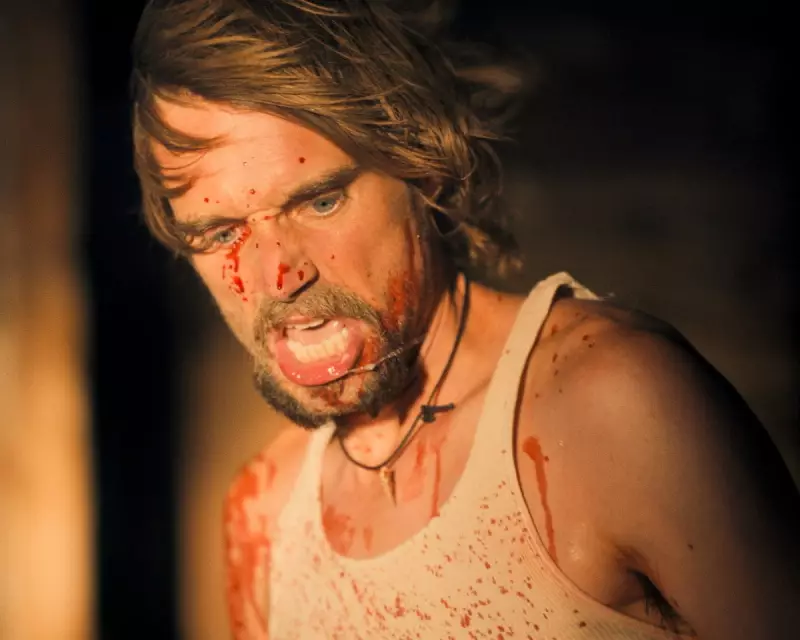
Director Joshua Erkman makes his striking feature debut with A Desert, a horror film that masterfully blends high art concepts with gritty Americana aesthetics. This unsettling cinematic exercise follows a photographer's fateful journey into California's Yucca Valley, where artistic ambition collides with dangerous realities.
An Unsettling Descent into Darkness
The film introduces us to Alex, played by Kai Lennox, a photographer documenting the decaying landscape of California's Yucca Valley. Driving his luxury SUV through the parched terrain, Alex captures images of abandoned buildings and ghost towns using an elaborate 8x10 inch camera that requires ten-second exposures. His subjects range from disused cinemas to the remains of forgotten military bases, though he mentions to his wife Sam (Sarah Lind) in a voicemail that he might transition to portraits.
Alex's detached artistic perspective becomes problematic when he encounters his neighbours at a motel - a couple embodying trailer-park aesthetics portrayed by Zachary Ray Sherman and Ashley Smith. When they invite him to join their party with turpentine-tasting homemade alcohol, Alex finds himself unable to refuse, setting in motion a series of events that transforms the film's trajectory.

Visual Mastery and Shifting Perspectives
Following a blur of electronic dance music and lurid lapdance sequences, the film executes a dramatic narrative shift reminiscent of certain iconic horror films. Without revealing spoilers, the story then follows new protagonists: Alex's wife Sam and private investigator Harold, brought to life by David Yow, as they navigate the same desolate highways of the valley.
Erkman, drawing on his experience as a cinematographer, collaborates with director of photography Jay Keitel to create what can only be described as an artbook vision of the economically depressed American West. Their visual approach merges the classic Americana style of Joel Meyerowitz with the ruin photography of Yves Marchand and Romain Meffre, resulting in breathtaking imagery that serves as more than mere backdrop.
Social Commentary Through Horror Conventions
The film delivers sharp commentary about artistic exploitation and blindness to human suffering. Alex and other visitors see the area's decay as merely photogenic material surrendering to natural forces, while remaining oblivious to the genuine human evil lurking in plain sight - a point chillingly confirmed by the film's final shot.
While the social message may not break new ground, the visual style and editing prove utterly captivating. A Desert establishes itself as part of a recent trend in sophisticated horror, sharing DNA with works like I Saw the TV Glow, David Lowery's A Ghost Story, and Ari Aster's Hereditary. The film successfully merges high-art discourse with gritty low-life characters, culminating in bloody consequences that will satisfy horror enthusiasts while potentially challenging those seeking more conventional scares.
Joshua Erkman's debut feature demonstrates impressive craftsmanship and originality, even as it ventures into abstract territory that may distance some viewers from its realistic elements. A Desert becomes available on digital platforms from 24 November, offering British audiences a thought-provoking addition to the contemporary horror landscape.