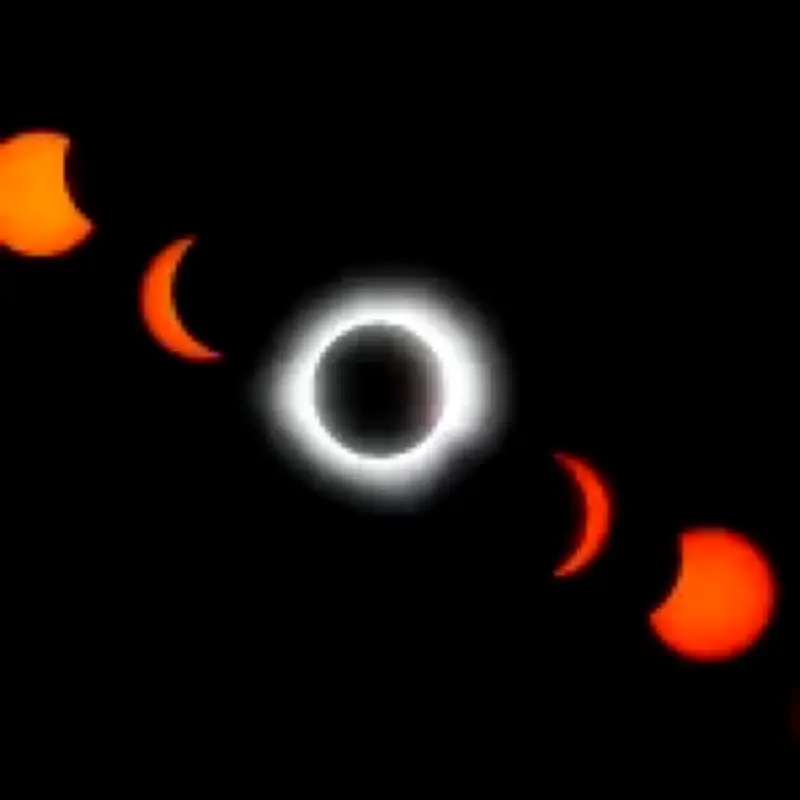
The total solar eclipse on August 12 is set to be a historic event, with Spain experiencing its first total eclipse in over 100 years. For the first time since 1905, the moon will completely cover the sun across parts of northern Spain, offering a spectacular show for locals and tourists alike.
What is a solar eclipse?
A solar eclipse occurs when the moon passes directly between Earth and the sun, blocking all or part of the sun's light. According to Jamie Carter, author of the Complete Guide to the Total Solar Eclipse 2026 and eclipse expert for New Scientist Discovery Tours, the precision of an eclipse is only possible because the sun and moon appear almost the same size in our sky. During totality, the sun's faint corona becomes visible as a halo around the moon's silhouette.
In the UK, the eclipse will not be total, with the moon covering roughly 90% of the sun at its peak. It will be the deepest eclipse since 1999 and the best until 2081, according to a TikTok video by @dani_dark_skies. Timings for the UK (based on London) are: first contact at 18:17, maximum partial eclipse at 19:12, and eclipse ends at 20:06.

Best places to watch the eclipse
Jamie Carter has provided the following top picks for viewing the eclipse, with a tip to use The Eclipse App, Eclipse Horizon Checker, and the Instituto Geográfico Nacional for the clearest views.
1. Castile and León, Spain
Castile and León in Spain's Iberian Peninsula is the best all-round choice. It offers relatively long totality (up to about 1 minute and 45 seconds at 8:28 pm CEST), favourable weather prospects, and wide, open landscapes. The region is home to Burgos, with its 13th-century UNESCO World Heritage Site cathedral, and is a UNESCO Creative City of Gastronomy, famous for slow-roasted suckling lamb and spiced black pudding.
In Palencia, you can stroll or cycle through the Canal de Castilla, a historic 18th-century waterway, or stop for tapas in Calle Mayor. Valladolid boasts charming Renaissance squares and is a hidden gem for wine lovers. Note that authorities in northern Spain are urging people to stay away due to wildfires.
2. Ebro Delta, Spain
On the east coast, the eclipse will take place at 8:30 pm CEST, lasting 1 minute and 30 seconds. The Ebro Delta in Catalonia features wetlands, lagoons, rice fields, and barrier beaches, offering uninterrupted views to the northwest. It is Catalonia's primary rice producer, and you can take boat tours to eat mussels and oysters from floating seafood farms.
3. S'Arenal Beach, Mallorca
The eclipse will take place just before sunset in Mallorca, so the island's capital, Palma de Mallorca, will not see anything. Jamie's insider tip is to head to S'Arenal beach, a long, white sandy spot with palm trees. The eclipse is set for 8:31 pm CEST, lasting 1 minute and 36 seconds. The Government of the Balearic Islands and AstroMallorca have launched Horizonte Eclipse 2026, a free tool to check visibility.
4. Scoresby Sund, East Greenland
About 15 expedition cruise ships full of eclipse chasers are heading to the world's largest fjord system, Scoresby Sund, for its dramatic scenery. In Greenland, the eclipse will take place at 4:35 pm EGST and last 2 minutes and 16 seconds. The area is home to whales, Atlantic walruses, and polar bears, and the isolated settlement of Ittoqqortoormiit has been the only permanent settlement there since 1924.
5. Reykjavík, Iceland
Iceland's capital is famed for its volcanic architecture and geothermal hot springs. The eclipse is set to happen at 5:48 pm GMT and will last 57 seconds. Reykjavík will have special viewing areas on the coast near the domestic airport. For music lovers, don't miss Echolalia, a one-day festival hosted by Björk, coinciding with the eclipse at the Víðistaðatún sculpture park in Hafnarfjörður, with tickets from 14,990 ISK (£89).
Why is a solar eclipse so special?
A total solar eclipse comes to any particular location only every few centuries, making it a once-in-a-lifetime experience for most. According to Jamie Carter, 'People have travelled to witness total solar eclipses for centuries, but the hobby has exploded in popularity following the hugely successful North American total solar eclipses of 2017 and 2024, which introduced millions of people to totality for the first time.'

Respecting the eclipse
As with any natural wonder, it's important to respect the environment. The Agency for Tourism of the Balearic Islands (AETIB) has issued guidance to help visitors protect the islands' natural environment, including respecting signage, not straying from paths, and disposing of rubbish properly.
Remember: do not look directly at the sun during an eclipse, as it can cause permanent eye damage. In 1999, 147 people in the UK damaged their eyes by not protecting them. Use eclipse viewing glasses or a pinhole projector.