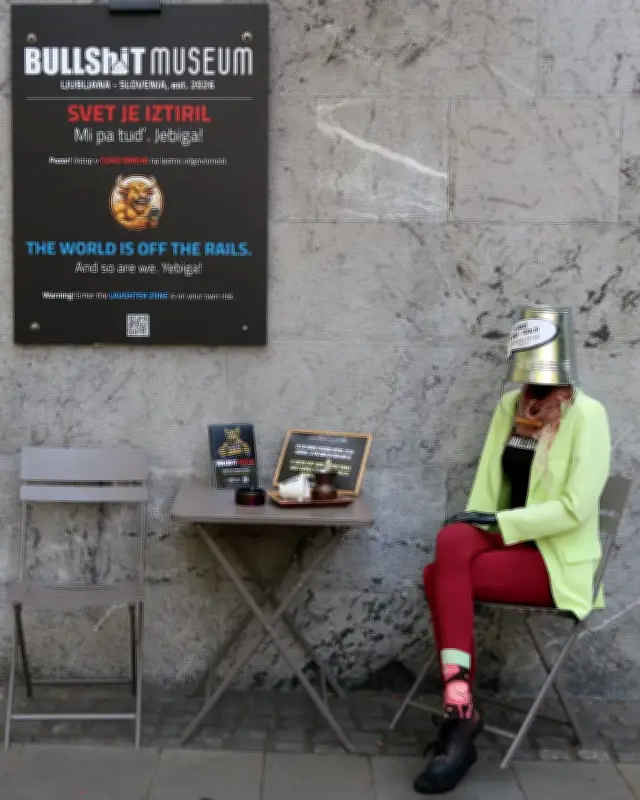
Ljubljana's new Bullshit Museum, which opened in May, is dedicated to the humour of the former Yugoslavia, drawing on a collection of about 25,000 jokes amassed by founder Borut Kokelj. The museum, located in the historic Old Town, features five small rooms filled with mannequins wearing odd accessories and AI-generated images accompanying the jokes.
The museum's central theme is encapsulated by the word "yebiga," loosely translated as "fuck it" or "screw it," which Kokelj describes as the essence of Balkan humour. "Even when there's no money, when there are no jobs, when nothing is settled, everything can be solved with humour," he says. "And for that to work, humour must have no filter."
Exploring the Roots of Balkan Humour
While presented as a museum of "Balkan" humour, the exhibition focuses primarily on the joke culture of the former Yugoslavia, which included Slovenia, Croatia, Serbia, Montenegro, Bosnia and Herzegovina, and Kosovo. The socialist federation was formed after the first world war to unite southern Slavs and some non-Slavic minorities under a common identity and language, then known as Serbo-Croatian. However, the genocidal wars of the early 1990s revealed the fragility of this unity, as nations defined themselves through distinct religious and linguistic identities.

The museum suggests that humour may have been the glue holding Yugoslavia's cultural diversity together. Some jokes on display play on language differences, such as a poster at the entrance reading, "A fool is a fool in both the Cyrillic and the Latin alphabets," using both scripts. The armed conflicts that shaped the region are also reflected, albeit indirectly, through wordplay on the title of the 1996 Serbian drama "Lepa Sela Lepo Gore" (literally "pretty villages burn nicely"), adapted into the absurdist line "Lepa jela lepo goje" ("Fine food fattens you up well").
The Role of Women and Everyday Absurdities
The exhibition also touches on the role of women in society, with an "encyclopedic" definition of a "starleta" – a woman seeking fame and wealth through beauty alone – as "the first Balkan mythical being with the body of a woman and the head of a turkey." Another joke reads, "She wanted to marry a prince, but a horse had more money," playing on the word "konj" (horse), used in many former Yugoslav nations to describe a "man."
Kokelj deliberately avoided politically loaded humour, stating, "If we were to exhibit all the truly 'Balkan' jokes, we likely wouldn't have opened," referring to jokes that directly address religion, ethnicity, or national symbols. The selection also excludes jokes mocking specific groups, such as stereotypes of Montenegrins as lazy. Only one AI-generated "ethnic" meta-joke appears, playing on the stereotype of Slovenes as eager to present themselves as "elegant" and "European," distancing themselves from the region.
Rakija and Yebiga: The Unifying Elements
Most jokes address everyday issues and life's absurdities, such as "Life is neither nail polish nor acetone" and "We had it better, and we still complained. Now that things are getting worse, we're complaining again." Others focus on romance: "Love is when you look like a sack of potatoes, but she sees you as fries." A recurring theme is self-deprecation: "Amateurs make mistakes, but we, the experienced ones, create catastrophes."
Rakija, the Balkan fruit brandy, serves as a unifying element throughout the exhibition. It is served to visitors upon entry and described as "the first aid of every Balkan household." It is also central to the definition of "yebiga," which one exhibit describes as "The Balkan way of saying: what are you going to do? Maximum feeling, minimum energy. It usually goes with rakija, a cigar and a song that hurts more than it should."