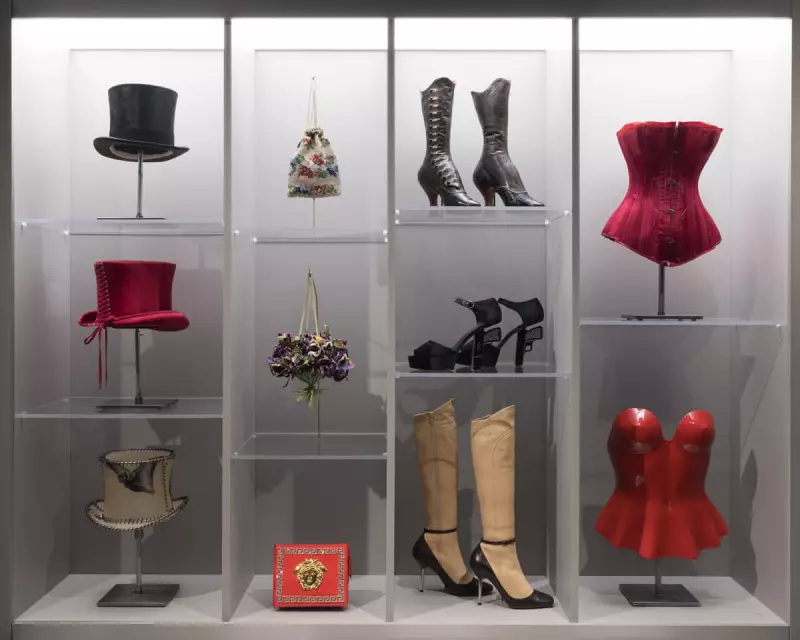
When you selected your outfit this morning, did you believe you were making independent choices? A groundbreaking exhibition in New York suggests our clothing decisions might be driven by deeper psychological forces beyond our conscious awareness.
The Deep Surface of Fashion
Dress, Dreams and Desire: Fashion and Psychoanalysis at the Fashion Institute of Technology presents a compelling case that clothing serves as what curators call the "deep surface" - a changeable, renewable second skin that conceals far more than practical needs.
Dr Valerie Steele, the curator famously known as "the Freud of fashion," explains that fashion fundamentally "communicates our unconscious desires and anxieties, with none of us fully aware of the messages we send." She contends that rather than being superficial, "fashion exposes people's desires and anxieties like a psychosomatic rash."
Psychoanalytic Perspectives Through History
The exhibition, which Dr Steele spent five years developing, examines 100 fashion looks from the 19th century to present day through psychoanalytic theory. While Sigmund Freud himself rarely discussed clothing in his work, his letters to wife Martha Bernays revealed his belief that women used "frivolous and fancy dress" to display their bodies, while men exhibited "passive exhibitionism" through hats and coats as substitutes for male sexuality.
Carl Jung proposed that clothing functions as a psychological "mask," representing the compromise between our inner self and external presentation. French psychoanalyst Jacques Lacan, however, took this further by arguing that identity forms beneath conscious awareness in the psyche.
According to Lacanian psychoanalyst Dr Patricia Gherovici, who consulted on the exhibition, "fashion is a way of dressing up the death drive" while also making "our mortal bodies look a little better."
Designers and Psychoanalytic Influence
The exhibition demonstrates how numerous designers have actively incorporated psychoanalytic concepts into their creations. Featured designs include works by Elsa Schiaparelli, Coco Chanel, Alexander McQueen, and John Galliano, who created a "Freud to Fetish" collection for Dior in 2000.
Alexander McQueen's collections frequently explored psychological themes. His 1998 Joan [of Arc] collection referenced the Catholic martyr burned at the stake after refusing to wear women's clothes, while his 2007 Witches and Persecution collection featured dresses alluding to the ritual of shaving women accused of witchcraft before execution.
Elsa Schiaparelli maintained particularly strong connections to psychoanalytic circles, counting Jacques Lacan among her friends alongside surrealists Salvador Dalí, Jean Cocteau, and Alberto Giacometti. The exhibition includes her evening jacket featuring embroidered rococo hand mirrors with fractured faces - a design element that directly connects to Lacan's Mirror Stage theory, where a child first recognises itself through the mother's gaze.
"Her mother told her repeatedly that she was ugly," Dr Steele reveals, highlighting how Schiaparelli's designs responded to this critical maternal gaze.
Contemporary Interpretations and Trends
The exhibition features several thought-provoking contemporary pieces, including a short reddish-brown dress made from hair by multidisciplinary artist Jenni Dutton, created specifically for the show. Dr Steele offers a Freudian interpretation that wearing such a garment might signal the wearer's desire to be naked, while most people prefer to conceal themselves in public.
Dr Steele also examines current fashion trends through psychoanalytic lenses, suggesting that the rise of nude fashion may respond to medications like Ozempic shifting body positivity conversations, while also carrying political charges against authoritarianism.
The exhibition doesn't shy away from discussing phallic symbolism in fashion. While Freud introduced theories about the oedipal complex and phallic development stages, Lacan argued that neither sex truly possesses the phallus. Dr Steele paraphrases: "Men think their penis is the phallus, and they hope it is, but women embody the phallus."
This becomes particularly relevant in discussing high heels. According to Dr Steele, women wearing stilettos aren't necessarily "collecting phallic symbols, nor is it they're dressing up in fetish clothes for men." Instead, every dominatrix she's interviewed claims such clothing demonstrates "who is in charge."
Fashion's Environmental Dilemma
The exhibition also addresses the psychological conflict between fashion consumption and environmental awareness. Dr Steele identifies this as a tension between Freud's Eros (the sex drive embodied in consumer desire for new clothing) and Thanatos (the death drive represented by ecological concerns).
"Many people who love fashion are also feeling hostile to it, in part because they see it as part of the destruction of the Earth," Dr Steele observes. "I'm starting to feel like there's some huge death drive, with people unwilling or feeling powerless to stop it, but they also want novelty, because a new dress is like a new skin."
Dress, Dreams and Desire: Fashion and Psychoanalysis continues at The Museum at FIT until 4th January 2026, offering visitors a unique opportunity to explore the hidden psychological dimensions of their wardrobe choices.