When words fail to convey the message, clothing often steps in to do the talking. This phenomenon has been particularly evident in recent celebrity culture, where what someone wears can speak volumes about their current situation, emotions, and intentions. The latest chapter in this ongoing narrative unfolded during Paris Fashion Week, where David Beckham made a striking appearance that has sparked widespread discussion about fashion as a form of communication and image management.
The Beckham Family's Parisian Display
More than a week has passed since what some have dubbed "Beckxit" – the public family drama involving Brooklyn Beckham's social media revelations about his upbringing – and the remaining Beckhams descended upon Paris Fashion Week with a carefully coordinated presence. David Beckham, once celebrated as the world's most famous footballer and now perhaps its most famous parent, arrived in the French capital to support Victoria Beckham as she received the honour of becoming a knight of the Order of Arts and Letters.
The family presented what celebrity observers might describe as "a united front," with various members wearing designs from Victoria Beckham and Loewe, appearing demure, sober, and remarkably coordinated in their fashion choices. Yet it was David's specific ensemble that captured the most attention and shifted the discourse surrounding the family's current situation.
The Semiotics of Sashiko and Hermès
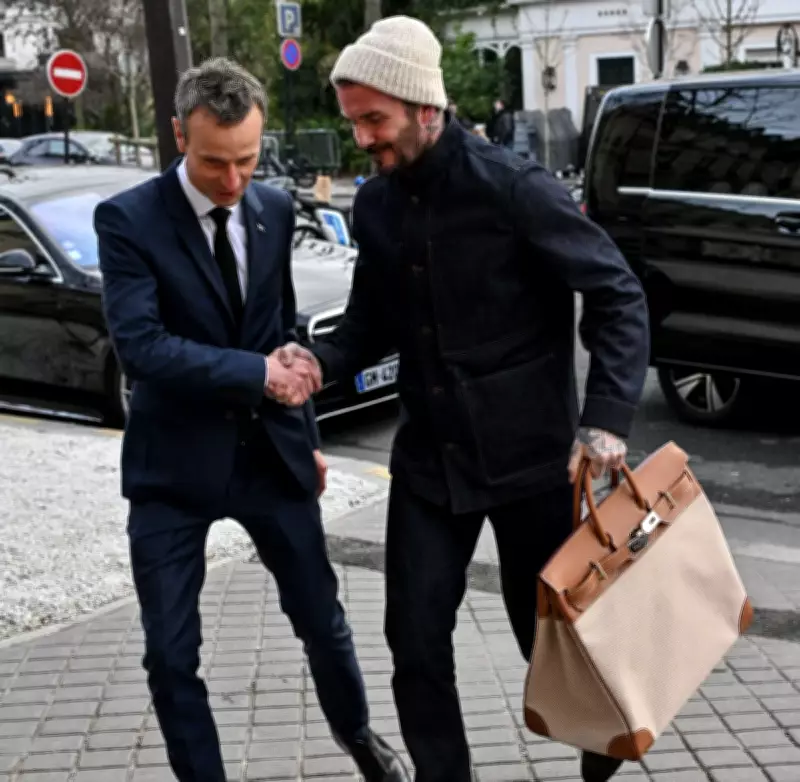
Walking into the luxurious La Réserve Paris hotel – an establishment so exclusive it boasts more suites than standard rooms – David Beckham carried a remarkably spacious tan canvas Hermès Haut à Courroie bag, an item even rarer than the iconic Birkin. More intriguingly, he wore a Momotaro jacket crafted from indigo-dyed sashiko dobby fabric.
The significance of this choice lies in the cultural meaning of sashiko, a traditional Japanese technique of decorative reinforcement often described as "visible mending." The term itself translates to "little stabs," creating an intriguing parallel to the current family dynamics. Whether intentional or coincidental, the fashion choice has prompted extensive analysis about its potential as a coded message.
Andy Milligan, brand consultant and author of "Brand It Like Beckham," suggests the choice could indeed be deliberate. "He's surrounded by the right people," Milligan notes. "For all brands, how you appear – your costume, your demeanour, the way you comport yourself – is critically important. Whether the semiotics are overt or covert."
The Evolution of the Clapback Costume
David Beckham's Paris appearance represents just the latest example of what fashion commentators have termed the "clapback costume" – sartorial choices that serve as non-verbal responses to personal or public situations. This phenomenon has deep roots in celebrity and royal culture, with numerous iconic examples demonstrating how fashion can communicate when words might fail or prove inadequate.
The most famous historical example remains Diana, Princess of Wales, whose stunning black dress worn to a 1994 gala shortly after her husband confessed his affair to the BBC became immortalised as the "revenge dress." This single fashion choice communicated resilience, independence, and strength without requiring a single spoken word.
More contemporary examples include Lily Allen dressing as the French schoolgirl character Madeline after discovering her ex-husband's lover's identity, Bella Hadid wearing an outrageous string bikini immediately following a breakup, and influencer Chiara Ferragni attending a Schiaparelli show in a leather power suit shortly after being acquitted of fraud charges.
Fashion as Crisis Management
Jacki Vause, CEO of Dimoso PR and co-presenter of "The Rest Is PR" podcast, emphasises the power of visual communication in modern public relations. "Images have always had more power than words, long before social media," Vause explains. "And what is more powerful for a family we associate with fashion than what they wear? In crisis management, we always tell people to pay more attention to how they are than what they say."
For the Beckham family, who have built their global brand on careful image management and public perception, fashion represents a crucial communication tool. As Vause notes, the Beckhams "warmed to the idea of using digital media for branding purposes earlier than most," making their fashion choices particularly significant in the current context.
Milligan adds historical perspective, pointing out that "fashion has been used to shape the conversation around David since he was a footballer," referencing the footballer's iconic hairstyles, sarongs, and leather jackets that kept him in public discourse throughout his career.
The Royal Precedent
The connection between fashion and non-verbal communication has particularly strong roots in royal circles. Beyond Diana's famous revenge dress, numerous royal figures have used clothing to send subtle messages. Vause cites Wallis Simpson, the American divorcée whose relationship with Edward VIII led to his abdication, as a prime example. "[She] always cocked a snoot at the royals by dressing in a particularly modern and classy way, without saying a word," Vause observes.
This tradition continues with modern royals, from Meghan Markle's strategic fashion choices to the late Queen Elizabeth II's symbolic hat selections, including her post-Brexit ensemble that notably avoided EU flag colours.
The Visual Age of Communication
We live in an increasingly visual age where images often precede and sometimes outweigh written communication. Before words are read or speeches are heard, judgments are frequently made based on visual presentation. For public figures like the Beckhams, this reality makes fashion choices particularly significant.
While David Beckham may not be considered traditionally fashionable – his penchant for flat-caps and tweeds demonstrates a more classic British style – he understands the power of public image. As a family that has built their business on fame and public perception, the Beckhams recognise that their clothing choices naturally attract scrutiny from fans and critics alike.
Clothing has not replaced the written word in public communication, but it has become an equally valid and sometimes more immediate tool for those in the public eye. The ability to parse these sartorial messages has become an essential skill in understanding modern celebrity culture and public relations strategy.
Whether David Beckham's Paris ensemble represents a deliberate clapback costume or simply comfortable travel wear remains open to interpretation. What remains undeniable is that in our image-saturated age, what public figures wear continues to communicate volumes about their personal narratives, brand positioning, and response to public scrutiny. The Beckham family's latest fashion chapter serves as a compelling case study in how clothing continues to shape public discourse and personal storytelling in the modern era.