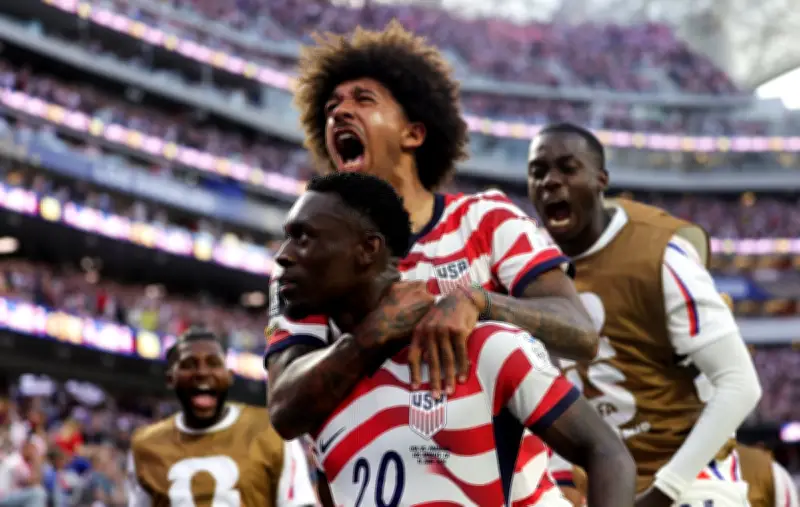
The United States men's national soccer team has long been seen as lacking a coherent identity, but according to a new analysis, the patchwork of paths its players have taken is actually an asset. From college soccer to European academies to MLS development systems, the team's diversity of backgrounds and cultures has produced its most talented generation.
Decades of Searching for Coherence
In 1993, the US Soccer Federation hired Dutch coaching legend Rinus Michels not to coach, but to assess the state of American soccer. After a three-month tour, Michels reported back: “You are a continent; you are not a country,” recalled general secretary Hank Steinbrecher. Michels noted that the football played in Los Angeles differed vastly from that in Maine due to climatic conditions, and that the Netherlands had a unified methodology from grassroots to the national team.
Following Michels, Portuguese coach Carlos Queiroz outlined a blueprint for a national philosophy, leading to Project 2010, which placed the under-17 men's national team in a full-time residency in Bradenton, Florida, starting in 1999. The program ran for 18 years and produced 33 senior national team players, including current stars Christian Pulisic, Tyler Adams, and Weston McKennie.
A Variety of Paths
Michels was right that developing talent in a vast country requires some ideological coherence, but he was wrong to see regional diversity as a problem. The current USMNT features players from a wide range of backgrounds. Some, like goalkeepers Matt Freese and Matt Turner, passed through college soccer—Freese for personal reasons, Turner because he needed more time to mature. Captain Tim Ream, at 38, credits his four years in college for his longevity, as the less demanding schedule allowed him to develop physically.
Others took different routes. Christian Pulisic was playing for Borussia Dortmund's first team at 17; Gio Reyna did the same even younger. Tim Weah and Weston McKennie debuted at 18 for Paris Saint-Germain and Schalke 04, respectively. Some went pro as teenagers in the US: Joe Scally signed with New York City FC at 15, Ricardo Pepi with FC Dallas, Tyler Adams with the New York Red Bulls at 16, and Auston Trusty with the Philadelphia Union just before his 18th birthday.
The Role of Immigration and Birthright Citizenship
The team has also benefited from players born abroad to American parents. Sergiño Dest (Netherlands) and Malik Tillman (Germany) were born to American servicemen fathers. Antonee Robinson was born in England to an American father. Birthright citizenship brought Folarin Balogun, whose mother was too close to her due date to fly back to England, and Yunus Musah, who happened to be born in the US. Johnny Cardoso, who missed this World Cup through injury, was born in New Jersey to Brazilian parents before moving back to Brazil months later.
Efficiency vs. Opportunity
The combination of college soccer, MLS academies, minor leagues, and European pathways is often dismissed as untidy. But the author argues that more pipelines mean more players emerging in their own time. The US elite youth system caters largely to the upper-middle class, yet the national team defies this structure. The team's diversity made a mockery of the Department of Homeland Security's social media post before the USMNT's 2-0 victory over Australia on Friday, which advocated for ending birthright citizenship.
In the end, what matters is that these players made it to the national team and formed the most talented and pedigreed version of the USMNT. The team reflects a nation that offers a bit of everything and everyone, because there are many ways to get there.