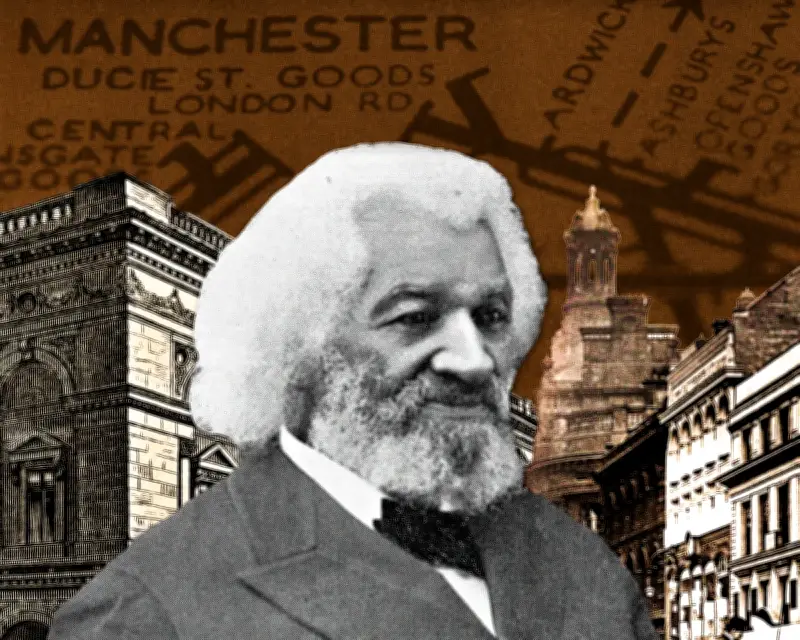
The Manchester Literary and Philosophical Society (Lit and Phil) has inaugurated an annual lecture series honouring Frederick Douglass, the American abolitionist, orator and statesman who spent pivotal years in Britain in the 1840s. The first lecture, titled Frederick Douglass: A Global Life, took place in June, marking the 180th anniversary of Douglass's speaking tour in Manchester.
Douglass's transformative years in Britain
Frederick Douglass arrived in the UK in 1845 at age 27 as a fugitive from enslavement in the United States. His 19-month tour began in Liverpool, but Manchester served as his base for much of the time. Between 2 July 1846 and 9 March 1847, he spoke at venues including the town hall, the Free Trade Hall, the Corn Exchange, the Mechanics Institute, and halls in Rochdale, Ashton-under-Lyne, Oldham, Stockport, Bacup and Warrington.
Historian David Olusoga, who delivered the inaugural lecture, said: “It was his time here in Britain, free from the fear of re-enslavement, able to live a quite expansive existence in an unsegregated society, that gave him the emotional space to evolve intellectually.”
From enslaved to free man
Douglass was born into enslavement in Maryland in 1818. As a teenager working in a shipyard, he fell in love with Anna Murray, a free Black woman who financed and inspired his escape by train disguised as a sailor. After marrying Murray, Douglass published his first autobiography, Narrative of the Life of Frederick Douglass, an American Slave, in 1845.
In Britain, his fundraising efforts—aided by Quaker social reformer Jonathan Dodgson Carr, founder of Carr's biscuits—enabled him to establish his first abolitionist newspaper, the North Star. In August 1846, Quaker sisters-in-law Anna and Ellen Richardson raised £150 to purchase Douglass's freedom from his enslaver, Thomas Auld. John Bright, the Rochdale-born reformer and Liberal statesman, also contributed to the fund.
Controversy over buying freedom
The decision to purchase his freedom drew criticism from some abolitionists. Henry C Wright wrote to Douglass: “I cannot think of the transaction without vexation … you always were free.” Douglass responded from Manchester on 22 December 1846: “I am legally the property of Thomas Auld, and if I go to the United States, Thomas Auld, aided by the American government can seize, bind and fetter, and drag me from my family … it was not to compensate the slave-holder, but to release me from his power; not to establish my natural right to freedom, but to release me from all legal liabilities to slavery.”
Legacy and impact
Dr Dhun Daji, a trustee of Lit and Phil, said the lecture series was created because “our society feeling the life and times of Frederick Douglass needed to be better known – he left a template for a kind of activism that is still needed today.” Despite Manchester's deep ties to the cotton trade that relied on enslaved labour, no blue plaque commemorates Douglass's presence in the city. The building where he stayed in St Ann's Square now houses a Holland & Barrett store.
Olusoga noted that Douglass's impact on Britain was profound: “He became a sensation. He revitalised the anti-slavery cause here in Britain in a way that no other speaker could. No American, including presidents, was photographed more than Douglass.”
In his farewell speech in London in March 1847, Douglass said: “I go back to the United States not as I landed here – I came a slave; I go back a free man. I came here a thing – I go back a human being.”