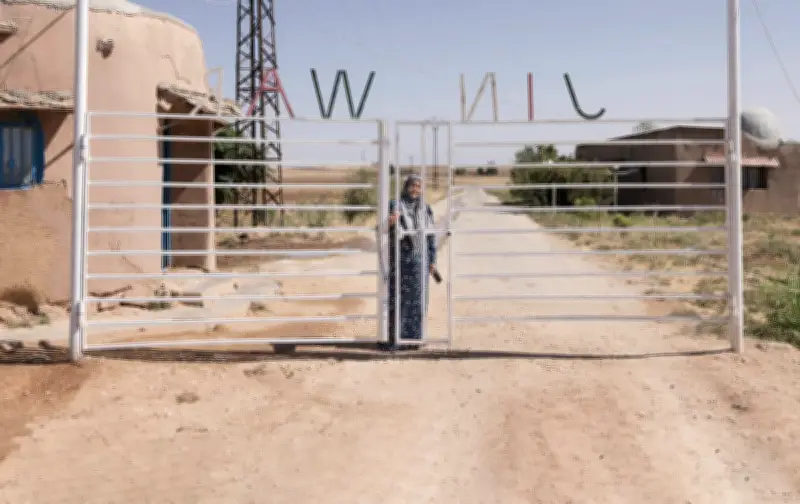
A mother carrying a rifle and gripping a walkie-talkie stands guard at the entrance to Jinwar, a women-only commune in Syria. Beyond the gate, about 30 mud-brick houses dot the desert landscape, their gardens filled with flowers, vegetables and fruit trees. The village, just outside Qamishli in Syria's predominantly Kurdish north-east, opened in 2018 and has become a refuge for women from across the region – Kurds, Arabs and Yazidis among them.
Life in Jinwar: self-sufficiency and solidarity
About 25 women live in the commune alongside their children and animals, including cows, sheep, chickens and peacocks. They run their own school, have built many homes using bricks formed of earth, water and straw, and cultivate much of their own food – aubergines, tomatoes, peppers, cucumbers, onions and garlic. Men can visit but cannot live there or stay overnight.
Jinwar was built during the Syrian civil war in response to violence, discrimination and challenges faced by women. The name combines the Kurdish words jin (woman) and war (home, land or place), meaning “women's space”.
Residents' stories: finding peace and strength
Welat, 55, arrived a little over a year ago after separating from her husband. “Life wasn't going well. I could barely get by,” she said. “Here I found myself – my true self.” She now spends mornings in Kurdish-language classes before taking watch duty. “The mothers work side by side. The relationships among women are beautiful. The psychological environment is good, the spirit very high.”
Nujîn Mihemed, 57, came after her husband died. “I suffered a great deal. I endured a lot of hardship. Both because of so-called ‘morality’ and because of society,” she said. “Our society has no mercy.” Today she helps with baking bread and watch duty. “We are each different from one another, but we're all like one household.”
Broader female-led communities in north-east Syria
Photographer Matteo Trevisan documented Jinwar as part of a wider series on female-led communities in north-east Syria. His images also include the ecological village of Jarudi (where women lead but men are allowed), members of the women's civil defence committees (HPC-Jin) in Qamishli, and women working in environmental institutions.
Jarudi is not exclusively female but is organised through communal structures, with residents sharing responsibility for agriculture and services. In 2013, residents created a public garden at the village centre; produce is sold in nearby markets with profits shared. Nesrin Boza, 28, arrived a year ago and now serves on the village council. “Since I came here, my life is less angry and I am stronger in giving to others,” she said.
Women in defence and ecology
Remziye Mihemmed İsmail, Niismiye Eemsedin and Wadhen Husseyn Sexmus are members of HPC-Jin, a women's civil defence committee in Qamishli. “I go to commemorations, monitor the streets, the city, the people and funerals,” said Mihemmed İsmail. “As a mother, I don't want war, but peace.” Eemsedin added, “In 2013, I worked in the fields, but in 2023 I decided that self-defence is essential, especially for women.”
Rovend Ebdo, 32, heads the ecology department of the Jazira region, seeking sustainable solutions after environmental damage from state policies, war and embargos. “The regime attacked nature. They brought destruction and cut all the trees,” she said. “If you spend 24 hours a day thinking about how to find water and energy, how can your mind be free?”