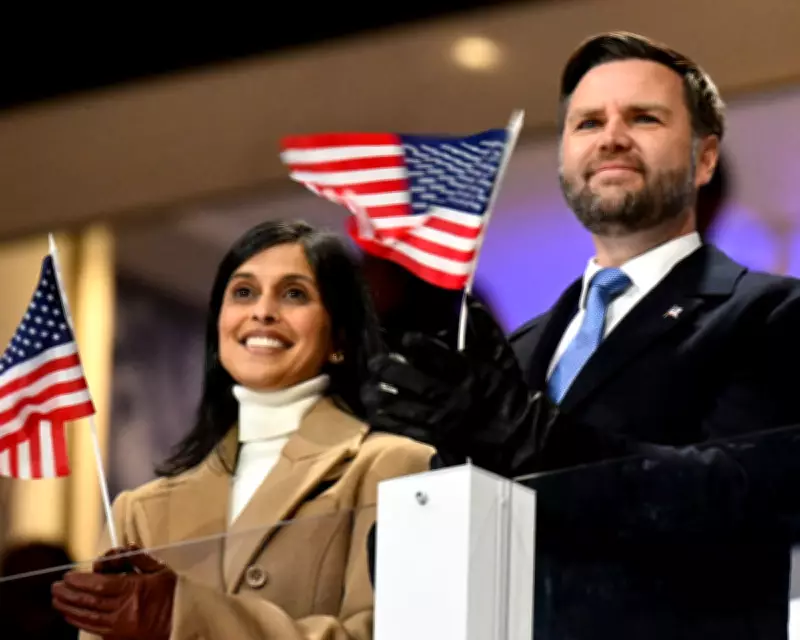
NBC's Muted Boos for JD Vance at Olympics Ignite Reality Distortion Debate
The modern Olympics are sold on a powerful illusion: the entire world, united in watching the same moment simultaneously. Yet, during the Winter Olympics opening ceremony in Milan, that illusion shattered in real time, exposing a growing tension between broadcast curation and digital transparency.
The Milan Moment: Cheers and Boos in the San Siro
When Team USA entered the iconic San Siro stadium, speed skater Erin Jackson led the delegation to enthusiastic cheers from the crowd. Moments later, cameras cut to US Vice-President JD Vance and Second Lady Usha Vance watching from the stands. Large sections of the audience responded with audible, sustained booing. Canadian viewers heard it clearly through CBC's broadcast. Journalists in the press tribunes, including this correspondent, distinctly heard the dissent. However, American audiences watching NBC's coverage heard nothing but muted crowd noise.
This editorial decision might have gone unnoticed in a different era. But today's sports media landscape is fundamentally changed. No single broadcaster controls the narrative anymore. The BBC liveblogged the incident. Fans clipped and shared videos. Within minutes, multiple versions of the same moment circulated online – some with boos, some without – transforming a routine production choice into a stark case study in information asymmetry.
The Digital Challenge to Broadcast Control
It is becoming increasingly difficult to curate reality when the rest of the world holds up its own camera angles. This raises uncomfortable questions as the United States prepares to host two of the planet's largest sporting events: the 2026 Men's World Cup and the 2028 Los Angeles Olympics.
If a US administration figure is booed at the LA Olympics or a World Cup match in New Jersey or Dallas, will American domestic broadcasts simply mute the crowd audio or avoid mentioning it? What happens when the world feed or a foreign broadcaster shows something entirely different? What occurs when 40,000 smartphones in the stadium upload their own versions in real time?
The risk is not merely that viewers will see through the curation. The greater danger is that attempts to manage the narrative will make American broadcasters appear less credible, not more. Audiences now assume there is always another angle. Every time a broadcaster trades credibility for insulation, it is a trade that audiences eventually notice and remember.
Structural Pressures and Editorial Choices
There are deeper structural pressures behind decisions like NBC's. The Trump era has been characterised, in part, by sustained hostility toward media institutions. Broadcasters do not operate in a vacuum; they function within regulatory environments, political climates, and corporate risk calculations. When presidents and their allies openly threaten or target networks, it is naive to pretend this has no downstream effect on editorial choices – especially during high-stakes live broadcasts tied to billion-dollar rights deals.
However, there is a crucial difference between contextual pressure and visible reality distortion. When global audiences can compare broadcast feeds in real time, the latter begins to resemble something else entirely: not editorial judgment, but narrative management. Comparisons to Soviet-style state-controlled broadcasting models – once dismissed as rhetorical exaggeration – are starting to feel less hyperbolic.
The Olympic Ideal and Political Reality
The irony is profound. The Olympics themselves are built around the idea that sport can exist alongside political tension without pretending it does not exist. The International Olympic Committee's own language – stating that athletes should not be punished for governments' actions – implicitly acknowledges that governments are part of the Olympic theatre, whether organisers like it or not.
Friday night in Milan illustrated this perfectly. American athletes were cheered, their enormous contingent receiving one of the most full-throated receptions of the evening. The political emissaries were not universally welcomed. Both things can be true simultaneously. Crowd dissent is not a failure of the Olympic ideal. In open societies, it is part of how public sentiment is expressed. Attempting to erase one side of that equation risks flattening reality into something audiences no longer trust.
The LA Olympics: A Coming Test of Transparency
Since Donald Trump's first term, American political coverage around sport has fixated on micro-moments: Was the president booed or cheered? Did the broadcast show it? Did he attend or skip events likely to produce hostile crowds? The discourse has often felt like a Rorschach test, filtered through partisan interpretation and selective clips.
The 2028 Los Angeles Olympics will be something else entirely. There is no hiding from an opening ceremony. No ducking a stadium when the Olympic Charter requires the host country's head of state to officially declare the Games open. No controlling how 200 international broadcasters carry the moment.
If Trump is still in the White House in mid-2028, one month after his 82nd birthday and in the thick of another heated US presidential campaign, he will stand before a global television audience as a key part of the opening ceremony. He will do so in California, in a political environment far less friendly than many domestic sporting venues he has appeared in over the past decade. And he will do it in a city synonymous with the political opposition, potentially in the backyard of the Democratic presidential candidate.
There will be some cheers. There will almost certainly be boos. There will be everything in between. And there will be no way to make them disappear. The real risk for American broadcasters is not that dissent will be visible. It is that audiences will start assuming anything they do not show is being hidden. In an era when trust in institutions is already fragile, that is a dangerous place to operate from.
A New Era of Global Sport Broadcasting
The Olympics have always been political, whether through boycotts, protests, symbolic gestures, or crowd reactions. What has changed is not the politics. It is the impossibility of containing the optics. Milan may ultimately be remembered as a small moment – a few seconds of crowd noise during a long ceremony. But it also felt like a preview of the next phase of global sport broadcasting: one where narrative control is shared, contested, and instantly verifiable. The world is watching. And this time, it is also recording.